Fort IX in Poznań: A Detached Fort of the Poznań Fortress


Site at a Glance
- Rating
- 4.4
- Popularity
- Low
- Country
- Poland
- Primary era
- Modern
- External website
- Open
- Eras represented
- Modern
- Civilizations
- German
- Site type
- Military
- Remains
- Fort
On this page10 sections
History
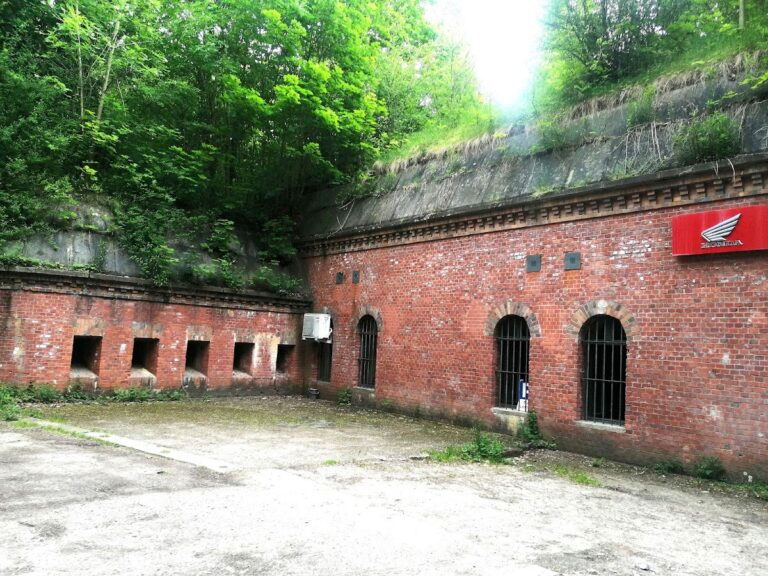
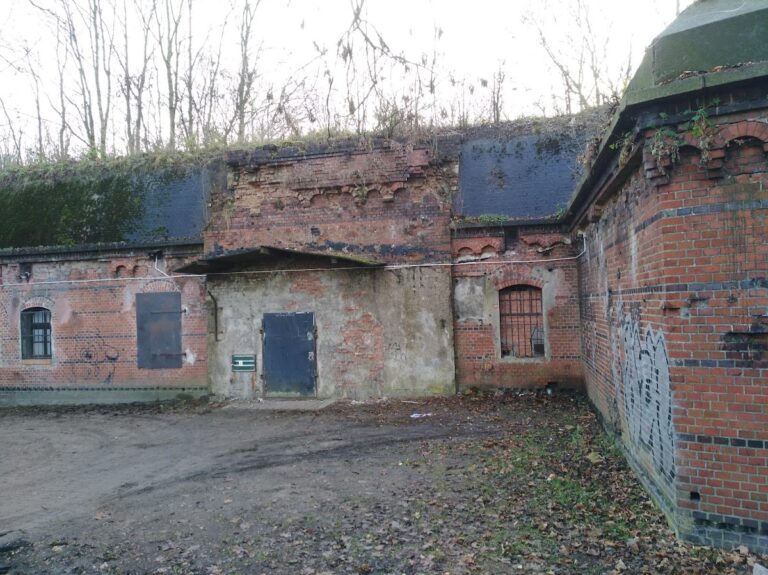
Fort IX in Poznań, Poland, is a detached fort of the Poznań Fortress, the defensive system that surrounded and protected the city. It was built between 1876 and 1880 during the first construction stage of the system, following designs by the German military architect and engineer Hans von Biehler.
Names and early military history
The fort was originally called Fort Brünneck in honour of Karl von Brünneck, a Prussian officer. Until 1902, the name Brünneck had been assigned to Bastion II. In 1931, the fort received a new patron, the Polish colonel Edmund Taczanowski, who had taken part in nineteenth-century Polish independence movements.
South of the fort, an 80-hectare training ground was established in the 1880s for the 6th Grenadier Regiment and the 47th Infantry Regiment, stationed in barracks in Jeżyce. During the interwar period, the area was used for exercises by the 14th Field Artillery Regiment from Solna Street and the 7th Anti-Aircraft Artillery Squadron from Sołacz.
Conflict and changing military roles
On 16 November 1918, shortly after Poland restored its statehood, 23 or 24 members of the Polish Military Organisation, an underground military organisation active in the struggle for independence, attacked the fort. Marian Wiśniewski commanded the group, which came from Łazarz and Górczyn. German forces, supported by a company of the 29th Sapper Regiment from Wilda, disarmed the attackers that evening. Some of the beaten men were taken to sickrooms in the sappers’ barracks, while others were held in the fort’s detention cells. All were later released after intervention by Polish members of the Workers’ and Soldiers’ Executive Department.
On 15 April 1919, Fort IX and Fort IXa were assigned to a non-commissioned officers’ infantry school. During the Battle of Poznań in January 1945, the forts in the Górczyn sector were not supplied with artillery. Soviet batteries of the 128th Light Artillery Brigade, commanded by Colonel Anatolij Kozub, began shelling Forts VIIIa and IX on 27 January. After heavy losses among the 27th and 74th Guards Divisions during their approach, Major General Anastasij Szemienkow ordered the 27th Guards Division to attack through the area between the forts and strike them from the rear. The entire Górczyn area was captured on 28 January.
Postwar use and protection
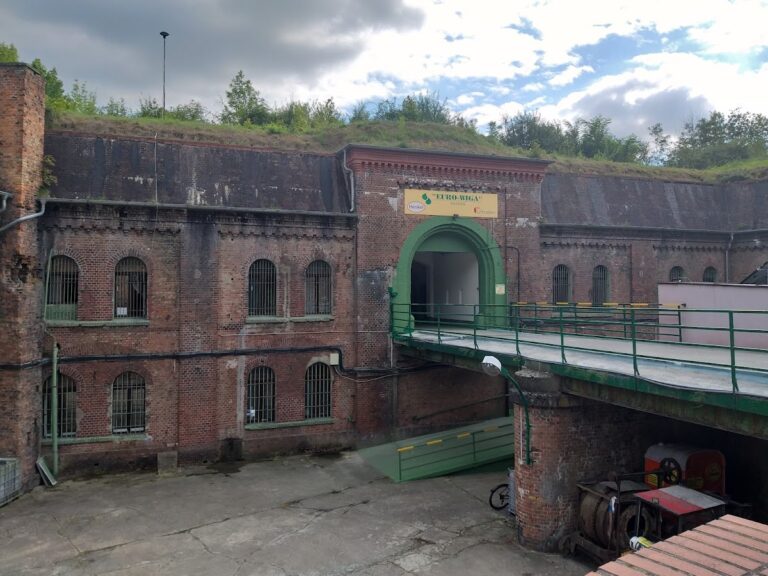
After the Second World War, the fort housed the 80th District Artillery Depot. It was also used by the quartermaster administration of Military District No. 3 in Poznań and by the district military housing and construction office. From the 1950s, sections of the fort served as warehouses for the Meatworks, WSS “Społem,” and Arged.
Since the late 1960s, the eastern part has been used by the Police. An additional entrance from Rawicka Street destroyed the fort’s left attached battery. The City of Poznań owns the fort. It was entered on the heritage register as A-245 on 25 May 1983 and forms part of the Natura 2000 special area of conservation called “Fortifications in Poznań.”
Remains
Plan and defensive construction
Fort IX has a symmetrical hexagonal plan, with an angle of 140 degrees between the sections of its front. Its usable floor area is 3,900 square metres. The barracks form two ranges. One is a two-storey structure in the gorge, the rear side of the fort, with four staircases connecting the floors in the centre and wings.
A dry ditch surrounds the fort. Its masonry escarp, the fortified inner side, and counterscarp, the fortified outer side, rise around a ditch 10 metres wide and 9 metres high. Three caponiers, fortified structures projecting into a ditch so defenders could fire along or across it, protected this obstacle. They comprised one double frontal caponier and two flank caponiers. The fort has no infantry parapet, a feature it shares with Fort VII.
Access, batteries, and later modifications
Roads and surrounding setting
The fortress road leading to the fort is now called Skalna Street, while the circumvallation road is now called Czechoslovak Street. Detached houses surround the site. Two railway lines run north of the fort, connecting Poznań Górczyn station with the main railway station and the station at Starołęka.
Artillery and observation positions
Two attached batteries, each with six positions, were constructed in 1887 and 1888. They were demolished after the Second World War, and the left battery was later destroyed by the additional entrance from Rawicka Street. Two positions for 15-centimetre ring cannons were built in 1881, followed by two W.T.90 observation positions in 1892.
Twentieth-century alterations
Around 1913, armour plates were added to the firing openings and some entrances were rebuilt. Two concrete observation and combat shelters were constructed in August 1939. In 1941, the ditch was roofed over, and the fort’s interior was adapted for weapons production, garages, and the storage of artillery equipment.