Fort Fleur d’Épée: A French Coastal Fortification in Guadeloupe


Site at a Glance
- Rating
- 4
- Popularity
- Low
- Country
- France
- Primary era
- Early Modern
- External website
- Open
- Eras represented
- Early Modern, Modern
- Civilizations
- French
- Site type
- Military
- Remains
- Fort
On this page12 sections
History
Fort Fleur d’Épée is an eighteenth-century French fortification in Guadeloupe, France, above Le Gosier on Grande-Terre. It was established to protect the anchorages of Grande Baie, which Fort Louis, built at the end of the seventeenth century to protect Pointe-à-Pitre harbour, could not adequately cover. The fort is regarded as the most important fortification on Grande-Terre.
From battery to fort
After the Seven Years’ War, the major international conflict fought from 1756 to 1763, engineer Labbé de Talsy established a battery on Morne Fleur d’Épée, a hill or elevated landform. The position received 18 large-calibre cannon transferred from Fort Louis. The exact date of the fort’s construction remains uncertain. It has been attributed to plans by Sébastien Le Prestre de Vauban, the seventeenth-century French military engineer and marshal known for his systems of fortification and siege warfare, and dated between 1750 and 1763. Another phase replaced the battery with a fort under Governor Collot, who was appointed in 1792, as France faced an English threat after the French Revolution.
Revolutionary conflict and reinforcement
British forces captured Fort Fleur d’Épée on 2 April 1794. During the night of 6 to 7 June, French forces led by Victor Hugues and General Charles Étienne Rouyer retook the position. Hugues was a French revolutionary official and military leader associated with the restoration of French control over Guadeloupe, while Rouyer was seriously wounded during the assault. Formerly enslaved people freed by the abolition decree of 4 February, together with republican colonists, helped defend the fort against further British attempts to recover it. British forces were expelled from Guadeloupe on 11 December 1794.
The fort was reinforced in 1801 and 1802 during uprisings that followed Napoleon Bonaparte’s re-establishment of slavery and during the armed resistance led by Louis Delgrès. Delgrès, a French military officer, led opposition in Guadeloupe to the restoration of slavery.
Nineteenth-century changes and modern preservation
Major works in the 1830s altered the fort’s defenses. A ditch was dug, the perimeter wall and rampart were raised, and the entrance and drawbridge were constructed. In 1854, the Fortifications Committee recommended permanent abandonment because the scarp wall, the main retaining or defensive wall on the inner side of a ditch, was poorly flanked and the position could be bombarded from nearby Morne Mascot.
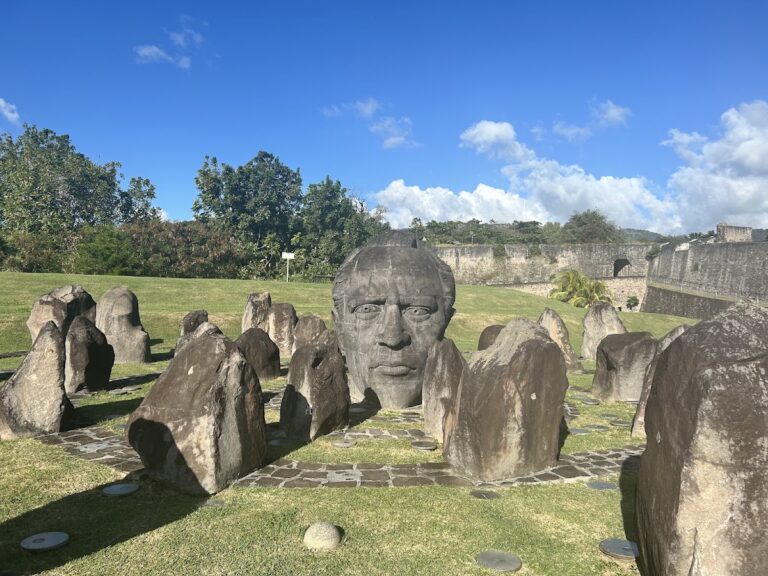
Fort Fleur d’Épée became the property of the General Council in 1946. During the 1960s, it was renovated and opened to the public through the efforts of Mario Petreluzzi, the first president of the Guadeloupe Historical Society. An order dated 21 March 1979 listed the fort as a historic monument, and it remains owned by the departmental authority. The fort also forms part of Guadeloupe’s cultural-heritage circuit, “The Route of Enslaved People/Traces-Memories,” associated with UNESCO’s Routes of Enslaved People initiative, which documents and interprets places connected with the history and memory of the transatlantic trafficking and enslavement of Africans.
Remains
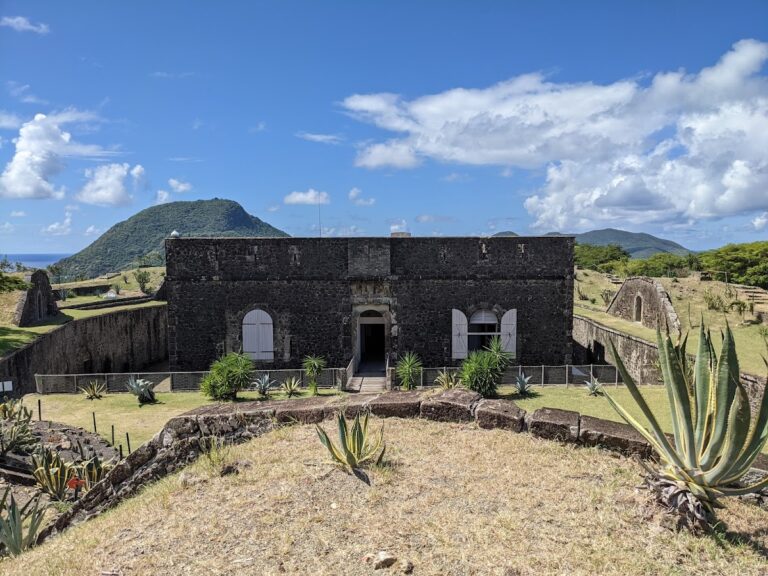
Fort Fleur d’Épée follows the summit of Morne Fleur d’Épée at an altitude of about 40 metres. It overlooks Grande Baie and faces Pointe de la Verdure. Descriptions give its elongated plan as approximately 150 metres by 45 metres, while another description characterizes the plan as hexagonal. Its documented components include a ditch, barracks, storage magazines, a powder magazine, and two cisterns.
Entrance and underground passages
Bridge and entrance
The entrance is approached across the ditch by a fixed bridge, which survives as part of the fort’s visible defensive arrangement. The entrance belongs to the nineteenth-century works that also raised the perimeter wall and rampart.
Corridors and rooms
Underground passageways lead from the fort into small rooms, many of which remain preserved. The spacious corridors periodically host temporary art exhibitions connected with Creole culture, giving the surviving interior spaces a later cultural use.
Military installations
Powder magazine and kitchen
The powder magazine remains visible, as does the kitchen with its furnace. These surviving service areas form part of the internal military complex alongside the barracks, storage magazines, and cisterns.
Engravings
Inscriptions and ship drawings
An inventory completed at the end of 2003 recorded more than 200 engravings across the fort. They date from 1812 to 2002 and include inscriptions and drawings of ships, adding a long record of later markings to the fort’s military fabric.