Acronauplia: The Historic Citadel of Nafplio, Greece


Site at a Glance
- Rating
- 4.7
- Popularity
- Medium
- Country
- Greece
- Primary era
- Early Modern
- Eras represented
- Bronze Age, Classical, Medieval, Early Modern, Modern
- Civilizations
- Ancient Greek, Byzantine, Crusader, Greek, Ottoman, Venetian
- Site type
- Military
- Remains
- Citadel
On this page12 sections
History
Acronauplia is the ancient citadel of Nauplion in Nafplio, Greece, occupying a rocky peninsula at the entrance to the Argolic Gulf. Activity on the peninsula reaches back to the third millennium BC, while the ancient city of Nauplia came under the authority of Argos from the seventh century BC. Stone walls were built around 300 BC, and the stronghold later followed the political history of the city through Roman, Byzantine, Frankish, Venetian, Ottoman, and Greek rule.
Ancient and Byzantine Nauplia
The peninsula remained an important fortified position through antiquity. Its early defenses included Bronze Age walls and later stone fortifications associated with the ancient city. Byzantine and early Christian occupation between the fourth and fourteenth centuries is represented by architectural elements, coins, eastern fortifications, and two chapels within the fortress. These remains show that the hill continued to serve both defensive and religious functions after the ancient period.
Frankish rule and the division of the fortress
In 1212, Frankish forces led by Geoffroi de Villehardouin captured Nauplion. The Franks were western European crusader rulers who established states in Greece after the Fourth Crusade and the capture of Constantinople in 1204. They divided the peninsula into two fortified areas. The central Frankish section became the administrative and military center, while the western section, known as the Roman or Greek castle, was occupied by Greeks. A square tower between the two areas controlled movement through the divided stronghold.
The fortified settlement remained within Acronauplia until the end of the fifteenth century. Nauplion then expanded beyond the peninsula, and the Venetians developed the lower town on artificial shores supported by wooden piles. Gates defended the lower town on both its sea and land sides, while the fortified island of Bourtzi provided additional protection for the harbor.
Venetian fortifications
Maria d’Enghien, a medieval noblewoman associated with the lordship of Argos and Nauplion, sold the fortress to Venice in 1388. During the first Venetian period, the eastern part of Acronauplia was developed as the Castello di Toro. The Venetians adapted the defenses to gunpowder warfare, adding stronger walls, artillery positions, and new gates.
Under the Venetian podesta Vittore Pasqualigo and the architect Antonio Gambello, the fortress was extensively rebuilt. In 1470, buttressed walls were added east of the Frankish castle. An eastern gate was closed and replaced by an entrance on the southern side. These works formed the defenses known as the Castello di Toro. Gambello also created a system of bastions and gates within the Frankish castle, later called the Cambello Traverse. A bastion was a projecting fortification that allowed defenders to fire along the adjoining walls.
In 1502, the Venetians constructed a five-gun battery. Its five large guns were equal in size, giving the fortress the name “Castle of the Five Brothers.” Venetian rule ended when the Ottomans captured Nauplion in 1540.
Ottoman and second Venetian occupations
The Ottomans, the imperial dynasty that controlled much of southeastern Europe and the eastern Mediterranean, called Acronauplia Iç Kale, meaning “Inner Fortress.” They strengthened the defenses with larger guns. Turks and Christians lived inside the fortress during this period. In 1668, the Ottoman traveler Evliya Celebi described many houses on the hill and a large mosque at the summit. He stated that the mosque had originally been a Christian church dedicated to Saint Andrew.
Venetian forces under Francesco Morosini recaptured Nauplion and Acronauplia in 1686. The Venetians partly dismantled the fortress while strengthening nearby Palamidi. Ottoman rule returned in 1715. During this second Ottoman occupation, Acronauplia and Palamidi were reinforced with 400 guns, including 84 weighing 64 pounds each. Repairs and new construction continued until the Greek Revolution, the war of independence against Ottoman rule that began in 1821.
The Venetians also continued to modify the fortress during their second occupation. In 1706, they built the Grimani Bastion in the eastern part, near the gate leading toward the lower town, and named it for the governor-general of the Peloponnese. They added a barracks, an arsenal, and a naval storehouse. The storehouse later housed the Archaeological Museum. In 1713, under Governor-General Agostino Sagredo, a gate was opened in the northern wall of the Roman castle.
Capture during the Greek Revolution
Greek forces under Staikos Staikopoulos captured Palamidi during the night of 30 November 1822. They turned its guns against Acronauplia, and the Ottoman garrison surrendered the fortress to General Theodoros Kolokotronis on 3 December. Kolokotronis was a leading commander of the Greek War of Independence. After the surrender, he raised the flag of freedom on the walls.
Anastasios Koutroumbis became the first Greek commander of Acronauplia. In 1824, after the political conflict that resulted in Kolokotronis’s arrest and imprisonment, the government replaced Koutroumbis with Nasos Photomaras.
The fortress in the modern Greek state
When Ioannis Kapodistrias became governor of Greece in 1828, Colonel Karl Wilhelm von Heideck took command of the fortresses of Nauplion. A garrison of 50 Spetsiot soldiers, commanded by Captain Nikolaos Goudis, was placed at Acronauplia. Kapodistrias oversaw the removal of accumulated ruins, the rebuilding of damaged sections, and the reconstruction of the completely demolished gun battery. A military hospital and a small church were also established.
During the reign of Otto I, the Bavarian army repaired the fortifications, built military storehouses, and improved the military hospital. After the capital moved from Nauplion to Athens, Otto ordered a general repair of Acronauplia’s fortifications and bastions in July 1835 and equipped them with new guns. Under George I, the fortress gained large infantry barracks, military prisons, and underground cisterns for collecting rainwater. It became a military cantonment center for soldiers from the Peloponnese.
During the reigns of Constantine I and Alexander I, the military prison was gradually adapted to newer Greek penitentiary practices. Prisoners worked in workshops, including carpentry and shoemaking. In spring 1937, during the dictatorship of Ioannis Metaxas, the prison became a Communist detention camp for political opponents, including communists, antifascists, and democratic citizens. About 600 people were held there in April 1941.
On the night of 30 August 1937, guards led by the warrant officer Bougas fired machine guns from the prison yard toward the prisoners’ quarters, killing the teacher Pavlos Stavridis. During the Axis occupation, detention conditions were severe. Many political prisoners died of hunger, while others were transferred to different camps. Communist prisoners were released after Greece’s liberation, although Acronauplia again served as a place of political exile after the war, when permanent military courts were reinstated under Regent and Archbishop Damaskinos.
The prison finally closed during the reign of Paul I. Between 1960 and 1971, the prison buildings, much of the Greek castle’s walls and buildings, and the Kapodistrian military hospital were demolished. The Xenia hotel was built on part of the cleared area in 1961, followed by Xenia Pallas in 1971. Acronauplia is protected under Greek law as an archaeological monument and as a protected building. In 2014, it was placed on Greece’s tentative list for a UNESCO World Heritage nomination together with Bourtzi and Palamidi.
Remains
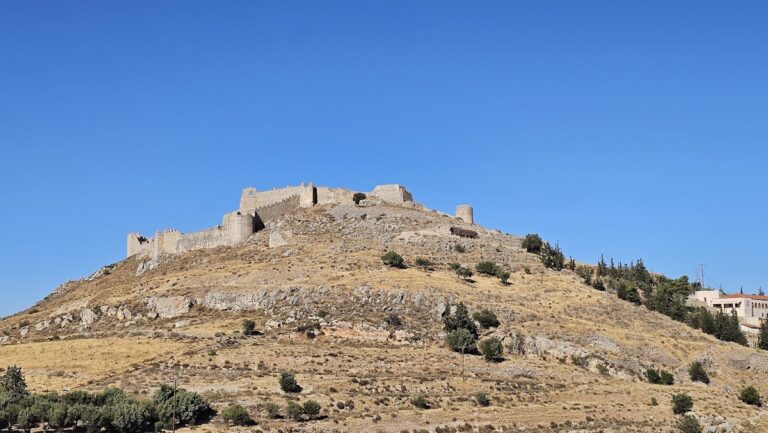
Acronauplia occupies a rocky peninsula opposite Bourtzi and below Palamidi. It rises to an average elevation of 45 metres above sea level, extends up to 900 metres from east to west, and is about 400 metres wide. The only land access is from the north, through the artificial ravine of Arvanitia. Steep cliffs protected the southern and western sides, while the northern approach was defended by walls, a ditch, and additional fortifications.
Ancient walls and defensive foundations
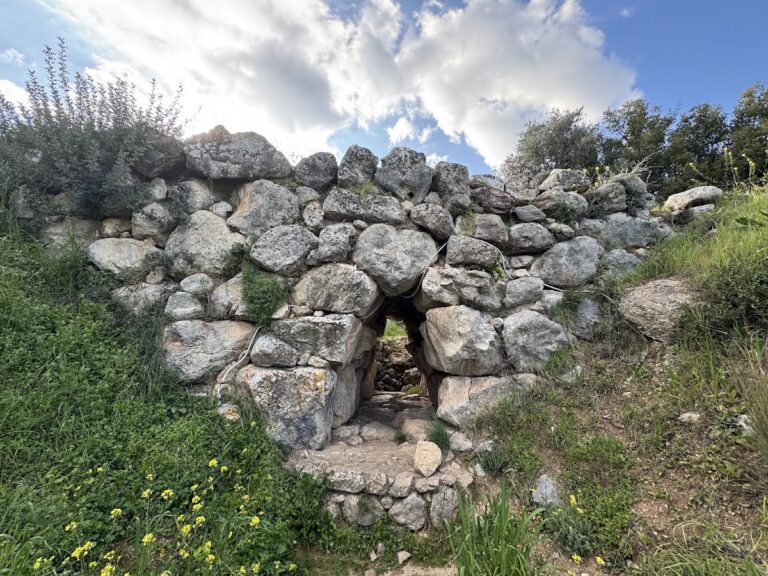
The lower parts of the defenses date from the Bronze Age. Surviving sections of ancient walls on the western side use dressed stone and date to the late fourth century BC. Other foundations use Cyclopean masonry, a method employing very large and irregular stone blocks traditionally associated with Bronze Age fortifications. Ancient polygonal masonry, formed from fitted stone blocks with many-sided faces, remains visible in the lower northern part of the fortress.
The fortress developed in three principal sections: an earliest section attributed to the third century, the Frankish castle, and the Venetian fortifications. Later defenses incorporated the earlier walls and foundations. Venetian construction introduced bastions, gates, and artillery positions designed for warfare with gunpowder and widespread firearms, while the Ottomans subsequently strengthened these works.
Approach and western divisions
A ditch separated Acronauplia from the mainland. A bridge of stone and wood crossed it, with a removable wooden section that could be taken away during an attack. Beyond the ditch stood another defensive work containing underground passages with explosives intended for use against attackers.
The western section formed the Roman or Greek castle. A dividing wall and square tower separated it from the central Frankish castle. Within the Frankish castle, the Cambello Traverse divided the defenses into further fortified areas. Its northern end contained the Clock of Nauplion. The eastern wall included the Gates of Peace, which were decorated with frescoes and protected by two round towers and a triangular fortification. The northern wall of the Roman castle later received the gate built in 1713.
Eastern Venetian defenses
East of the Frankish castle stood the Castello di Toro. Its eastern side was defended by buttressed walls, while its southern part contained the Sea Gate. Farther east was the Grimani Bastion, built in 1706 near the entrance toward the lower town. The eastern part also contained a barracks, an arsenal, a naval storehouse later used for the Archaeological Museum, and other military buildings.
A Venetian northeast tower built in 1502 faced Palamidi. A separate western bastion faced the gulf and held the five large guns known as the Five Brothers. Together with the Cambello Traverse, these structures illustrate the successive adaptation of Acronauplia to artillery warfare. Parts of the later fortifications survive alongside the older walls, while substantial sections were removed during the demolitions of the twentieth century.
Military and religious buildings
The fortress contained military hospitals, storehouses, large infantry barracks, prisons, and underground cisterns for collecting rainwater. In the eastern part, Kapodistrias established a military hospital and built the Church of the Holy Unmercenaries. A small church stood near the hospital. The hospital and associated military buildings were later demolished, while the Church of the Holy Unmercenaries remained intact.
The surviving site therefore brings together wall sections and architectural elements from ancient, Roman, Byzantine, Frankish, Venetian, Ottoman, and modern Greek phases. Its physical remains include ancient masonry, parts of the successive defensive systems, and the Church of the Holy Unmercenaries, alongside the altered areas created by the fortress’s long military use and later demolitions.
Nearby sites