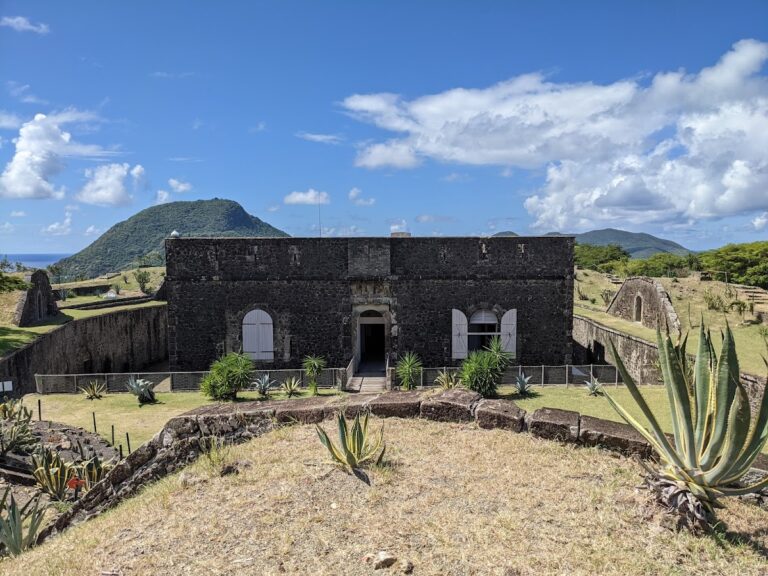
Fort Delgrès: A French Coastal Fortress in Basse-Terre, Guadeloupe


Site at a Glance
- Rating
- 4.2
- Popularity
- Medium
- Country
- France
- Primary era
- Early Modern
- External website
- Open
- Eras represented
- Early Modern
- Civilizations
- French
- Site type
- Military
- Remains
- Fort
On this page8 sections
History
Foundation and Expansion
Fort Delgrès is a French fortification in Basse-Terre, Guadeloupe, begun by Charles Houël in 1649 or 1650 as a fortified tower known as the Château de la Basse-Terre. Houël was governor of Guadeloupe and later its lord and proprietor. The fort defended Basse-Terre, the colony’s capital, while also providing a secure symbol of his authority over the population.
Successive governors enlarged and altered the original work. The complex acquired several names during its history, including Fort Houël, Château de Guadeloupe, Fort Saint-Charles, Fort Royal, Fort Matilda, Fort Richepance, and finally Fort Delgrès. Major enlargement phases took place between 1720 and 1759 and between 1759 and 1770.
Franco-British Conflicts
From its inauguration, the fort was drawn into the Franco-British struggle for control of the Antilles. During the War of the League of Augsburg, a European conflict that extended into colonial possessions, English forces bombarded it for 35 days in 1691. They withdrew when reinforcements arrived from Martinique.
During the Seven Years’ War, a global conflict between Britain and France, intensive bombardment on 23 January 1759 forced the French army to evacuate. British forces renamed the fort Fort Royal, and Guadeloupe returned to French control in 1763. The name Fort Saint-Charles had been used from 1753, while Fort Royal applied from 1759 to 1763.
Revolution and the Resistance of 1802
British forces occupied Basse-Terre during the French Revolution in 1794 and called the fort Fort Matilda. Victor Hugues, a French revolutionary commissioner, recaptured it after heavy fighting late that year. His victory allowed France to regain control of Guadeloupe and enforce the abolition of slavery decreed by the National Convention on 4 February 1794.
In 1802, Napoleon Bonaparte sent General Antoine Richepanse to Guadeloupe to re-establish slavery. Louis Delgrès, a French colonial military officer and leading opponent of that policy, and Ignace, a Guadeloupean military leader, occupied the fort with colonial troops resisting Richepanse’s forces from metropolitan France. They were driven out after a battle that became the last military engagement involving the fort.
Delgrès and approximately 300 soldiers withdrew to Anglemont plantation. On 28 May 1802, they killed themselves by igniting their gunpowder stores. Napoleon ordered the fort renamed Fort Richepance in 1803, in honour of the general, who died that year. The name Fort Matilda was used again from 1810 to 1814 and from 1815 to 1816. Fort Richepance remained the official name from 1816 to 1960.
Decommissioning and Preservation
The military officially decommissioned the fort on 23 August 1904. Authorization for the public sale of Guadeloupe’s forts followed on 15 July 1912, subject to their dismantling, but recruits for the First World War were quartered at the fort in January 1916. On 26 May 1917, Governor Merwart designated it a “remarkable monument of Guadeloupe.” Some parcels were later sold to private individuals, while other parts were occupied by squatters.
From 1924, Maurice Fissier used the fort as a banana-export warehouse. The collapsed drawbridge was replaced with a timber-plank bridge during this period. A fire damaged the large barracks that had housed the army in 1950. The name Fort Saint-Charles was restored from 1960 to 1989.
The state transferred the fort to the Department of Guadeloupe for a nominal franc in 1975. It became a historic monument on 21 November 1977 and was restored in 1993 with support from volunteers from Chantiers Histoire et Architecture Médiévales. In 1989, the General Council of Guadeloupe renamed it Fort Delgrès in honour of Louis Delgrès and the struggle against slavery. Since 2004, it has been owned by the Department of Guadeloupe and has served as the headquarters of its cultural affairs and heritage directorate.
Remains
Layout and Defensive Works
Fort Delgrès occupies approximately 5 hectares at the southern end of Basse-Terre, beside the Galion and the Caribbean Sea. Built mainly of stone, it stands on a height above the city. Its thick walls remain visible from the sea and overlook the sea, the town, and the mountain. The first structure was a square tower about 11 metres on each side and four storeys high. Projecting octagonal angles later strengthened it, followed by two walled courtyards on the east and west.
The earliest plan ran from east to west, perpendicular to the sea, and was backed against the northern bank of the Galion. Its living areas faced the sea, an arrangement that left them vulnerable to cannon fire from that direction. Defensive traverses, which helped stop cannonballs and divide the fort into separate sections, were added later. Large crescent-shaped buttresses further strengthened the defenses.
Interior Structures and Water Systems
Between 1720 and 1750, the oldest part of the fort received casemates, fortified chambers enclosed by thick masonry for protection and use with artillery or storage, together with a postern, a small discreet entrance, and a large powder magazine for protected gunpowder storage. These additions formed part of the major enlargement work carried out between 1720 and 1759 and between 1759 and 1770.
Kitchens and cisterns were added between 1763 and 1780. An underground passage led toward the ditches in the direction of Carmel, and a bridge over the Galion was built between 1773 and 1780. The surviving complex includes the barracks, guardhouse, courtyards, walls, casemates, postern, powder magazine, kitchens, cisterns, underground passage, ditches, Galion bridge, and drawbridge.