Schloss Herzford: A Baroque Water Castle and Manor Estate in Germany


Site at a Glance
- Rating
- 4.6
- Popularity
- Very Low
- Country
- Germany
- Primary era
- Early Modern
- Eras represented
- Medieval, Early Modern
- Civilizations
- Holy Roman Empire
- Site type
- Domestic
- Remains
- Manor House
On this page12 sections
History
Schloss Herzford is a Baroque water castle and manor complex in Germany, near Lingen in Lower Saxony. The present manor house was built between 1717 and 1723 under the administration of the Diocese of Münster, replacing a medieval fortress whose foundations and vaulted cellar spaces remain beneath it. Herzford originated as a strategic stronghold on the left bank of the Ems, where it guarded Münster’s possessions and the road between Rheine and Meppen.
Early settlement and the medieval fortress
Herzford was first recorded in 890 as “Hriesforda,” a name meaning “deer ford.” Later forms included Herzeforth, Herzenfurth, Herseforth, Hersenword, Herssevoerde, and Herzfurt(h). The place belonged to the Diocese of Münster from at least that date and lay in the area now associated with Schepsdorf, south of Lingen.
In the fourteenth century, the Diocese of Münster was also a territorial power. Its prince-bishop, an office combining episcopal authority with secular rule, controlled lands, roads, and fortifications. Bishop Ludwig II ordered a fortress called thor Slips, or thor Slips bey Herzeforth, to be built in 1336 and 1337. The stronghold was intended to resist Count Nikolaus I of Tecklenburg and raiding forces from Bentheim and Ottenstein, protect Münster’s Emsland possessions, and secure movement along the northern Emsland road.
A Freiherr von Langen became the first Burgmann, a noble military official responsible for duties connected with the occupation and defence of a castle. Shortly before the fortress was completed in 1337, Counts Nikolaus I of Tecklenburg and Simon of Bentheim destroyed it. Bishop Ludwig II ordered its reconstruction in 1346, making substantial concessions to Count Otto III of Bentheim and accepting him as another Burgmann. In 1363, Bishop Johann I of Münster appointed Freiherr Cord von Langen to the office, but Count Otto VI of Tecklenburg attacked and destroyed the fortress.
The castle on the Slipse
Bishop Heidenreich of Münster built a new castle near the earlier stronghold on the Slipse in 1385. The name referred to a narrow strip of land beside the Ems. After Münster and Osnabrück joined forces against Count Otto VI of Tecklenburg, Münster’s ministerial officials administered the castle. In 1400, Count Nikolaus II of Tecklenburg renounced his rights to the castle and to the adjoining road along the left bank of the Ems. The castle then lost its military importance and was demolished.
The estate passed in 1432 to Count Hermann of Münster of the Meinhövel and Botzlar family. Ownership subsequently moved through the Münster family and related heirs, including Count Heinrich of Münster, Rolof and Roelof van Münster, Roloff von Münster, and Count Roleff von Münster, before passing to the von Loen family. Rittmeister Franz Roland von Loen held Herzford by 1657 and remained associated with the estate in 1675. His son Johann Casper Rotger von Loen received it in 1700, but died in 1702. His daughter Rotgera was granted the fief in 1703 and again in 1708.
The Baroque manor
Rotgera sold Herzford to Prince-Bishop Franz Arnold von Wolff-Metternich of Münster through the Münster court and chamber councillor Anton Helweg on 30 October 1714. On 24 December 1718, the prince-bishop sold it for 8,000 Reichstaler to Colonel Hermann Werner Joseph von Schorlemer of the Overhagen line. Under Helweg and the von Schorlemer family, the present manor house rose on the foundations of the demolished castle between 1717 and 1723. Its architect was Gottfried Laurenz Pictorius, a Münster architect associated with Westphalian Baroque buildings. Dendrochronology, which dates timber through its annual growth rings, revised the earlier accepted construction date of 1732 to 1734.
Hermann Werner Joseph von Schorlemer later became lieutenant general and commander of the Münster troops. He lived at Herzford with his first wife, Antoinette Christine von Brabeck, established a chapel in the manor house, and employed a household chaplain. Following her death in 1735, he married Maria Alexandrine von Korff-Schmising zu Tatenhausen. In 1740, he agreed with the community of Elbergen that the chaplain could celebrate weekday services in the Elbergen chapel. Schorlemer added a tower to the chapel and established a Mass for Saint John of Nepomuk on 16 May. The associated procession continues as a local tradition, and Pope Benedict XIII granted the chapel a general indulgence for that day.
Inheritance and nineteenth-century ownership
Schorlemer’s two marriages produced no children. After his death in 1766, Franz Otto von Korff, known as Schmising, was initially enfeoffed with Herzford in 1767. A legal dispute changed the succession, and the estate instead passed to Count Carl Franz von Nesselrode, the son of Schorlemer’s sister Maria Anna Theresa Sophie.
Herzford remained with the Nesselrode family through Count Carl Franz von Nesselrode, Count Carl Franz Alexander von Nesselrode, and his daughter Auguste Caroline, who became heir and “mistress of Herzford” in 1780. She later married Gustav von Müller at Herzford after his first marriage had been invalidated. A former Hanoverian officer, von Müller lived at the estate until 1832 and later leased it.
Karl Wilhelm Viktor von Müller sold Herzford on 10 December 1847 for 38,000 Taler to Hauptmann Freiherr Ferdinand von Morsey gen. Picard, who had previously leased the property. Morsey transferred it to his son Konstantin in 1849. On 14 July 1853, Ferdinand von Morsey gen. Picard sold Herzford to Duke Prosper August of Arenberg for 28,000 Taler.
The Arenberg estate and forestry district
The Arenberg domain chamber in Meppen administered Herzford as a leasehold estate containing arable land, meadows, moorland, and woodland. The duke and his successors expanded and reforested parts of their regional holdings, particularly between about 1860 and 1910. From 1928 to 1933, the Arenberg family transferred its property in the German Reich into regional limited companies. Herzford consequently became part of Arenberg-Meppen GmbH, based in Nordkirchen until 1967 and thereafter in Meppen.
For many decades, the castle served as a forestry residence for the surrounding protection and forestry district. Johann Hermann Altmeppen worked there as a forest warden from about 1877 to 1903. He was followed by his son Hermann Altmeppen and then by his nephew Bernhard Hermann Altmeppen, who served as chief forestry officer until 1976 and lived at the castle until 1969.
The estate district contained 17 families and 110 inhabitants in 1850. It lost its independent administrative status in 1920, when its territory was assigned to municipalities formed from the Elbergen and Schepsdorf-Lohne districts. Later administrative changes made Herzford part of the city of Lingen and the Emsland district, and it now belongs to Lingen’s Schepsdorf district.
War, restoration, and later administration
A prisoner-of-war camp operated about 1,800 metres southeast of Herzford from 1941 to 1945 during the Second World War. It held up to 80 French prisoners, who were forced to work in chemical factories and agriculture in Lohne and Schepsdorf. The camp buildings no longer survive, while a memorial stone and plaque commemorate the site. Although Lingen was heavily bombed and besieged by British forces, Herzford was spared.
In 1970, Arenberg-Meppen GmbH sold Schloss Herzford to the Lingen businessman Bernhard Merswolke. He thoroughly renovated the buildings and grounds, seeking to follow the original plans and return the complex to its presumed earlier form. The two entrance pavilions beside the bridge were reconstructed in historically faithful form in summer 2011. Since 1989, the charitable Stiftung Herzog Engelbert-Charles und Herzogin Mathildis von Arenberg has been the sole shareholder of Arenberg-Meppen GmbH.
Herzford remained connected with Catholic institutions through its household chaplain, weekday and early Mass obligations, and an inherited burial place for its owners in the Schepsdorf cemetery. In 1892, Duke von Arenberg ended the owner’s remaining ecclesiastical obligations through a single payment of 20,000 Mark. Since the creation of Lower Saxony and the postwar administrative reorganization, Herzford has belonged to the Diocese of Osnabrück rather than the Diocese of Münster.
Remains
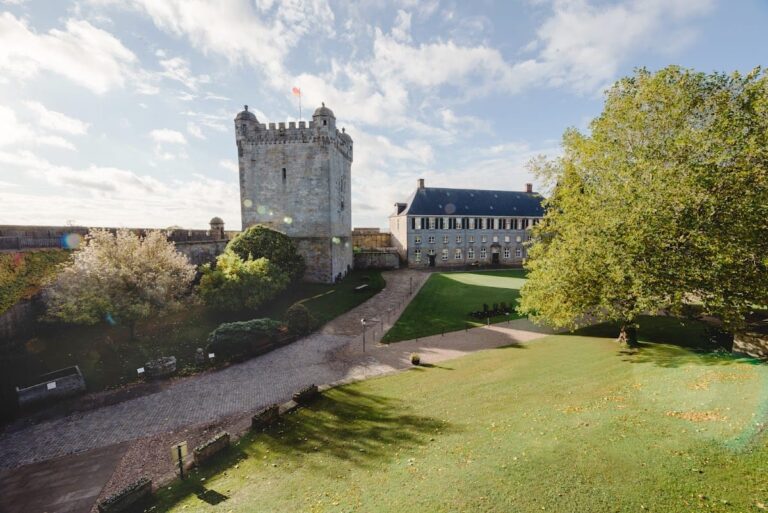
Schloss Herzford occupies the edge of the Lingener Höhe on the left bank of the Ems, about three kilometres south of Schepsdorf. It is a water castle, meaning a fortified residence surrounded wholly or partly by water, and the estate is popularly known as “Vorgarten.” The manor house stands on the foundations of the medieval castle beside the former Slipse. Stone cross-vaulted cellar spaces from that earlier stronghold remain beneath the Baroque building.
The manor house
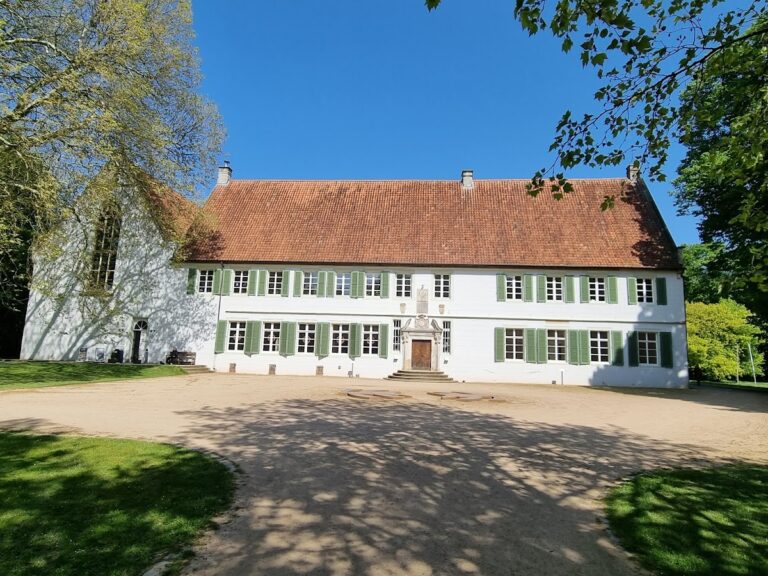
Built between 1717 and 1723, the manor house is a single-storey Baroque structure made from small-format bricks. Sandstone quoins and sandstone surrounds frame its windows and doors, while two small projecting wings extend from the rear. A high hipped roof, which slopes down on all sides, covers the building. The tall basement level has masonry cross vaults and contains a spacious kitchen, storerooms, and a small household chapel.
An alliance coat of arms belonging to Hermann Werner Joseph von Schorlemer and his wife appears above the main portal and again in the rear gable field. A separate statue on the estate also carries both spouses’ coats of arms, with the date 1742 on its pedestal. These features connect the surviving house and grounds with the family that shaped Herzford during its Baroque rebuilding.
Bridge, entrance, and service buildings
Johann Conrad Schlaun planned the bridge complex, outer bailey, and gardens. The realized entrance arrangement included a forecourt, the bridge, two pillars at the castle entrance, and two elegant gate pavilions with mansard roofs beside the high bridge pillars. A mansard roof has two slopes on each side, with the lower slope steeper than the upper one. The pavilions were demolished in 1950 after becoming structurally unsafe and were reconstructed in 2011 using more than 6,000 manually produced beaver-tail tiles made for tower roofs abroad.
Of the service buildings that formerly flanked the front of the manor house, the southern building remains. Schlaun’s later plan from 1775 to 1780 showed a proposed gate, service buildings, and the course of the garden moat. The complete design was not carried out because practical utility took priority over the full decorative scheme.
Gardens and estate landscape
Schlaun’s garden plan envisaged a geometrically ordered Baroque design. Around a fountain basin, Dutch embroidery-parterre patterns were to be combined with large moat and basin structures, while a pavilion would stand on the central axis at the far end of the garden. Elements of the garden layout were realized alongside the bridge complex and entrance forecourt.
The former estate included fields, meadows, moorland, woodland, a moat, and fishing rights along approximately one mile, or 1.61 kilometres, of the Ems on the Herzford side of the estate boundary. In 1852, it comprised about 617 Morgen of farmland, 800 Morgen in the large moor, 14 Morgen of woodland, 22 Morgen of meadow in the Elbergen Mark, and 100 Morgen in the Lohner Mark. A Mark was a communal landholding area in which local communities exercised shared rights such as grazing or woodland use. Later purchases expanded the property to about 467 hectares.
The present Herzford property covers approximately 467 hectares, or 4.67 square kilometres, of woodland and agricultural land. Herzford Forest is mixed woodland dominated by pine, oak, spruce, larch, beech, and Douglas fir. A post mill stood at the forest edge from 1700 until 1939, and forestry workers erected a wayside cross there at their own expense in 1879.
Former farms and changing landholding
The former estate district also included the farm sites of Schottelhof, Bekel, and Hofschlag. During the 1970s, the tenant-farmer families Bertling, Lambers, Menger, Rickling, Schomaker, and Wenning moved to Schepsdorf. In the eighteenth century, cattle from Elbergen were still watered from the castle moat. Later grants and divisions of land in the Elbergen, Schepsdorf, and Lohner commons enlarged Herzford’s agricultural and woodland holdings.
Road construction altered the forestry property in the late twentieth century. Federal Road 213 took substantial woodland in the north during the 1980s, followed by the A31 motorway in the west during the 1990s. Purchases and land exchanges, mainly in the northwest, had largely restored the former area by 2010.