Schloss Sighartstein: A Late-Baroque Castle in Austria
Site at a Glance
- Rating
- 4.3
- Popularity
- Very Low
- Country
- Austria
- Primary era
- Early Modern
- External website
- Open
- Eras represented
- Medieval, Early Modern, Modern
- Civilizations
- Holy Roman Empire
- Site type
- Military
- Remains
- Castle
On this page10 sections
History
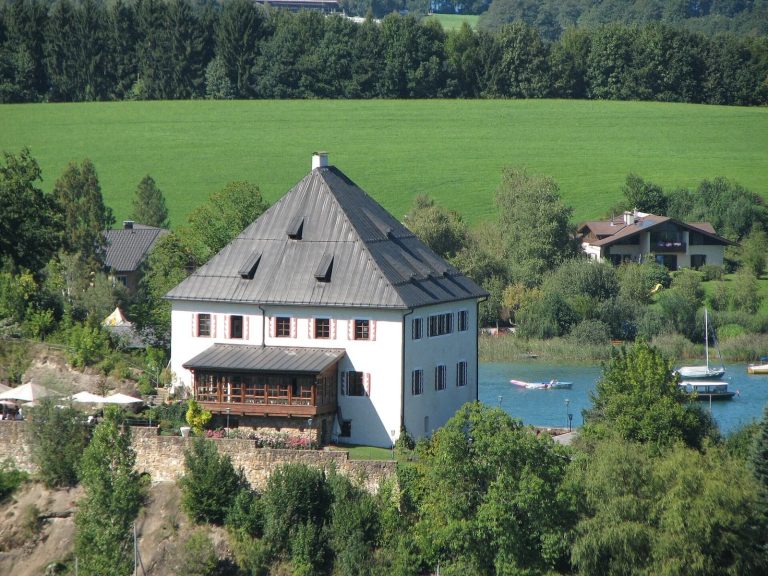
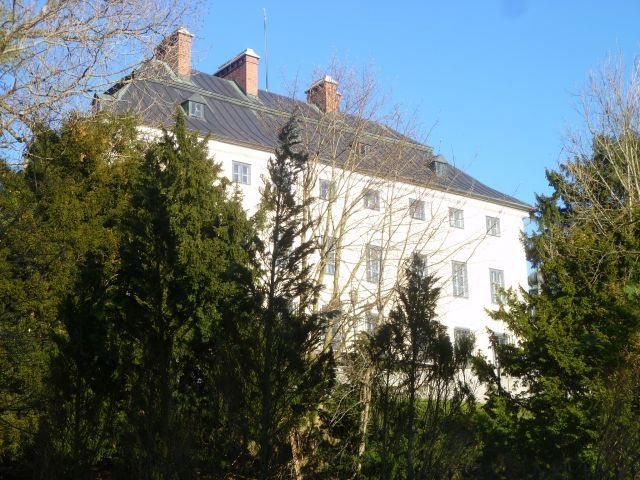
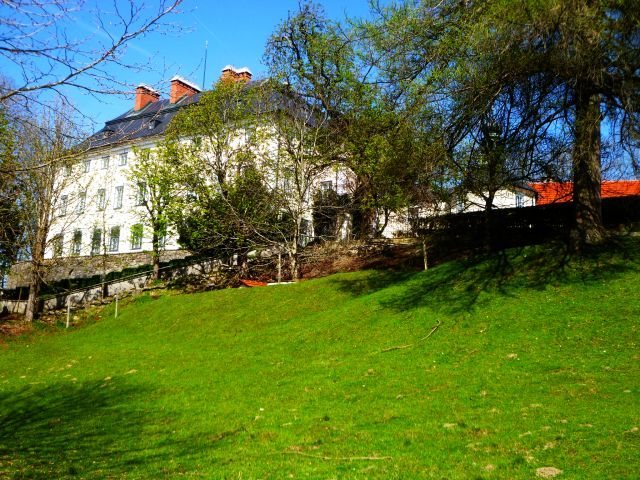
Schloss Sighartstein is a historic castle in Austria, located in the Sighartstein district of Neumarkt am Wallersee. Principally a late-Baroque building incorporating a late-Gothic main wing, it stands on a rocky promontory in Salzburg’s Flachgau region and is protected as a historic monument.
From estate to castle
In 1297, Eckhart von Tann transferred the Sighartstein estate, then described as a farm, to Raitenhaslach Abbey. The property returned to the von Tann family through an exchange in 1340, before Salzburg Prince-Archbishop Pilgrim II acquired it in 1372.
During the first half of the fifteenth century, the Uiberacker family exchanged three estates behind the Lueg Pass for Sighartstein, which they received as a freehold. Virgil Uiberacker owned the property in 1442 and began constructing a new building from 1456 onward. The new structure was then known as a castle. Georg von Uiberacker, who served as Bishop of Seckau, consecrated its chapel to Saint Sigmund and Saint Helena on 29 June 1452. On 24 January 1456, Cardinal Nicholas of Cusa granted the chapel’s owner indulgence rights, and Count Anton Uiberacker established a benefice, an endowed foundation supporting a religious office or chapel, there in 1765.
Jurisdiction and noble status
In 1541, Emperor Charles V renewed Sighartstein’s Hofmark rights. A Hofmark was a lordship whose holder exercised local rights, especially lower judicial authority, over the associated estate. Archbishop Sigismund von Schrattenbach renewed these privileges in 1754, but the lordship surrendered them to the municipality of Neumarkt in 1820.
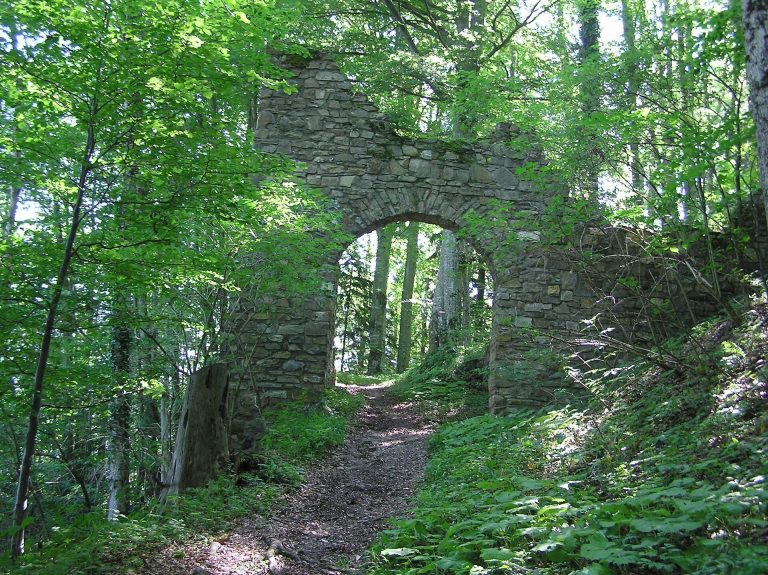
A boundary gate marked the limits of the Hofmark. Its privileges helped support the Uiberackers’ elevation to the rank of barons in 1669 and counts on 20 April 1688. The estate’s tavern, known since 1444, also held the right to transport wine into Austria and sell it directly from the cask.
Baroque renewal and later changes
Wolf Max Uiberacker, an imperial-royal major general in Habsburg service during the War of the Spanish Succession, substantially renewed the castle in 1714. Further work followed in 1720, 1736–1737, and 1792. These alterations extensively changed the late-medieval castle, including the construction of the gatekeeper’s house over the earlier gate area.
Toward the end of the nineteenth century, the building was extended eastward beyond the former free-standing line of the ring wall, and the extension was closed by a terrace. The Uiberacker family retained ownership until 1964. On 24 February that year, Gabrielle Pálffy, née Uiberacker, transferred the property to her son Martin Pálffy. Part of the castle was used as a hotel for a period.
Twentieth-century ownership
The property later passed to Arnold Henhapl. After an unsuccessful fifteen-year attempt to sell the castle and its 7.2-hectare grounds, he became insolvent in 2009. Bankruptcy proceedings began at the Salzburg Regional Court on 16 September 2009. The castle was released for auction on 27 June 2012 with an opening price of €3.75 million, but no bidder came forward. It was later sold for €3 million to Sighartstein Besitz- und Verwaltungsgesellschaft m.b.H.
The estate has hosted prominent visitors including Empress Maria Theresa, Wolfgang Amadeus Mozart, Napoleon Bonaparte, Arturo Toscanini, and the opera singer Maria Callas.
Remains
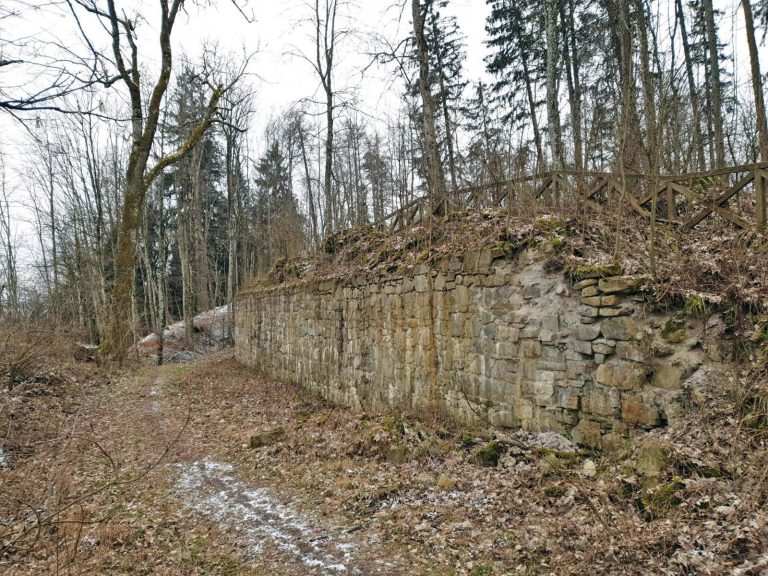
The present castle combines a late-Gothic main wing with late-Baroque alterations and south-side extensions. It occupies rocky ground that falls steeply to the east and more gently toward the west. The eastern side retains a fortified appearance, while the western elevation presents an eighteenth-century façade with a mansard roof, a roof form with two slopes on each side. The façade has a rusticated ground floor, a smooth upper level with rectangular plaster surrounds around the windows, corner pilasters, and a moulded main cornice.
Fortifications and entrance
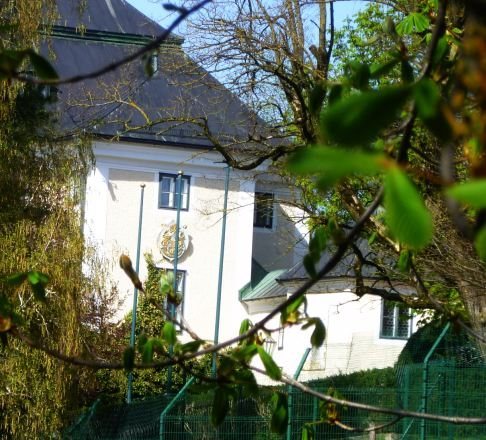
Access is across a drawbridge leading to a projecting gate structure bearing the double arms of the Uiberacker and O’Donnell families, whose houses were related by marriage. The main entrance has a reinforced Baroque door. Beyond it, a wrought-iron-fitted stairwell dates from 1714, beside a watch room with a barrel vault and curved openings called lunettes. The castle was three storeys high in 1541 and was reached by a stairway crossing earthworks raised around the building. In 1585, the ring wall was covered with stone slabs and the courtyard was raised, enabling a church and gatehouse to be built in 1589.
Interior decoration and collections
Vaulted basement levels retain impressions from their timber formwork and preserve evidence of the medieval building. The residential rooms have elaborate stucco ceilings, while chimney walls are faced with Adnet marble, a red or variegated limestone quarried in the Salzburg area. Baroque doorframes with pediments and double-leaf panelled doors enrich the principal rooms. A Rococo stove was brought from Schloss Pfongau. Weapons and portraits, assembled in connection with the Uiberackers’ military careers in the service of Salzburg’s archbishops, remain dispersed throughout the castle.
Castle chapel
A new chapel was built in the courtyard southeast of the main castle around 1600, while the older chapel within the castle building was secularized. The present chapel has a groin vault, formed by two intersecting barrel vaults, which changes in the apse to a lunette vault carried on pilaster-like supports. Its eighteenth-century Baroque treatment included a trapezoidal porch. The high-altarpiece painting, dated 1747, shows Saint Sigmund and Saint Helena beneath a figure of the Madonna and Child. The tabernacle, altar base, and reliquary shrine date from the Rococo period. A side altar dedicated to Saint Anthony was built during the first quarter of the eighteenth century, and the organ dates from 1740. In 1896, the chapel contained two bells cast in 1666 and 1869.
Forecourt and castle hill
A fountain with a statue of Saint Sighart stands in the forecourt and dates from 1893. On the castle hill, a stone statue of Saint John Nepomuk dates from the eighteenth century.