Schloss Schwarzenraben: A Baroque Water Castle in Germany


Site at a Glance
- Rating
- 4.3
- Popularity
- Very Low
- Country
- Germany
- Primary era
- Early Modern
- Eras represented
- Medieval, Early Modern
- Civilizations
- Holy Roman Empire
- Site type
- Domestic
- Remains
- Castle
On this page12 sections
History
Schloss Schwarzenraben is a Baroque water castle in Germany near Lippstadt, built by the von Hoerde family between 1748 and 1765. It developed from the medieval estate of Wambeke and is regarded as one of Westphalia’s finest water castles.
Wambeke and the medieval estate
Wambeke first appears in the historical record in 1031, when Paderborn Bishop Meinwerk confirmed the donation of part of his hereditary estates, including Wambeke, to Abdinghof Monastery, a Benedictine monastery in Paderborn. The name Wambeke roughly means “settlement beside a stream with little water.”
By the end of the Middle Ages, economic management had transformed Wambeke into an isolated manor fortified as a lowland castle. The estate was divided into two parts, which were held as fiefs by the Boleke and Vrydach families during the fifteenth century.
The von Hoerde estate
Alhard von Hoerde acquired one part of Wambeke in 1510, and the von Hoerde family obtained the second part in 1584. These acquisitions established the family branch known as von Hoerde zu Wambeke. The family later began calling the estate Schwarzenraben.
Construction of the Baroque castle
By the early eighteenth century, the medieval lowland castle was considered outdated. The von Hoerde family commissioned plans for a replacement in the mid-1740s. Ferdinand Friedrich Freiherr von Hörde, who served as a Landdrost, a senior territorial administrator, and as a Privy Councillor, a high-ranking princely adviser, had the design by Johann Matthias Kitz of Arolsen carried out. Proposals by Franz Christoph Nagel and Johann Leonhard Mauritz Gröninger were also incorporated.
The new Baroque water castle was constructed from 1748 to 1765. The Baroque style, associated with monumental forms and elaborate ornament in the seventeenth and eighteenth centuries, shaped both the building and its decoration. Work on the orangery was completed in 1774, while the castle chapel continued until 1777.
Inheritance and family succession
The Schwarzenraben branch of the von Hoerde family ended in the male line in 1846 with Engelbert Matthias. His widow, Kunigunde, born a Freiin von Asbeck, inherited Schwarzenraben and Schloss Eringerfeld. After her marriage in 1850 to her widowed brother-in-law, Wilhelm Otto Freiherr von der Decken, she transferred the von Hoerde property to her stepdaughter and niece, Marie Kunigunde von der Decken, to secure the succession.
Marie Kunigunde married Friedrich Clemens von Ketteler of Thüle in 1863. The couple acquired nearby Schloss Störmede in 1885, another former von Hoerde residence. In 1922, one year before her death, Marie Kunigunde transferred all her property to her grandson, Wilderich Friedrich Freiherr von Ketteler.
Fire and reconstruction
On 23 April 1935, a major fire caused by a forgotten iron devastated the castle. During salvage operations, firefighter Otto Kersting and district forester Heinrich Mertens were killed by a falling chimney. The disaster led to a nationwide review and reform of firefighting services.
Wilderich Freiherr von Ketteler and his wife, Maria Rosa, born a Countess zu Eltz, decided to rebuild the castle. Only the exterior walls remained after the fire. Reconstruction began in 1935 under architect Max Sonnen. Karl Brechmann recreated the stucco work in the halls, while Heinrich Landgrebe produced new ceiling frescoes for the halls and chapel.
Later ownership
Franz Anton von Ketteler came into possession of the estate in 1963. Economic difficulties later led to the sale of the 8,000-volume library in 1994, the woodland and agricultural land in 1995, and the inventory through Sotheby’s. Otto Drosihn acquired the castle, its outbuildings, and its park in 1998, after which extensive restoration and renovation followed.
Remains
Castle and decorative interiors
Main castle
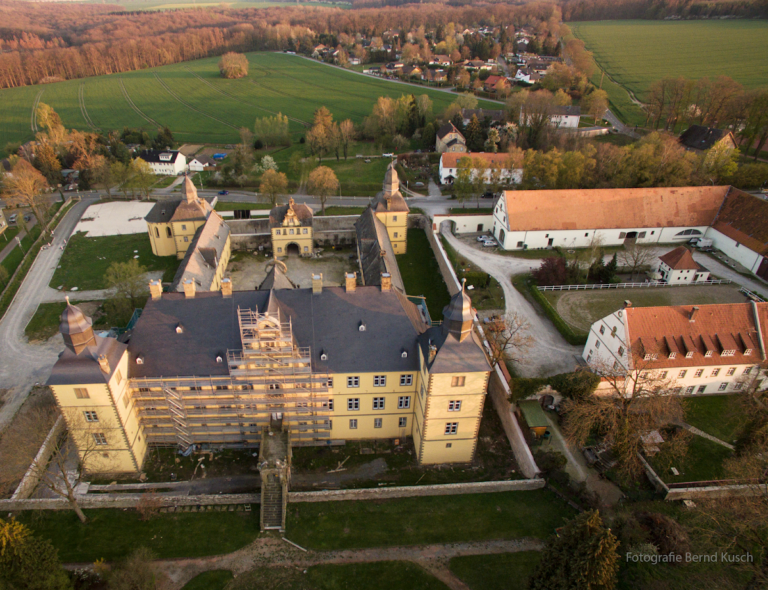
Schloss Schwarzenraben consists of a Baroque water castle set within a park and accompanied by associated outbuildings. Its interiors feature elaborate stucco work by the Metz brothers and large ceiling paintings by the fresco painter Joseph Gregor Winck. The 1935 fire left the exterior walls standing, and the subsequent rebuilding restored the structure and its principal interior decoration. Karl Brechmann recreated the hall stucco, while Heinrich Landgrebe repainted the ceiling frescoes in the halls.
Castle chapel
The castle chapel contains stucco work by the Metz brothers and an altar made by the sculptor Anton Joseph Stratmann. Its decoration belongs to the Rococo, an eighteenth-century style known for lighter, delicate, and highly ornamental interiors. The chapel is described as one of the finest Rococo chapels in Westphalia. Following the fire, Heinrich Landgrebe created new ceiling frescoes for the chapel.
Park and orangery
The castle is accompanied by a park containing its orangery, whose construction was completed in 1774. The park and associated outbuildings form part of the surviving estate complex acquired by Otto Drosihn in 1998 and subsequently restored and renovated.