Palace of Sorzano de Tejada: A Neoclassical Palace and Museum in Orihuela, Spain


Site at a Glance
- Rating
- 4.1
- Popularity
- Low
- Country
- Spain
- Primary era
- Modern
- External website
- Open
- Eras represented
- Early Modern, Modern
- Civilizations
- Spanish
- Site type
- Domestic
- Remains
- Elite Residence
On this page8 sections
History
The Palace of Sorzano de Tejada is a historic Neoclassical palace in Orihuela, Spain, dating from the late eighteenth and early nineteenth centuries and now housing the Pedrera Foundation Museum. Also known as the Palace of Romero de Tejada, it developed from a house-palace that was enlarged and transformed during the nineteenth century.
Formation of the Palace
In 1804, Matías Sorzano de Nájera, described as one of the wealthiest and most powerful figures in nineteenth-century Orihuela, petitioned the city council to recognize his nobility as a divisero, a person with a hereditary share or right in a noble estate. His claim concerned the lordship of the Solar de Tejada. Once the status was recognized, he acquired the associated privileges and the right to display the family coat of arms.
The palace took shape through the combination of several properties. In 1820, Sorzano de Nájera paid 51,439 reales in gold and silver coins to Josefa Sardo de Raymundo and her daughter Bárbara for two adjoining houses that they jointly owned. Their properties were merged with his own house, creating the building that forms the basis of the present palace.
Nineteenth-Century Expansion
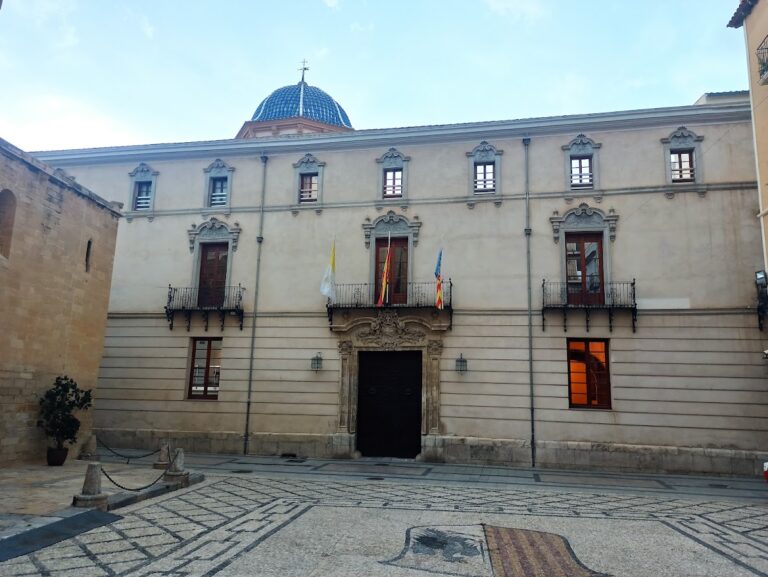
The building was expanded during the nineteenth century. It originally had two storeys, but a third upper storey was added later. This alteration concealed the dome of the palace chapel and changed the building’s external proportions.
Restoration and Cultural Use
A major restoration in 1998 and 1999 substantially changed the interior. After the work, the palace became a university college affiliated with Miguel Hernández University of Elche. A university college, or Colegio Mayor, is a university-linked residential and academic institution that also supports educational and cultural activities.
In 2010, businessman and patron Antonio Pedrera Soler, then the owner, transferred the use of much of the building and more than 500 paintings from his private collection to the city of Orihuela through the foundation bearing his surnames. The Pedrera Foundation Museum was established in the palace in 2011. An agreement between Orihuela City Council and the University of Valencia also provided for cultural activities to take place there.
In 2017, the foundation sought to recover ownership of the palace, alleging that the city council had not complied with the agreement. The council refused the request in 2020 and rejected the allegations.
Remains
The palace is a Neoclassical building arranged over a basement, a ground floor, a principal floor, and two further storeys. Neoclassicism draws on the forms and principles of Classical Greek and Roman architecture. The facade has four semicircular-arched openings on each level, while the principal floor is marked by three balcony doors with individual pediments, the crowning elements above them. The central pediment is curved.
Facade and Heraldic Features
At each end of the facade, a stone-framed doorway with a lintel opens into the building. The doorway on the left serves as the principal entrance. The other leads to the chapel. A coat of arms is fixed to the left-hand corner of the facade. According to the tradition represented by the shield, King Ramiro I granted it to Sancho Fernández de Tejada.
The shield is divided into four quarters by a cross pattée, whose arms widen toward their ends, and is associated with the Order of Saint John, a medieval Catholic military-religious order. The first quarter contains two crenellated castles with a flag rising from them, recalling the strongholds of Viguera and Clavijo that Sancho Fernández de Tejada erected. The second shows two crescent moons surrounded by thirteen stars, representing Sancho, his wife, and their thirteen children. A rampant lion, shown upright with raised forelegs, fills the third quarter and recalls his relationship with the royal house of León. The fourth contains a yew tree with a bear tied to it, representing the connection between the estates of Tejada and Valdeosera.
Thirteen scallop shells and crosses of Santiago decorate the quarters, referring to the relationship between Sancho’s thirteen children and the Order of Santiago, a Spanish military-religious order founded in the twelfth century. Thirteen flags around the shield represent his victories in battles against Muslims, while the downward-pointing crescents carry the same association. The upper motto reads, “Ecce beatificamus eos qui sustinverunt,” translated as “Behold, we exalt those who endured.” An accompanying shield shows a warrior making a solitary assault on a tower or castle and refers to the surname of Sancho’s wife, Ángela Adalid. Versions of the coat of arms can also carry a border inscription, although it does not appear on the stone example on the facade: “Laudeamus viros gloriosus et parentes nostros in generatione sua,” meaning “Let us honor our glorious men and our ancestors in their generation.”
Interior and Chapel
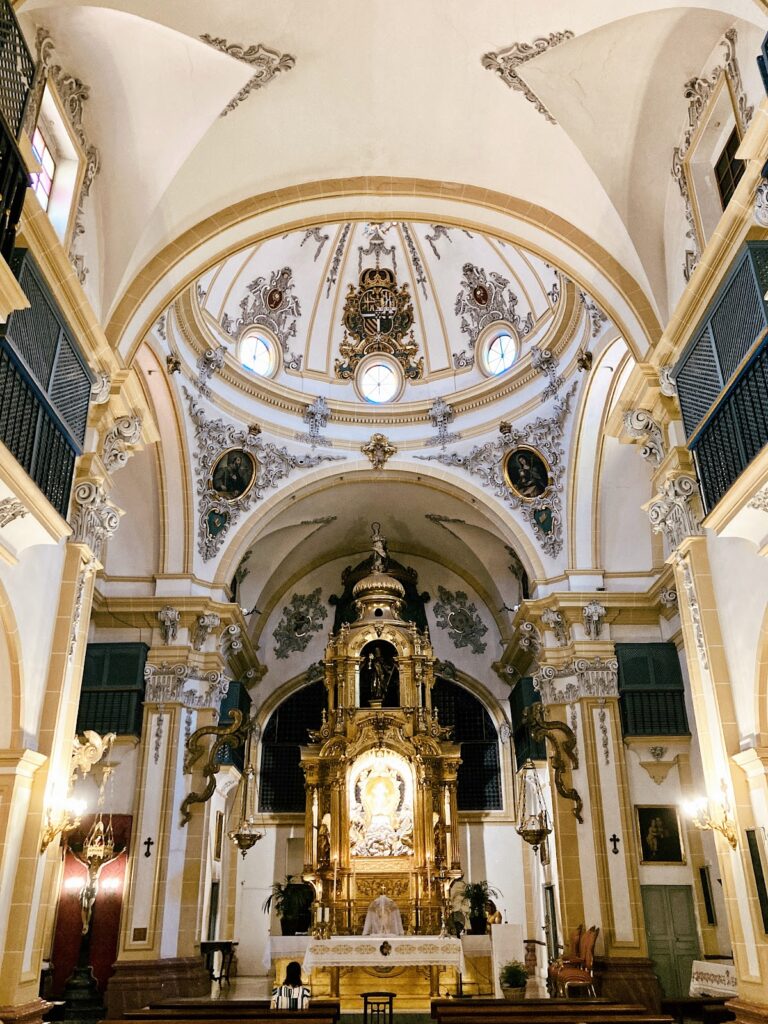
A balanced staircase, designed with uniform tread depth along its length, rises beneath a Bohemian crystal lamp and leads to the first floor and the Hall of Mirrors. The hall is used for concerts and cultural activities. The second doorway on the facade opens to a chapel with an altar formed in the Classical manner. The interior also includes halls and a basement that retains the old kitchen.
The restored interior combines several decorative periods and materials. Nineteenth-century tiles appear alongside Neo-Mudéjar coffered ceilings, chandeliers, and mirrored halls. Neo-Mudéjar architecture adapts decorative forms associated with the Mudéjar tradition of Islamic-influenced architecture in medieval Spain. A coffered ceiling is divided into recessed panels.
Exhibition Rooms
The second and third floors contain exhibition rooms for works belonging to the Pedrera Foundation. The displayed collection includes paintings by Joaquín Agrasot, the Orihuela artist whose works form part of the foundation’s holdings.