Jílové Castle: A Renaissance Chateau and Municipal Heritage Complex in Czechia


Site at a Glance
- Rating
- 4.5
- Popularity
- Low
- Country
- Czechia
- Primary era
- Early Modern
- External website
- Open
- Eras represented
- Medieval, Early Modern, Modern
- Civilizations
- Holy Roman Empire, Kingdom of Bohemia
- Site type
- Domestic
- Remains
- Castle
On this page9 sections
History
Jílové Castle is a historic castle complex in Jílové, Czechia, whose origins reach back to a water castle standing on the site around 1370. The town of Jílové first appears in a charter issued by Charles IV, the fourteenth-century Holy Roman Emperor and king of Bohemia, in December 1348. The present complex reflects medieval, Renaissance, industrial, aristocratic, and public uses.
From medieval castle to Renaissance chateau
From 1527, the site belonged to the Bünau family, a German noble family with estates in central Europe. The family transformed the medieval castle into a Renaissance chateau in the Saxon Renaissance style. After the Battle of White Mountain in 1620, a decisive Catholic imperial victory over the Protestant Bohemian estates that brought major political and religious changes in Bohemia, the Protestant Bünau family left the country. The property was then sold to Christopher Simon von Thun of Teschen, a member of the Thun noble family associated with the historical town and territory of Teschen in Silesia.
Under Franz Sigismund von Thun and Hohenstein, Grand Prior of the Order of Malta in Bohemia, the castle was rebuilt into its present form. The Order of Malta was a Catholic religious and chivalric order linked historically with caring for the sick and defending Christianity. As its senior administrative and religious officer in Bohemia, the Grand Prior oversaw a substantial enlargement of the building that included the addition of two floors.
Industrial and aristocratic residence
In 1842, Josef Münzberg leased the unused castle and established a wool-spinning and wool-textile factory there. The spinning mill continued operating until 1922, giving the former aristocratic property an industrial function.
During the 1930s, the Thun-Hohenstein family transferred its castle in Teschen to the Czechoslovak state and moved to Jílové. Franz von Thun and Hohenstein adapted Jílové Castle as a modern family residence between 1928 and 1930. Much of the interior appearance dates from this phase.
War damage and public use
Allied bombing damaged the castle in April 1945. The property was confiscated after the war, while the Thun family remained there until spring 1946. Reconstruction was considered from 1947, but the planned rebuilding did not take place in its intended form.
Later in the twentieth century, the castle housed an orphanage and then an agricultural school with a boarding facility. It also served as a hospice and boarding institution. Since 2000, the complex has belonged to the municipality of Jílové, which has gradually reconstructed it. The restored ground and first floors now contain a library and a museum, while three exhibitions in the Renaissance cellars present the history of Jílové and its surroundings. The castle complex, park, and stables are protected as a national cultural monument of the Czech Republic under catalogue number 1000140764.
Remains
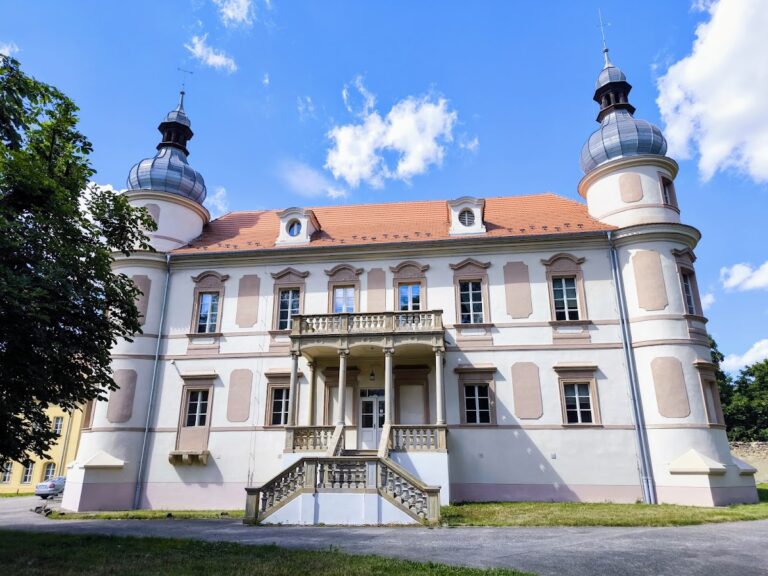
Jílové Castle has an L-shaped plan, with the rectangular castle occupying the central part beside the park and associated buildings arranged mainly around a courtyard. The complex includes the castle, entrance gate, stables and carriage house, former moat and bridge, a statue of John of Nepomuk on a column, and a large fountain at the courtyard’s centre. A perimeter wall encloses part of the estate, with mature trees beside it partly screening the building.
Castle and courtyard
Castle building
The principal facade rises three storeys beneath a large mansard roof, a roof with two slopes on each side, the lower one steeper than the upper. The building is fully plastered and ochre-coloured, and its windows have stone surrounds. Its principal Renaissance portal has a semicircular arch, niches on either side, and a triangular pediment. Most interior rooms and stone fittings date from the 1930s, although Renaissance stone elements remain in some rooms and halls.
Courtyard and entrance features
The entrance gate provides access to the castle and the courtyard buildings. The stables also functioned as a carriage house. The courtyard contains the column carrying a statue of John of Nepomuk and a large fountain, which was brought from the courtyard of Tetschen Castle. A recreated moat surrounded the castle around 1800. Historical maps show the building enclosed by water, with gardens on its north and west sides.
Park and water features
West of the castle lies an English landscape park with coniferous and deciduous trees, a stream, and stone bridges fitted with wrought-iron railings. The grounds incorporate a pre-existing natural body of water. Around the lake stands a circular gloriette, a small ornamental pavilion used as a garden focal point or viewing structure, with an open grassy area at its centre.
In front of the castle’s western facade, the grounds are arranged geometrically. A slightly segmented wall separates this part of the park from the main road to the south. The gloriette originally stood below Tetschen Castle before being moved to the park at Jílové.
Nearby sites