Neu-Augustusburg Castle: The Early Baroque Ducal Residence in Weißenfels


Site at a Glance
- Rating
- 4.3
- Popularity
- Low
- Country
- Germany
- Primary era
- Early Modern
- External website
- Open
- Eras represented
- Early Modern
- Civilizations
- Holy Roman Empire
- Site type
- Domestic
- Remains
- Palace
On this page10 sections
History
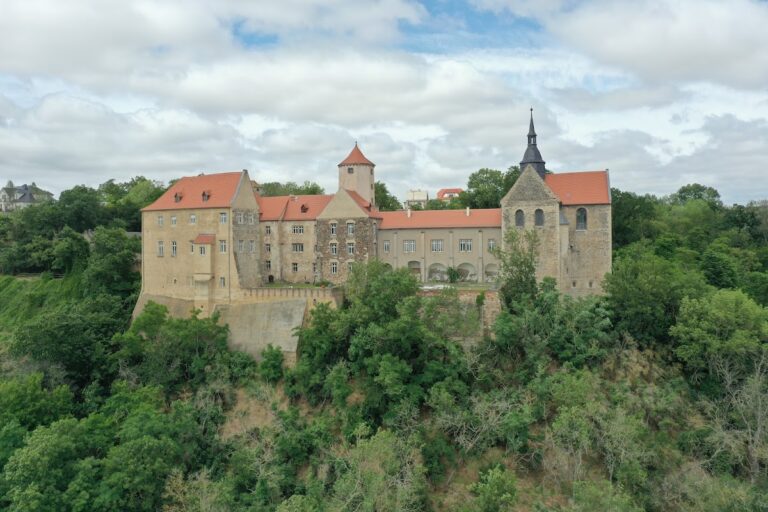
Neu-Augustusburg Castle is an early Baroque palace complex in Weißenfels, Germany, built between 1660 and 1694 as the residence of the Dukes of Saxe-Weissenfels. It replaced a castle destroyed by Swedish forces in 1644 during the Thirty Years’ War, the European conflict that lasted from 1618 to 1648 and reshaped territorial control in the German lands.
Foundation and ducal residence
Augustus, Duke of Saxe-Weissenfels and administrator of the Archbishopric of Magdeburg, laid the foundation stone on 25 July 1660. He governed the duchy from his episcopal New Residence in Halle. Because the postwar settlement was expected to transfer Magdeburg to Brandenburg after his death, Augustus appears to have intended the new palace chiefly for his heirs, who would no longer be able to remain in Halle.
Augustus died in 1680 before the palace was complete. His son Johann Adolf I then moved into the unfinished building as the first duke to reside there and oversaw its completion during the following fourteen years. Construction was directed by Johann Moritz Richter and his son, who produced one of the largest early Baroque palace complexes in central Germany.
Saxe-Weissenfels was a secondary principality, or Sekundogenitur, created for a younger son or junior branch of a ruling dynasty. The resident dukes were Johann Adolf I from 1680 to 1697, Johann Georg from 1697 to 1712, Christian from 1712 to 1736, and Johann Adolf II from 1736 to 1746. When the Weißenfels ducal line became extinct in 1746, the palace returned to the Electorate of Saxony. It became a secondary residence and was thereafter rarely occupied.
A centre of music and culture
During the ducal period, Neu-Augustusburg became a cultural centre associated with Johann Beer, Johann Philipp Krieger, Georg Philipp Telemann, and Friederike Caroline Neuber. Johann Adolf I recognized the musical ability of the young Georg Friedrich Händel after asking his father, the court physician Georg Händel, to have his son play the organ in the palace church.
Johann Sebastian Bach composed the hunting cantata Was mir behagt, ist nur die muntre Jagd, BWV 208, for Duke Christian. It was first performed in Weißenfels in 1713. Bach’s shepherd cantata Entfliehet, verschwindet, entweichet, ihr Sorgen, BWV 249a, was performed at the palace on the duke’s birthday in 1725, and Bach also composed the Toccata and Fugue in F major, BWV 540, for the church organ. Telemann wrote the festive work Jauchzet dem Herrn alle Welt, TVWV 1:951, for the fiftieth anniversary of the palace church’s consecration in 1732.
Military and political uses
After Weißenfels passed to Prussia in 1815, the palace was converted into barracks for a battalion of the 1st Thuringian Infantry Regiment No. 31 at Erfurt. The army used the complex as a school for non-commissioned officers until 1920, after which the police occupied it.
From March to August 1933, Neu-Augustusburg served as a detention and assembly camp for political prisoners. During the Nazi period, the Gestapo, Nazi Germany’s secret state police, also used the palace.
Postwar preservation and museum use
After 1945, refugees and displaced persons were housed in the palace. The complex later accommodated a specialist school for local-history museums and the GDR Shoe Museum. The German Democratic Republic, or GDR, was the East German state that existed from 1949 to 1990; the shoe museum’s presence at Neu-Augustusburg dates from 1964.
Since 1993, the city of Weißenfels has administered the building, while the palace itself remains state-owned. Restoration has proceeded in stages. The north wing was renewed from 2005 to 2010, and the southern west wing was restored from 2012 to 2018. Work carried out between 2018 and 2021 included installing tie rods in the south wing, securing the ground-floor vault at the east gable, and repairing cellar masonry. Restoration of the two western sections continued in January 2026.
The palace now houses Museum Weißenfels, a museum of regional and urban history founded in 1910. Its displays include shoemaking, continuing the tradition of the shoe museum established in 1964, and an extensively redesigned exhibition on the Duchy of Saxe-Weissenfels opened in 2007. Neu-Augustusburg is recognized as a nationally important cultural monument and functions as a museum.
St. Trinitatis Palace Church has been used every Sunday since 1946 by the Evangelical Lutheran St. Trinitatis congregation of the Independent Evangelical Lutheran Church. Under an agreement with the city reached in 2004, the congregation established parish rooms and a parsonage in the adjoining northeast wing. That wing also contains the superintendent’s office of the Saxony-Thuringia church district.
Remains
Neu-Augustusburg survives as a well-preserved early Baroque palace complex on the site of the earlier castle. Its palace terrace provides a broad view over Weißenfels. The most richly preserved interior is St. Trinitatis Palace Church, whose outward form does not readily reveal its ecclesiastical purpose. Inside, its arrangement, painted galleries, emblems, ducal gallery, altar, crypt, and historic organ retain the character of a court chapel.
St. Trinitatis Palace Church
The church was planned around the opposition between the altar and the ducal box on the gallery. Two tiers of galleries organize the interior. Paintings on the first gallery present related scenes from the New Testament, while those on the second gallery show scenes from the Old Testament. Johann Oswald Harms, a German Baroque painter known for theatrical and religious compositions, painted the interior, where numerous emblems provide another major element of the decoration.
Altar and galleries
The original pulpit altar was made by Johann Heinrich Böhme of Schneeberg and Johann Balthasar Stockhammer between 1678 and 1680. After the palace passed to the Catholic House of Saxony, the pulpit altar was dismantled in 1751, and an Annunciation relief became the altarpiece. The church’s gallery arrangement continues to express the relationship between the ducal seat and the altar that shaped its original design as a palace chapel.
Ducal crypt
A hereditary crypt lies beneath the altar area. It contains the burials of the Weißenfels ducal family and their relatives in elaborately decorated coffins made from wood or tin alloys. The crypt is an important monument of Baroque funerary culture in central Germany.
Among those buried there are Augustus, the first Duke of Saxe-Weissenfels, his two wives Anna Maria of Mecklenburg and Johanna Walpurgis of Leiningen-Westerburg, and several of their children. The crypt also contains Friedrich, Duke of Saxe-Weissenfels-Dahme, and Moritz, an officer in Electoral Saxon service, together with further members of the family and a stillborn son of Augustus from 1679. Christian, the fourth duke, his wife Luise Christiana of Stolberg-Stolberg, and Johann Adolf II, the fifth duke, are also interred there. Johann Adolf I, Johann Georg, their wives, children, and other members of the ducal line complete the recorded burials. The entrails of Christian, Friederike Elisabeth of Saxe-Eisenach, Johann Adolf II, and one of Johann Adolf II’s daughters were placed separately in urns.
Förner organ
The church organ occupies the third gallery. Christian Förner built it between 1667 and 1673 with 22 stops on two manuals and pedals. An organ stop is a separately controlled group of pipes producing a particular tone colour; the manuals are played by the hands, while the pedals are operated by the feet. Contemporaries regarded the instrument as a technical and musical masterpiece of central German organ building.
Decades of neglect during the barracks period were followed by a radical rebuilding by Johann Friedrich Schulze in 1839 and repairs by Friedrich Ladegast in 1864. The pipes and case suffered severe damage after 1945. In 1985, the A. Voigt organ-building company carried out a largely new partial reconstruction. The instrument now has 32 stops on two manuals and pedals, and it remains an important monument of musical history and a key instrument in the development of central German organ building.