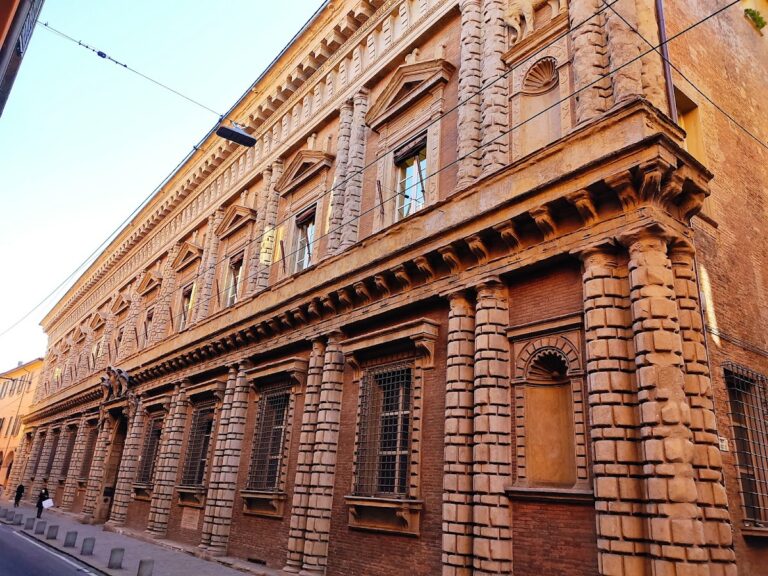
Palazzo Hercolani: An Aristocratic Palace and University Seat in Bologna


Site at a Glance
- Rating
- 4.6
- Popularity
- Low
- Country
- Italy
- Primary era
- Early Modern
- External website
- Open
- Eras represented
- Early Modern, Modern
- Civilizations
- Papal States
- Site type
- Domestic
- Remains
- Palace
On this page13 sections
History
Palazzo Hercolani is an eighteenth-century palace in Bologna, Italy, commissioned by the Hercolani family and built in 1793 in a combination of Neoclassical, Late Baroque, and Rococo forms. The palace stands on Strada Maggiore in the city’s historic centre and was designed by Angelo Venturoli for Filippo Hercolani, a marquis, the fourth Hercolani prince, and a member of Bologna’s powerful senatorial family.
Construction and Hercolani patronage
Filippo Hercolani commissioned the present palace in 1785. Its construction replaced earlier buildings associated with the Muzza, Manzi, and Nascentori families. The completed design balanced a restrained Classical treatment on the exterior with more elaborate solutions inside, where Late Baroque and Rococo ornament shaped the ceremonial spaces.
In the early nineteenth century, Astorre Hercolani commissioned a large internal garden inspired by the major European parks of the late eighteenth century. The garden combined French and English ideas, ornamental structures, and small artificial hills, extending the palace’s designed environment beyond its rooms.
University ownership and restoration
The University of Bologna acquired Palazzo Hercolani in 1973. Restoration carried out between 1989 and 1992 prepared the building to serve as the seat of the university’s Faculty of Political Sciences, which continues to use the palace for offices. A further university restoration campaign, undertaken from 1995 to 1997, treated the monumental staircase, the principal reception hall, and a Chinese-style room. Palazzo Hercolani is recognized as an Italian cultural property.
Remains
Exterior and garden layout
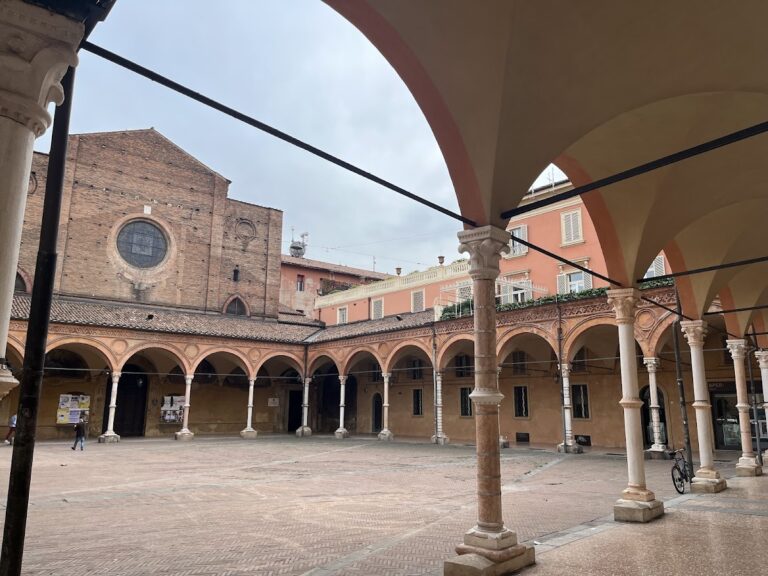
Palazzo Hercolani is a large palace organized around an internal courtyard with a portico and a substantial interior garden. Its facade has a restrained Classical character, reflecting the balance and formal order associated with Neoclassical design. Inside, the layout connects ceremonial rooms with the garden, while the palace’s decorative program brings together Classical subjects, theatrical Late Baroque effects, and Rococo ornament.
The garden is arranged in a mixed French and English manner. Its design includes ornamental structures and small artificial hills, creating a planned landscape within the palace complex. The garden’s relationship with the ground-floor Winter Garden gives the interior decoration a direct visual connection with the outdoor setting.
Staircase and principal halls
Monumental staircase
The monumental staircase is decorated with mythological stucco statues by the Neoclassical sculptor Giacomo De Maria. Its vault carries The Glory of Hercules, also known as The Apotheosis of Hercules, painted around 1799. Filippo Pedrini supplied the figures, while Davide Zanotti created the architectural quadratura, an illusionistic painting technique that represents columns, cornices, arches, and related structures as extensions of the real architecture.
Hall of honour
The hall of honour contains the allegory Apollo and the Hours, produced in 1798. Filippo Pedrini painted the figures and Flaminio Minozzi supplied the ornamental work. The hall is dedicated to Roberto Ruffilli.
Painted and decorated rooms
Upper-floor frescoed room
A frescoed upper-floor room, probably painted by Filippo Pedrini, depicts Fame and Human Genius. The composition includes Homer, Pindar, and Hesiod, major ancient Greek poets, together with Democritus, the ancient Greek philosopher associated with atomism.
Zodiac Hall
The palace includes the Sala dello Zodiaco, or Zodiac Hall, a Neoclassical room with frescoes probably executed by Antonio Basoli.
Winter Garden
The ground-floor Sala Boschereccia, or Winter Garden, is a landscape room painted by Rodolfo Fantuzzi in 1810. Fantuzzi created woodland scenery across the room, which opens onto the internal garden. At its centre stands Adamo Tadolini’s Cupid and Psyche, a sculpture that imitates Antonio Canova’s Neoclassical group and establishes a symbolic dialogue with statues in the garden.
Chinese-style rooms
Two rooms were decorated in a Chinese or Chinoiserie style by Vincenzo Armani and Davide Zanotti in 1803 and 1804. Chinoiserie was a European decorative approach that reinterpreted Chinese artistic motifs, forms, and imagery. Other rooms contain decorations and paintings associated with Giovanni Battista Frulli, Luigi Busatti, Antonio Basoli, Serafino Barozzi, Pietro Fancelli, Gaetano Caponeri, Flaminio Minozzi, and Vincenzo Martinelli.