Schloss Liebenberg: A Historic Manor Estate in Germany


Site at a Glance
- Rating
- 4.5
- Popularity
- Medium
- Country
- Germany
- Primary era
- Modern
- External website
- Open
- Eras represented
- Early Modern, Modern
- Civilizations
- German, Kingdom of Prussia
- Site type
- Domestic
- Remains
- Manor House
On this page13 sections
History
Schloss Liebenberg is a historic manor estate in Germany, in the Liebenberg district of Löwenberger Land in northern Brandenburg. Developed as a knight’s estate during the sixteenth century, it grew into a major landed residence whose present palace complex took shape through historicizing expansions between 1875 and 1906.
The Bredow and Hertefeld Estate
The noble Bredow family developed Liebenberg into a knight’s estate during the sixteenth century. In 1652, the Kleve family von und zu Hertefeld acquired the property and began a period of prosperity. Jobst Gerhard von und zu Hertefeld made Liebenberg the principal residence of his family after his father had acquired possessions in the Mark Brandenburg, the historical territory that later formed the core of the Brandenburg-Prussian state, through connections with Elector Friedrich Wilhelm of Brandenburg.
Jobst Gerhard served as chief hunting master of Kleve and helped establish the foundations for agricultural use in the surrounding area. Theodor Fontane later described these achievements as epoch-making for the cultural history of the Mark Brandenburg. The Hertefeld male line ended with Karl Freiherr von und zu Hertefeld in 1867. The estate then passed to his grandniece Alexandrine Freiin von Rothkirch-Panthen, whose marriage to Count Philipp Conrad zu Eulenburg transferred Liebenberg and the family’s Lower Rhine possessions to the Eulenburg family, later elevated to princely rank.
Expansion and the Eulenburg Era
The Liebenberg holdings included the subsidiary estates of Wulkow and Gühlen, a 1,958-hectare estate at Häsen, the 2,045-hectare Liebenberg estate with the Hertefeld and Louisenhof outlying farms, and another 213 hectares in the municipality of Bergsdorf. The manor house had been built by 1743 at the latest. From 1875 to 1906, it was enlarged into the palace complex that survives today.
Philipp Prince zu Eulenburg and Hertefeld became Liebenberg’s best-known lord. A diplomat and close confidant of Wilhelm II, the German emperor and King of Prussia from 1888 to 1918, he hosted the emperor’s hunting visits in the game-rich Liebenberg forests. Their association formed the basis of the Liebenberg Circle. It ended after the journalist Maximilian Harden accused Eulenburg of homosexuality, provoking the political and legal controversy known as the Harden-Eulenburg Affair.
In 1908, Eulenburg built Seehaus on the eastern shore of the Großer Lankesee. During the National Socialist period, Hermann Goering visited Liebenberg for hunting. Eulenburg’s granddaughter Libertas Schulze-Boysen spent her childhood at the estate and married Harro Schulze-Boysen in the palace chapel on 16 July 1936. The couple later belonged to the resistance networks called the Red Orchestra by the Gestapo, which opposed National Socialism.
Wartime Relocation and East German Use
From autumn 1943 until spring 1945, the Kaiser Wilhelm Institute for Cell Physiology moved its operations to Seehaus Liebenberg because of the war. The institute studied cellular processes under the direction of the physiologist Otto Warburg.
After the Second World War, Liebenberg became part of the Soviet occupation zone. The palace and the entire estate were expropriated without compensation and transferred by the Soviet Military Administration in Germany to the Socialist Unity Party of Germany, or SED, the ruling communist party of East Germany, to supply its Karl Marx Party College.
During the East German period, the palace held apartments, apprentice accommodation, offices, storage areas, a hairdressing salon, a medical practice, and a kindergarten. The administration used the palace chapel for celebrations. The estate operated as a party enterprise supplying the corresponding organizations in East Berlin.
From the late 1940s, Seehaus functioned as a guarded restricted area with its own electricity and water supplies and a direct telephone line to East Berlin. It served as a holiday residence for the SED Central Committee and accommodated Wilhelm Pieck, Otto Grotewohl, Walter Ulbricht, a Soviet ambassador, and other state guests. The Liebenberg forest became a state hunting area in 1964. From 1971, during Erich Honecker’s leadership, Seehaus was reserved for lower-ranking or former Central Committee members and guarded by a special unit of the German People’s Police.
Transformation After 1989
In December 1989, during the peaceful revolution in East Germany, demonstrators gathered outside Seehaus and demanded entry. A delegation was admitted. The Treuhand Agency, the East German trust institution that administered and privatized state-owned property after communist rule, took over the estate in 1991 and offered it for purchase in 1996. Residents of Liebenberg were allowed to buy the houses in which they lived. Around the turn of the millennium, Deutsche Kreditbank acquired the remaining estate.
The palace was later converted into a hotel and Seehaus into a conference center. A museum and farm shop were established on the estate, while the fields were leased to an organic farming operation. In 2005, the DKB Foundation for Social Engagement took over the property and began maintaining it according to monument-preservation principles. Its work includes sustainable-development education, cultural education, support for young people, inclusion, prevention, and the preservation and interpretation of the estate’s cultural heritage. Since 2009, the foundation has operated Hotel Schloss & Gut Liebenberg and the youth village at Lake Ruppin in Gnewikow as independent integration enterprises. The estate is protected under Brandenburg monument law, including the manor house, estate buildings, park, Seehaus, and associated structures.
Remains
Manor House and Park
Schloss Liebenberg
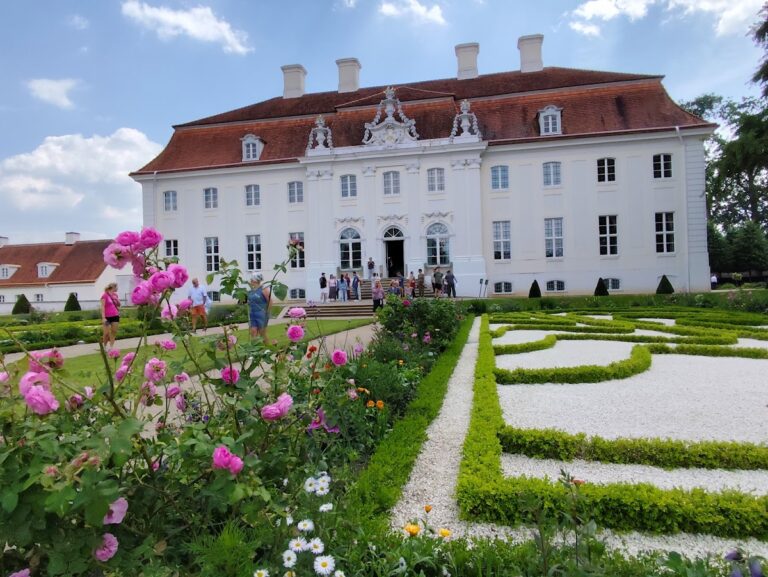
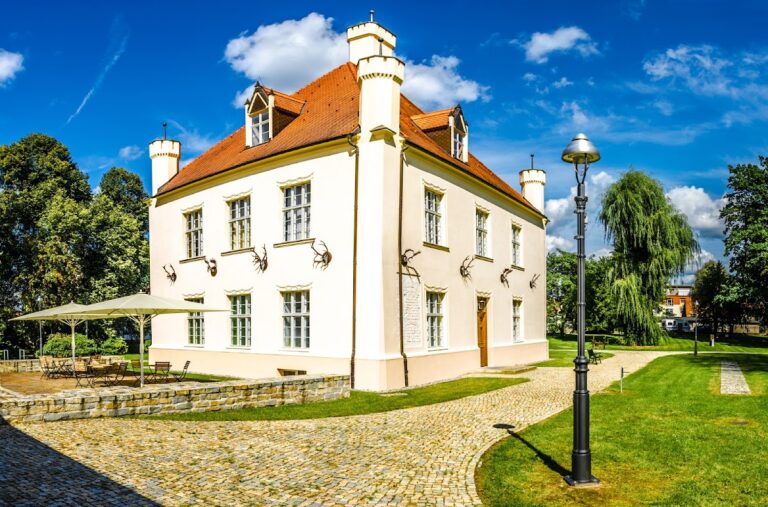
The central manor house developed from a building erected no later than 1743 and enlarged between 1875 and 1906 in a historicizing style. The palace forms the central element of the estate ensemble and includes the wall painting Battle of Alexander. The palace chapel is also part of the complex. Its later use for celebrations organized by the estate administration reflects the building’s continued place within the institutional life of Liebenberg.
Landscape Park
The former baroque garden was reshaped during the nineteenth century as a landscape park incorporating baroque elements. Its design ideas were associated with Peter Joseph Lenné, a leading nineteenth-century Prussian landscape designer known for formal gardens and landscape parks. The park includes the Lintenhaus and a tea house.
Estate and Farm Buildings
Hunting and Residential Buildings
The estate complex contains a hunting and weapons hall building, hunters’ houses, an avenue, and the coach house. It also includes an inspector’s house now used as a storage building, along with the residential buildings known as the Kastanienhaus and Gärtnerhaus. The inn Zum Roten Hirsch, two ice cellars, and an enclosure form additional parts of the historic estate group.
Farmyard
The farmyard consists of a forge, five stables, two barns, and a timber-framed storage building. Together, these structures represent the agricultural infrastructure of the landed estate and its associated working premises.
Seehaus at Großer Lankesee
Seehaus was built in 1908 on the eastern shore of the Großer Lankesee as an associated part of the Liebenberg estate. The complex includes ancillary buildings, a gate, and surviving sections of an enclosure. Its buildings and related features remain components of the protected estate ensemble alongside the palace, park, and other estate structures.
Nearby sites