Schloss Bensberg: A Baroque Hunting Palace and Military Institution in Germany


Site at a Glance
- Rating
- 4.6
- Popularity
- Medium
- Country
- Germany
- Primary era
- Early Modern
- External website
- Open
- Eras represented
- Early Modern, Modern
- Civilizations
- Duchy of Berg, Holy Roman Empire
- Site type
- Domestic
- Remains
- Palace
On this page13 sections
History
Schloss Bensberg is a Baroque palace in Germany, in the Bensberg district of Bergisch Gladbach, commissioned in 1703 by Elector Johann Wilhelm II of the Palatinate as a hunting residence for his second wife. Johann Wilhelm II, also known as Jan Wellem, entrusted the design to Count Matteo d’Alberti. The project was conceived as a prestigious courtly palace rather than a small lodge, with architectural ideas oriented toward Versailles and Christopher Wren’s design for Winchester Castle.
Construction and decline
Johann Wilhelm II died in 1716, before the palace was finished. Later rulers lived mainly in the Palatinate and visited Bensberg only rarely. The complex therefore declined in importance, even as work on its extensive buildings continued gradually toward completion.
Military hospitals and the Milchborntal burials
In January 1793, after the Battle of Jemappes, the palace became a field hospital for wounded Austrian soldiers. The hospital operated under the commandant of Cologne without the authorization of Duke Charles Theodore of Jülich-Berg, and despite opposition from Burggravine Helena Theresia Moureaux. Shortages of furniture, straw, firewood, food, and hygienic facilities severely damaged the interiors. Furniture was replaced with straw bedding, while fires were lit directly on the floors of former reception rooms.
Typhus broke out in March 1793 and caused extensive loss of life. By the end of the war, more than 3,000 people who had died at Bensberg had been buried in large communal graves in the nearby Milchborntal. In 1813, French forces established another military hospital in the palace. Typhus again caused many deaths, and the victims were buried in Milchborntal near the earlier imperial graves. Imperial and French cemeteries, along with memorials to the dead soldiers, were established in the valley.
Prussian and municipal uses
From 1819 to 1837, Schloss Bensberg served as a Prussian military hospital for contagious eye diseases. Between 1840 and 1918, it housed the Prussian Kadetten-Haus Bensberg, a military boarding school that educated boys and young men for careers as officers. By the beginning of the twentieth century, Bensberg had become an important officer-training center of the German Imperial Army.
After the First World War, the cadet institution was abolished, and occupation troops initially used the palace as barracks. The complex came under municipal control in November 1919. When the occupation forces withdrew in autumn 1922, the mayor’s office moved into the south wing. Other parts accommodated municipal departments, a local museum, Protestant church activities, youth homes, and a vocational school. From 1924 to 1933, the remaining rooms were used as a homeless shelter for 93 municipal families.
Nazi period and wartime destruction
From 1935 until the end of 1944, the palace housed the Nationalpolitische Erziehungsanstalt Bensberg, a Nazi state school system commonly called NAPOLA that aimed to train future political and military elites. From 1937, the institution was directed by SA leader Paul Holthoff.
In 1944, the Bensberg subcamp of Buchenwald concentration camp operated at the site. About 40 forced laborers, mainly from the Soviet Union and Poland, were housed there and made to repair damage caused by a palace fire in 1943. On 22 March 1944, two forced laborers whom the Nazi authorities classified as “Ostarbeiter” were shot in the palace park. In early November 1944, the NPEA and the concentration-camp subcamp were evacuated to Hardehausen near Warburg because of the expected Allied advance.
Postwar transformation
After 1945, American and British occupation troops successively used the complex, followed from 1946 by Belgian forces. From 1965 to 1997, it was the seat of the Belgian secondary school Koninklijk Atheneum Bensberg. The palace was added to Bergisch Gladbach’s register of historic monuments on 30 June 1988 as entry number 136.
In 1997, North Rhine-Westphalia sold the complex, including the palace park and ancillary buildings, to Aachen Münchener Lebensversicherung, now Generali Deutschland. Extensive renovation between 1997 and 2000 converted the deteriorated palace into the Grandhotel Schloss Bensberg. The former palace remains in use as a luxury hotel, while its historical identity is also reflected in the 9.3-kilometre Bensberg Castle walking route, designated Bergischer Streifzug No. 13.
Remains
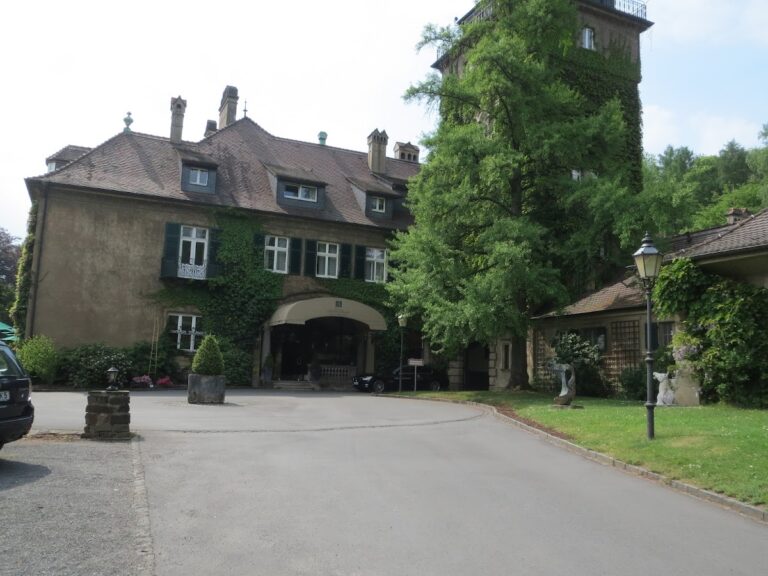
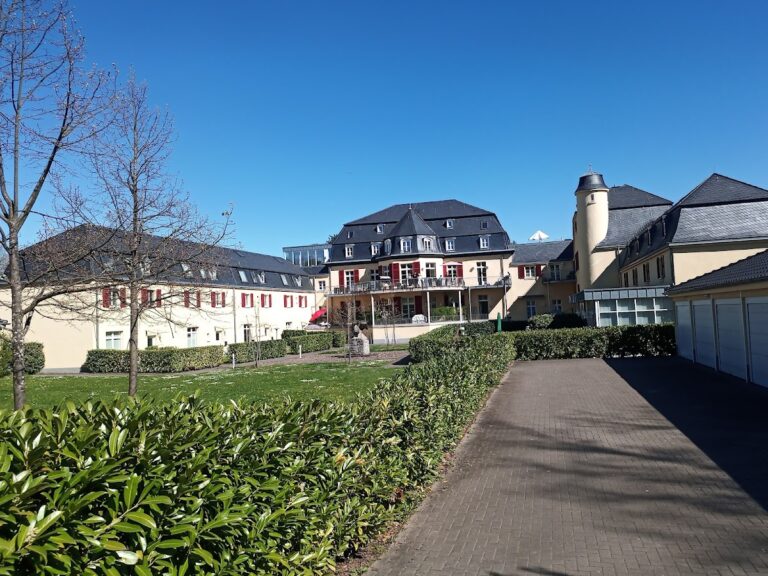
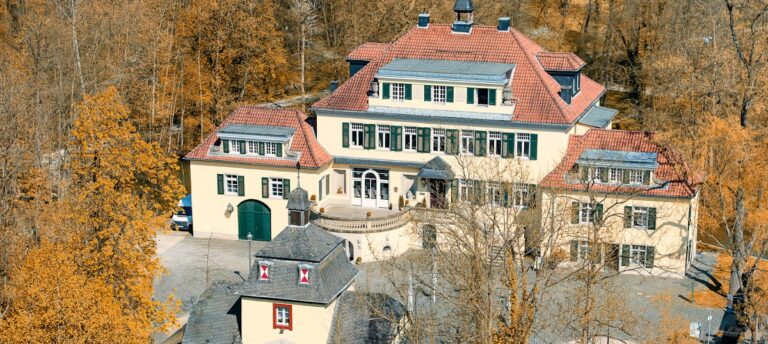
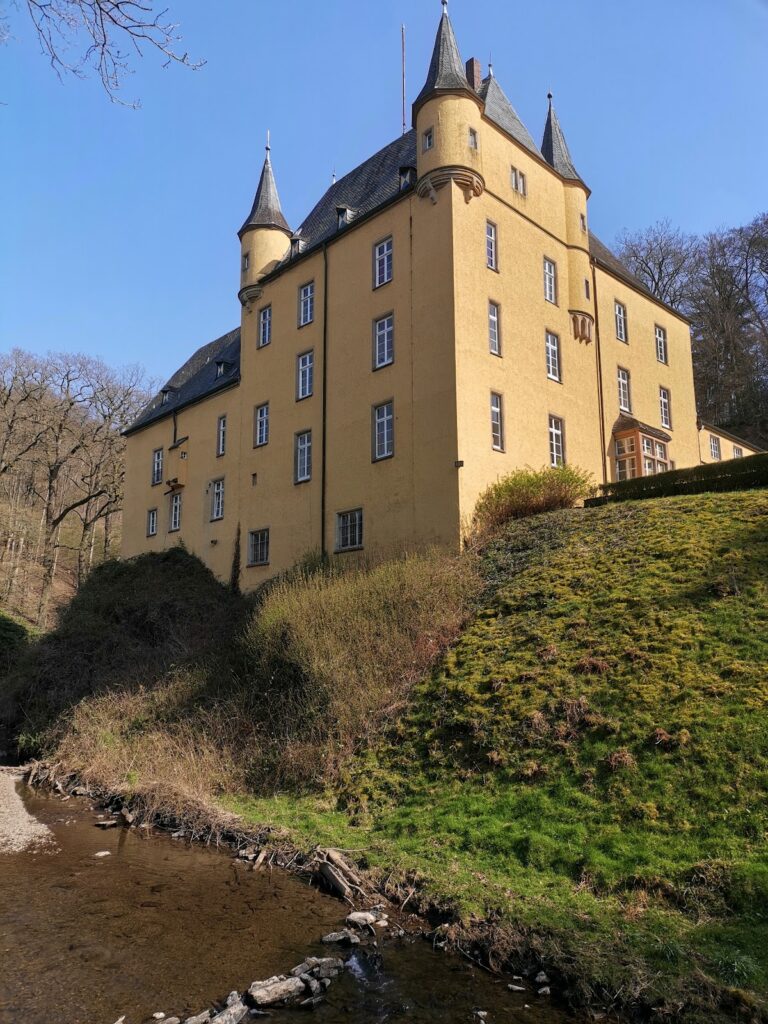
Schloss Bensberg is a brick-built Baroque complex arranged on a symmetrical U-shaped plan, with the open side facing east. A four-storey central block forms the core. Two wings of equal height meet it at right angles, and three-storey buildings continue from those wings with slight setbacks. Five domed turrets crown the four-storey buildings, with one taller turret at the center and four lower turrets around it.
Palace setting and principal axis
The palace stands on elevated ground overlooking forests, fields, heathland, part of the Rhine, and the Siebengebirge. An entrance gate leads into the complex, and a fountain stands before the main entrance. The principal axis is precisely aligned with Cologne Cathedral, approximately 14 kilometres away in a straight line.
Interior spaces and surviving decoration
Library
The library occupies 55 square metres and measures approximately 4.55 by 5.60 metres. It contains about 5,000 antiquarian books, forming one of the surviving interior collections associated with the palace’s later hotel conversion.
Zanetti Hall
The Zanetti Hall contains a ceiling fresco titled The Fall of the Titans by Domenico Zanetti. A ceiling fresco is a painting applied directly to the plaster of a ceiling or vault. Zanetti was the painter associated with this work at Schloss Bensberg.
Transferred decorative works
Jan Weenix’s hunting scenes, commissioned as decorative works for the palace, have survived and are now held in the Alte Pinakothek in Munich. Silk wallpapers and additional paintings from the palace are now located in Schloss Augustusburg in Brühl. These surviving works preserve elements of the decorative scheme beyond the building itself.
Park and later buildings
The palace park contained the Kadettenbad, a swimming hall built between 1897 and 1900 during the cadet-school period. The building is still in use. Much of the former park was later used for residential construction, while the palace itself was renovated and adapted for hotel use.
Nearby sites