Palais Lascaris: A Baroque Aristocratic Residence and Musical-Instrument Museum in Nice


Site at a Glance
- Rating
- 4.4
- Popularity
- Medium
- Country
- France
- Primary era
- Early Modern
- External website
- Open
- Eras represented
- Early Modern
- Civilizations
- Duchy of Savoy
- Site type
- Domestic
- Remains
- Elite Residence
On this page13 sections
History
Aristocratic residence
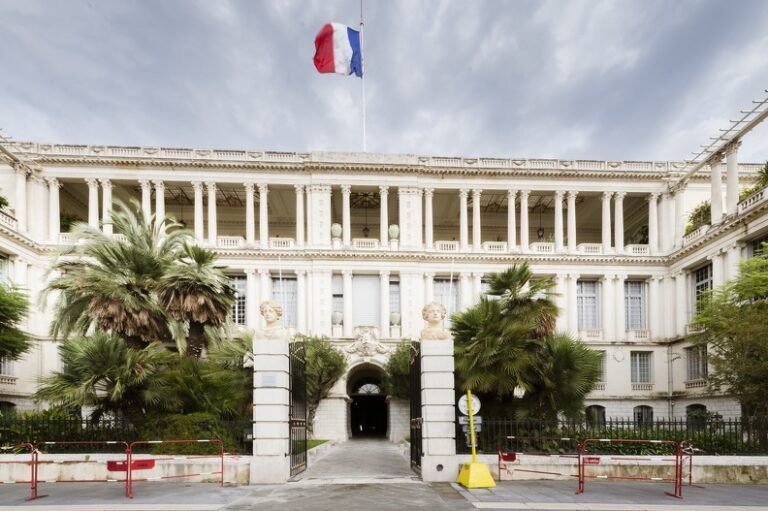
Palais Lascaris is a former aristocratic residence in Nice, France, built by the Lascaris de Vintimille family during the first half of the seventeenth century in the Genoese Baroque manner. The family, whose name uses the French form of Ventimiglia, retained ownership until 1802. The palace was altered during the eighteenth century, when its salons received additional decorative work.
By the beginning of the twentieth century, the building had fallen into disrepair. The City of Nice purchased it in 1942 with the intention of creating a museum devoted to regional arts and popular traditions. Palais Lascaris received protection as a French historic monument on 15 February 1946. Rehabilitation during the 1960s was completed in 1970, when the palace opened to the public.
Development as a musical-instrument museum
Nice’s historical musical-instrument collections were transferred from the Musée Masséna to Palais Lascaris in 2001, as part of a plan to establish a museum dedicated to musical instruments. The permanent exhibition of ancient instruments opened in 2011. The collection now contains about 500 instruments, and the City of Nice describes it as the second most important collection of its kind in France.
The collection is based chiefly on the bequest of Antoine Gautier, a lawyer and amateur violinist and violist born in Nice in 1825. At eighteen, he founded a quartet with his brother Raymond. Gautier later assembled more than 225 instruments and a musical library at his home on rue Papacino, where his musical salon attracted performers including Jacques Thibaud and Eugène Ysaÿe. Gabriel Fauré played several piano compositions there in January 1902, and the Gautier Quartet celebrated its sixtieth anniversary at the house in 1903. Gautier died there the following year at the age of seventy-nine.
His bequest was established by a will dated 26 May 1901 and a codicil dated 8 June 1901. The Nice municipal council accepted it on 19 September 1904. It comprised instruments and accessories, scores, and books, as well as 60,000 francs for musical education. The bequest required 600 francs each year to be assigned to a luthier, a craftsperson who makes, repairs, and maintains stringed instruments, responsible for caring for the instruments.
After Gautier’s bequest, the City of Nice continued to expand the holdings. The collection was successively exhibited or preserved at the Musée des Beaux-Arts, the Musée Masséna, and the Nice Conservatory before reaching Palais Lascaris. In 2009, AXA deposited the Gaveau-Érard-Pleyel collection at the palace. The Institut de France deposited the Tissier-Grandpierre collection there on 31 January 2013, adding 66 instruments, including 18 historical harps. The museum also participates in the Musical Instrument Museums Online project, whose records are available through Europeana.
Remains
Palace architecture and interiors
Facade and entrance vestibule
Embedded in Nice’s old urban fabric, the palace presents a richly ornamented principal facade in the Genoese Baroque manner. Its windows are strongly emphasized, and its balconies carry balustrades of white marble. The entrance leads into an imposing vestibule with ribbed vaults and boldly colored decoration, establishing the ceremonial character of the interior.
Staircase and ceremonial apartments
A monumental staircase rises between arcaded galleries decorated with statues and leads to the first-floor rooms used for temporary exhibitions. The second level forms the noble floor, or ceremonial residential level, with apartments whose original ceiling decoration was painted in fresco during the middle of the seventeenth century. Eighteenth-century statues and rocaille decoration, a style of asymmetrical shell-like and rock-like forms, were added to the salons. Flemish and Aubusson tapestries hang on the walls, while seventeenth- and eighteenth-century furniture occupies the rooms. The palace also contains a chapel and a chamber.
Religious furnishings
Religious paintings evoke the influence and religious vocation of the Order of Saint John of Jerusalem, a Catholic religious and military order whose members combined religious duties with the protection of pilgrims and military service. Devotional objects, especially reliquaries, come from the inheritance of the Lascaris de Vintimille family.
Historical musical instruments
Early bowed and wind instruments
The collection includes a tenor sackbut made by Anton Schnitzer in Nuremberg in 1581. A sackbut is an early trombone with a telescoping slide. Its violas d’amore include instruments by Joannes Florenus Guidanti of Bologna dated 1717, Gagliano of Naples dated 1697, Johann Schorn of Salzburg dated 1699, and Johann Ott of Füssen dated 1727. A viola d’amore is a bowed instrument with sympathetic strings. The holdings also include violas da gamba, bowed instruments held between the legs, including one made by William Turner of London in 1652, and a bass violin by Paolo Antonio Testore of Milan dated 1696.
Baroque guitars and recorders
Particularly rare Baroque guitars include instruments by Giovanni Tesler of Ancona dated 1618, René Voboam of Paris dating from about 1650, and Jean Christophle of Avignon dated 1645. The Christophle guitar is one of the earliest surviving dated French guitars. Eighteenth-century recorders include an alto recorder made by Johann Christoph Denner of Nuremberg in the early eighteenth century.
Harpsichord and harps
An anonymous eighteenth-century harpsichord, formerly a claviorganum, is among the keyboard instruments. A claviorganum combines a harpsichord with an organ. The harp holdings include Sébastien Érard’s first single-action and first double-action prototypes, as well as a harp made by Naderman in Paris in 1780 that formerly belonged to the Viscountess of Beaumont.
Later instruments and regional holdings
Other holdings include a rare group of clarinets, experimental string instruments, and several instruments made by Adolphe Sax, including a saxophone quartet and a saxotromba. French keyboard instruments from the eighteenth to the twentieth century include a Pleyel piano made in Paris in 1863, formerly owned by Nice’s Cercle Masséna. The collection also contains a playable guitar made by Antonio de Torres in Almeria in 1884, numerous instruments from southern France, about fifty nineteenth-century non-European instruments from the Gautier collection, and a Grafton saxophone from the 1950s.
Nearby sites