Château d’Auzon: A Historic Estate in Lucenay-lès-Aix, France


Site at a Glance
- Rating
- 4.4
- Popularity
- Very Low
- Country
- France
- Primary era
- Early Modern
- External website
- Open
- Eras represented
- Early Modern, Modern
- Civilizations
- French
- Site type
- Domestic
- Remains
- Castle
On this page12 sections
History
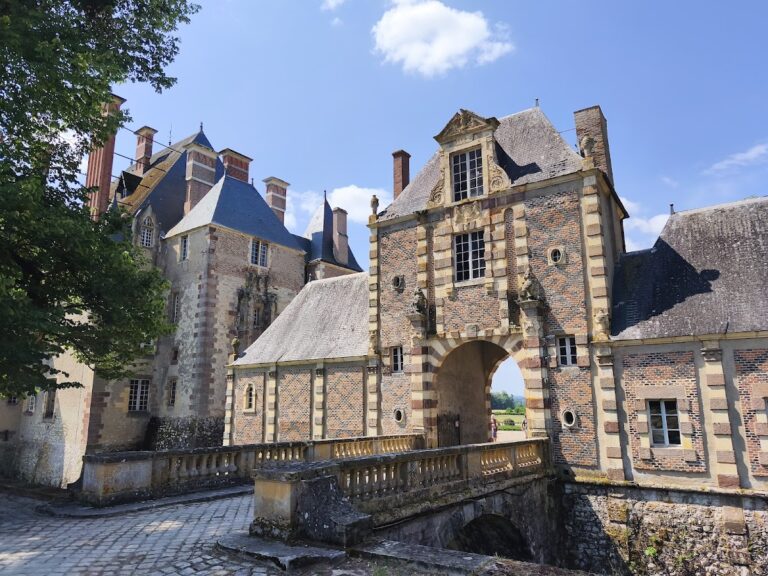
Château d’Auzon, also known as Château d’Ozon, is a historic estate in Lucenay-lès-Aix, France, beside the Auzon or Ozon River near the boundary with Allier. The fief is attested from the early fourteenth century, while the property is documented as a château and fief by 1626. Although it was called a château, Auzon never served a defensive purpose. Its long history reflects changing patterns of landed control, regional administration, estate development, and twentieth-century military occupation.
The fief and the Gentil family
Earlier domain buildings may date from the fifteenth century. The Gentil family held Auzon from at least that period. Jean Gentils was lord of Auzon around 1443, followed by Pierre Gentils, who held Auzon and Aulnay from 1444 to 1472. Guyot des Gentils held Auzon between 1477 and 1496. Louis Gentil is also recorded as lord of the estate.
Philibert, or Philippe, des Gentils held Auzon from 1556 to 1596. Antoine des Gentils, lord of Auzon and several other estates, was a knight of the king’s order and one of the king’s one hundred gentlemen in 1626. He died in 1639. Annet des Gentils retained the estate until his death in 1657, while Antoine-François des Gentils was lord of Auzon before his death before 1689. Anne-Paul-Laurent des Gentils, Count of Bessay and a cavalry commander, held the family properties from 1696 to 1713.
An act of 1680 describes the interior of Auzon and mentions a tower and a chapel. By then, the estate was an established landed property rather than a military stronghold. Its dependent domains extended across Lucenay-lès-Aix, Chézy, La Chapelle-aux-Chasses, Saint-Ennemond, and Gennetines. Louteaux, in Chézy, remained attached to the fief until 1815.
Transfers in the eighteenth century
Madeleine, Lady of Bessay and Aglan, sold Aglan and related properties in 1720. The Gentil family was ruined by the Law system, the financial scheme associated with John Law whose collapse caused severe losses for investors. Guillaume Jolliard, receiver of domains and forests at Moulins, is recorded as lord of Auzon in 1720 and 1728.
Around 1750, Pierre-Gilbert Farjonnel, a magistrate and treasurer of France at Moulins, incorporated Auzon into the large regional estate he assembled. His heir, Sébastien Alarose de la Brenne, later held the property. Alarose was arrested at Louteaux and guillotined during the French Revolution on the day of Robespierre’s fall.
François Thiériot, a tobacco entrepreneur at Moulins, acquired Auzon in 1771. Pierre-Philippe Pearron de Serennes, governor for the king of the town and château of Vierzon, bought it in 1787. During the Revolution, Pearron de Serennes was described as an émigré in 1792, a term applied to people who had left revolutionary France. Auzon and Louteaux were not confiscated, however, and remained his property until their sale to Jean-Baptiste Mollot in 1805.
Nineteenth-century ownership and alteration
Jean-Baptiste Mollot, a Savoyard resident of the Place Vendôme in Paris, acquired the estate in 1805. His widow married the chevalier François Charrier in 1807, and Charrier owned Auzon from that year. He lived there in 1838 after serving as an auditor at the Council of State and as a sub-prefect. He later became president of the General Council of Allier and mayor of Moulins from 1838 to 1840.
Changes to the central building and one tower began during the Restoration, the period of restored Bourbon monarchy between 1814 and 1830. A northern wing was added and the roofs were raised. The work was initiated under François Charrier, linking the physical development of the château with his place in regional public life.
Victor Chabot acquired Auzon through his marriage to Clémentine Emmanuelle Charrier, François Charrier’s daughter. Jules Benoit Pons de Freluc then acquired it through his marriage to Marie Chabot. Joseph, Vicomte de Durat, later held the property through his marriage to Emmanuelle Benoit Pons de Freluc.
Auzon’s territorial affiliation remained difficult to define. In 1789, Lucenay-lès-Aix appeared in both the Nevers and Moulins judicial jurisdictions. In 1838, François Charrier described Auzon as belonging to Allier even though the estate itself lay in Nièvre. It was the southernmost property in the Nièvre department, beside the river that appears in different periods as Auzon or Ozon.
War, archaeology, and protection
German troops occupied the château and estate from June 1940. A guardhouse stood at the roadside gate because Auzon supported troop relief near the demarcation line between the occupied and unoccupied zones. German forces withdrew at the beginning of September 1944, and the French Forces of the Interior, or FFI, liberated Auzon that month after four years of occupation. The passage of the FFI is associated with photographs, officers’ signatures in the visitors’ book, and an order of mission referring to the “château d’Ozon.” Francs-Tireurs et Partisans, or FTP, forces later engaged the FFI stationed at Auzon. Colonel Sardier stayed at Auzon after 1945, before his rehabilitation.
Pieces dating from the reign of Charles VII, king of France from 1422 to 1461 during the later stages of the Hundred Years’ War, were discovered at Auzon in 2018. In 2024, the built estate and park were entered on the register of historic monuments. The protected ensemble includes the château and commons, their façades and roofs, the park designed by Choulot, its western perspective, the portals, and the park’s ornamental structures.
Remains
The surviving estate combines a stone-and-brick château, slate-roofed service buildings, and a park of approximately 30 hectares extending across Nièvre and Allier. Painted render covers the brickwork, while some parts display Bourbonnais cross patterns made with polychrome brick, a treatment also associated with Bourbonnais Sologne. The Auzon or Ozon River crosses the park and forms the basis of its principal water feature.
The château and estate buildings
Château building
The château consists of a central building flanked by two taller wings. Its composition is asymmetrical because of a terrace on the southern wing. The buildings are constructed of stone and brick, with painted render over parts of the brickwork. The central building and one tower were modified during the Restoration, when the northern wing was added and the roofs were raised. A tower and a chapel were already present in the interior arrangement described in 1680. The château is roofed with slate, and its façades and roofs form part of the protected historic-monument ensemble.
Commons and working facilities
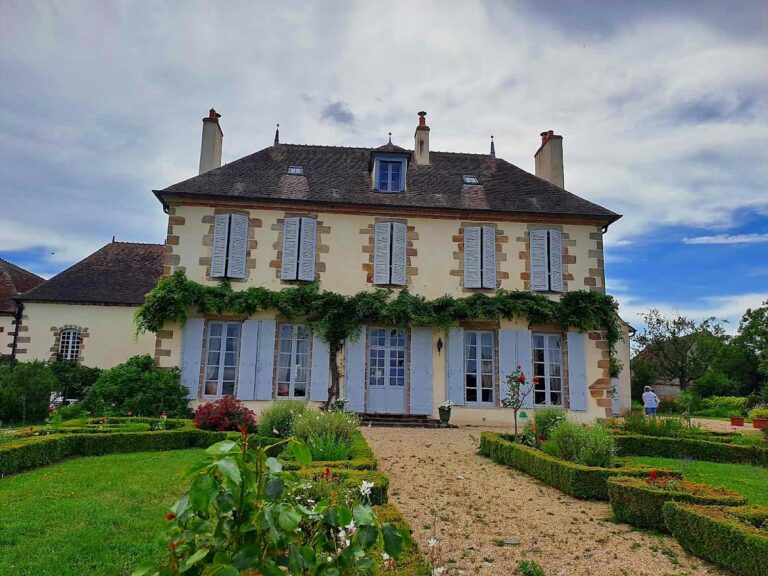
The commons were completely rebuilt around 1870 to enable the château and its reserve to operate with economic self-sufficiency. The complex included a dairy, a forge, and an icehouse. At the beginning of the twentieth century, the estate also had a mill and a tile works. The commons retain their place within the protected ensemble, including their façades and slate roofs.
The Choulot park
Lake, island, and park structure
Paul de Lavenne de Choulot laid out the park in 1849 for Madame Chabot, using an older park or garden as its basis. The earlier arrangement included ponds that were later filled in. Choulot, a nineteenth-century French landscape designer known for large ornamental and agricultural parks, introduced a lake, an island, and an alpine garden on bare ground. Avenues and fabriques, purpose-built ornamental structures within a designed landscape, form part of the composition, which also retains areas used for grazing animals and certain crops.
The park is crossed by the Auzon or Ozon River. An artificial lake was created there in the middle of the nineteenth century, and the park has retained an area of approximately 30 hectares. Two fabriques remain visible. The park plan is preserved at Auzon, while Choulot’s working drawings are held by the Association des parcs Choulot.
Trees and ecological features
The park contains varied and rare tree species whose origins are associated with nineteenth-century plant exchanges and journeys by nurserymen, including the Treyve family. Other exchanges took place with the nearby Balaine arboretum in Allier, a botanical garden and tree collection. Choulot’s precise choice of trees cannot be established with certainty, but he deliberately arranged groups of conifers to create lines of perspective. Yew plantings also survive.
Agreements with the architectural, urban-planning, and environmental councils of Allier and Burgundy support the protection of European pond turtles. Studies have also examined bat populations, and Auzon is classified as a bat refuge. The names Auzon and Ozon occur in different periods and documents for both the estate and the river. The property is said to have given its name to the river because the estate’s name was longer, while the hydronym is associated with the Latin word Alnus, meaning alder.