Castle Blitterswijck: A Fourteenth-Century Castle in the Netherlands


Site at a Glance
- Rating
- 4.5
- Popularity
- Very Low
- Country
- Netherlands
- Primary era
- Medieval
- External website
- Open
- Eras represented
- Medieval, Early Modern, Modern
- Civilizations
- Holy Roman Empire
- Site type
- Military
- Remains
- Castle
On this page7 sections
History
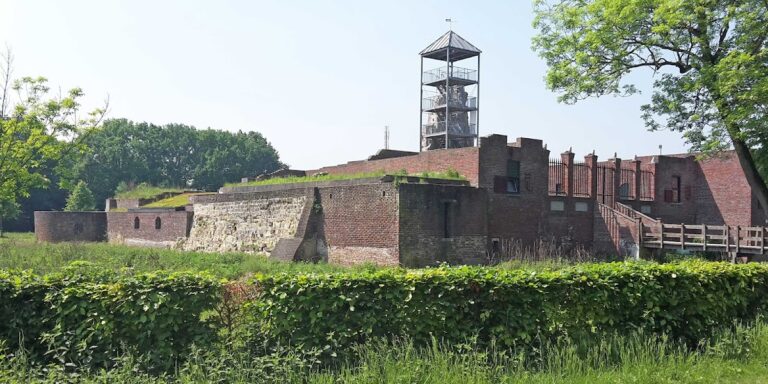
Castle Blitterswijck is a fourteenth-century castle in the Netherlands, near Blitterswijck in the present municipality of Venray. Its surviving visible walls date from the fourteenth century, while archaeological investigation later revealed foundations belonging to an older structure.
The Lords of Blitterswijck
The Lords of Blitterswijck first appear in the historical record in 1242, when Willem van Blitterswijck sold several properties to Kamp Abbey, a Cistercian monastery at Kamp, now Kamp-Lintfort in Germany. Wouter van Blitterswijck was recorded in 1316, Robbert van Blitterswijck in 1330, and Sybrecht van Blitterswijck in 1359. Sybrecht was married to Elisabeth van Broeckhuysen.
The castle itself is first mentioned in 1374. After Sybrecht’s death around 1406, Arnt van Blitterswijck became lord. Arnt died in 1449 and was succeeded by Johan van Blitterswijck. By 1502, Dirk van Blitterswijck held the lordship.
Transfer to the Van Lynden family
Dirk van Blitterswijck married Jutta van Appeltern, but they had no children. After Dirk’s death around 1515, his sister Walburga inherited the lordship. Her marriage to Dirk van Lynden, who was also lord of Hemmen, transferred the property to the Van Lynden family.
The Van Lyndens retained ownership into the eighteenth century, apart from the years 1683 to 1692. During that interval, the lordship was sold and later bought back. A seigneurial lordship was a territorial estate whose lord held defined judicial, administrative, and economic rights.
War, religion, and changing ownership
Around 1585, soldiers aligned with Spain occupied and seized Blitterswijck Castle and the nearby castle of Geysteren. The Van Lynden family’s Protestant faith placed them at a disadvantage in Upper Guelders, the southern part of the historical Duchy of Guelders, which then belonged to the Spanish-ruled Southern Netherlands.
Johanna Elisabeth van Lynden married Johan van Ossenbroich, who obtained the usufruct of the lordship in 1603. A usufruct was the legal right to use property and receive its benefits while another person retained ownership. Johan died in 1615 and was buried at Kalkum.
By 1670, the castle had fallen into disrepair, but Frans van Lynden made it habitable again. Diederik Wolter van Lynden was lord in 1700, and Frans Godart van Lynden succeeded to the lordship in 1749.
The final aristocratic residents
In 1788, the seigneurial rights passed by inheritance to Barthold, Baron de Cocq van Haeften, Frans Godart’s grandson. Barthold, first widowed from Carolina Justina Huydecooper, later married Arnoldina Margaretha Mackay. They had five daughters.
The castle was embellished in 1789 and altered in 1806. Arnoldina Margaretha Mackay also ensured the construction of a Protestant church at Blitterswijck in 1822. Barthold died that year, and Arnoldina died in 1849.
Their daughter Margaretha Bartholda, Baroness de Cocq van Haeften, inherited the castle but died in 1850. Following complex divisions of the inheritance, the property passed in 1857 to Frederik Willern, Baron von Hamelberg. He died childless in 1884, ending the succession of aristocratic residents at the castle.
Later owners and destruction
In 1885, the castle was sold to Anna Ephenia Schinasen, the wife of Oscar Thissen, a lawyer and procurator. Joseph Servatius Hubertus Brouwers, a notary in Venlo, acquired it in 1899.
French nuns purchased the property in 1904. In 1920, it passed to the Fathers of the African Missions of Saint Paul, members of a Roman Catholic missionary institution. They sold it in 1935 to Alfons Cremers, who intended to acquire it for his daughters.
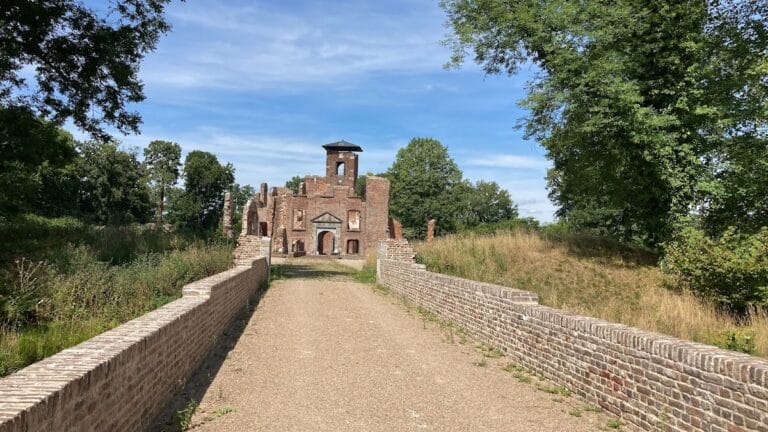
In November 1944, retreating German soldiers blew up the castle. The structure survived thereafter only as a ruin. The municipality of Meerlo-Wanssum purchased the ruin in 1964, and archaeological investigation followed in 1969. That work distinguished the fourteenth-century castle walls from foundations belonging to an older structure.
Remains
The surviving remains are the ruinous physical evidence of a fourteenth-century castle. The visible walls belong to the fourteenth-century structure, while foundations beneath or associated with the ruins point to an earlier building phase. The explosion of November 1944 left the site in ruined form, and the 1969 archaeological investigation established the relationship between the surviving walls and the older foundations.