Château de Coiselet: A Fourteenth-Century Fortified House in France


Site at a Glance
- Rating
- 4.7
- Popularity
- Very Low
- Country
- France
- Primary era
- Medieval
- Eras represented
- Medieval
- Civilizations
- Duchy of Savoy
- Site type
- Military
- Remains
- Castle
On this page5 sections
History
Château de Coiselet is a fourteenth-century fortified house in Matafelon-Granges, France. Built as a seigneurial residence, it became the historical center of the lordship of Coiselet, a territorial domain where a lord exercised ownership, authority, and judicial rights.
The Aleman lordship
On 28 November 1370, Guillaume and Jean Aleman, sons of the knight Pierre Aleman, acknowledged themselves as liegemen of the lord of Thoire-Villars for the land of Coiselet. A liegeman owed a particularly binding form of fealty to a superior lord. The property remained with the Aleman family until Philiberte Aleman, lady of Arbent, Mornay, and Coiselet, became the last member of the family to bear the Aleman name.
Philiberte transferred the lordship, along with her other lands, to Jacques de Chalant, a knight who held Coiselet briefly. After her husband’s death, she sold Coiselet under a contract dated 25 May 1517 to the brothers Barthélemy and Philippes de Forcrand, squires and lords of Arromas.
Transfer to the Forcrand family
The 1517 sale described Coiselet as a fortified house with high, middle, and low jurisdiction, meaning several levels of judicial authority. It was held as a free allodial possession, land owned independently rather than as a feudal fief or subordinate holding.
Part of the sale price repaid Amand Goyet, lord of Monthoux, councillor and household steward to the Count of Geneva. Philiberte had previously pledged the lordship to him. Claude de Chalant, lord of Arbent and Mornay and Philiberte’s son and heir, ratified the sale on 9 November 1518.
After the jointly held property was divided between the brothers, the lordship of Coiselet went to Philippes de Forcrand. It then passed to his descendants, who continued to bear the Forcrand name and arms. In the mid-seventeenth century, the brothers Claude and Antoine de Forcrand were its lords.
Château de Coiselet received partial protection as a French historic monument through an order dated 4 November 1983. This protection applies to the façades and roofs.
Remains
The fortified house and riverside setting
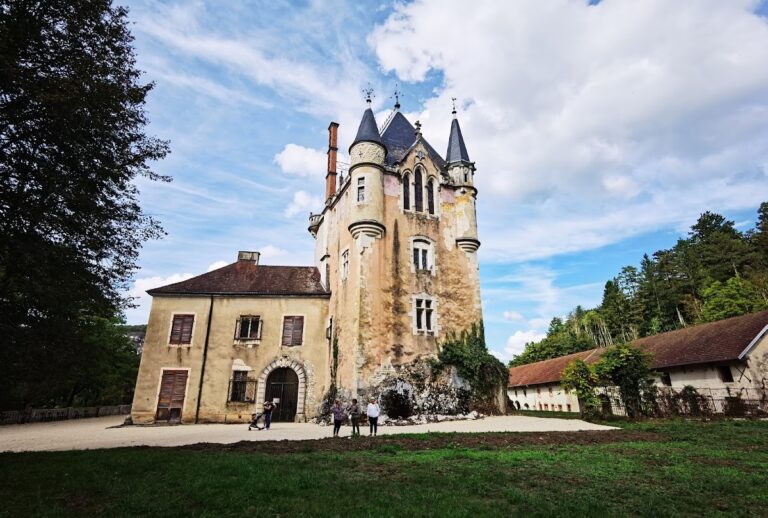
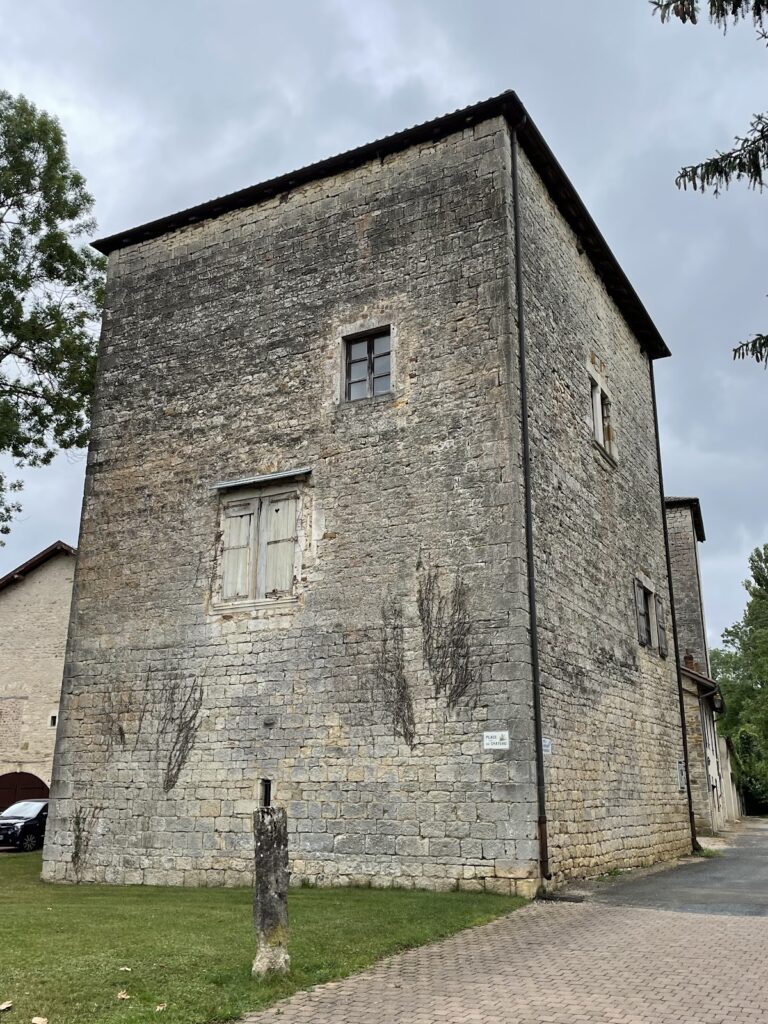
Château de Coiselet is a medieval fortified house dating from the fourteenth century. A fortified house was a seigneurial residence equipped with defensive features, generally smaller and less heavily fortified than a major castle. The building stands on the bank of the Ain River, which formerly marked the boundary of the County of Burgundy.
The surviving protected exterior consists of the château’s façades and roofs. These elements represent the partial historic-monument protection granted to the medieval residence.