Château de Grugnac: A Fifteenth-Century Fortified Manor in France

Site at a Glance
- Rating
- 5
- Popularity
- Very Low
- Country
- France
- Primary era
- Medieval
- Eras represented
- Medieval
- Civilizations
- Unclassified
- Site type
- Military
- Remains
- Castle
On this page7 sections
History
Medieval origins and the fifteenth-century fortress
Château de Grugnac is a fifteenth-century fortified building in France, in the hamlet of Grugnac within the commune of Sousceyrac-en-Quercy. The fortress was built by the Viscounts of Turenne, hereditary rulers of the Viscounty of Turenne, a major feudal lordship, to oversee the falconry of the Duke of Luynes. Jacques de Verdale, a later lord of the château, associated the site with a small chapel that stood there in the twelfth century.
The fief of Grugnac, a landed estate held through a feudal relationship, belonged to Bertrand de Narbonnès in 1334. In that year, he rendered homage, the formal acknowledgment of dependence on a superior lord, to the Viscount of Turenne. Eustache de Narbonnès, lord of Puylaunès, made another feudal acknowledgment in 1441 to a tenant liable for a cens, a recurring payment owed under the feudal system. The Narbonnès family held full judicial rights over the fief.
Changes of ownership
Jean de Narbonnès, lord of Puylaunès, sold the fief and its judicial rights in 1593 to Pierre Massip, also known as Pierre Macip, a notary in Sousceyrac. The price was 800 livres. In 1597, Massip rendered homage to the Viscount of Turenne for the noble fief of the village of Grugnac and all its jurisdictions.
The first surviving reference to a noble house at Grugnac dates from 1643. Amalric de Massip, lord of Grugnac and La Boisse, then rendered homage to the Viscount of Turenne. Joseph de Massip later leased the estate to the Scribe family of Sousceyrac. In 1659, François Lauricesque, Amalric de Massip’s heir, sold the fief and château to Durand Scribe, a bourgeois of Sousceyrac who lived from about 1615 to about 1672. Durand was the son of Pierre Scribe and had married Marguerite de Massip, a relative of the former lords.
Jean Louis Scribe, lord of Grugnac and Combal, lived in the château in 1671. In 1790, inheritance transferred the property to Louis de Verdal de Lestang, also called Louis de Verdal de Grugnac, who lived from 1715 to 1812. He had been a captain in the Penthièvre Infantry Regiment, which emigrated during the Revolution before returning to France.
Revolutionary damage and protection
The château was looted during the French Revolution, amid the rural revolt and hostility toward aristocratic residences that followed 1789. Château de Grugnac was listed as a historic monument on 30 May 1989.
Remains
Fortified exterior
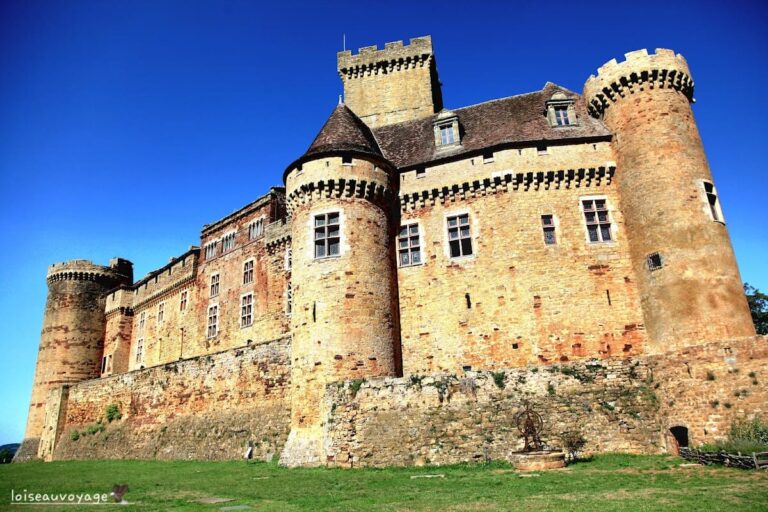
Château de Grugnac is a rectangular fortified building covered by a roof made of stone slabs. Three round towers project from the structure, with two on the north side and a third on the main façade. A defended wall-walk, a passage along the top of a fortified wall, runs with machicolations, which are projecting openings used to observe or attack enemies below. A monumental staircase forms the entrance approach.
Interior arrangement
The floors are linked by a spiral staircase in the south tower. Each floor contains a single room. The lowest level includes a kitchen and dining room, while the first floor contains a large salon. Bedrooms occupy the towers and the building attached to the north side.
Nearby sites