Fredriksholm Fortress: A Danish-Norwegian Harbor Defense in Norway


Site at a Glance
- Rating
- 4.5
- Popularity
- Very Low
- Country
- Norway
- Primary era
- Early Modern
- Eras represented
- Early Modern
- Civilizations
- Denmark–Norway
- Site type
- Military
- Remains
- Fort
On this page9 sections
History
Fredriksholm Fortress is a seventeenth-century Danish-Norwegian fortress in Norway, built on an islet off Kristiansand to protect Flekkerøy harbor and the western maritime approach to the city. Construction began in the mid-seventeenth century and was completed in 1662. The fortress formed part of the defenses of Kristiansand and was named for Frederick III, king of Denmark.
Foundation and Danish-Norwegian rule
Fredriksholm replaced Christiansø Fortress on Gammeløya, about 1 kilometer away. When Christiansø was abandoned on 1 May 1658, its stone, building materials, and other useful materials were moved to the new fortress. Its construction followed the advice of Jørgen Bjelke, a Danish-Norwegian nobleman and military officer associated with its planning.
Denmark-Norway controlled Fredriksholm from its completion in 1662 until 1814. It then came under the Swedish-Norwegian Union, which retained it until 1874. The fortress was abandoned in 1804, after Kristiansand’s newer military facilities, including Christiansholm Fortress and Lagmannsholmen, had assumed greater importance in the defense of the city and harbor.
Destruction and later use
During the English Wars, a period of conflict involving Britain and Denmark-Norway, three Royal Navy ships commanded by Captain Robert Stopford approached Kristiansand after the Battle of Copenhagen. Christiansholm Fortress fired heavily on them, so the British turned against the disused Fredriksholm. They blew up the fortress on 18 September 1807, and four British servicemen died while checking the fuses of powder barrels.
Fredriksholm was partly repaired and rebuilt in 1808, but it was finally taken out of service in 1874. A separate defense battery was built on the mainland at Batteriodden in 1808 and 1809 to cover the landward side facing the island. It had 96 infantrymen and 48 artillerymen and was abandoned around 1850.
In 1910, the island was temporarily connected with Roald Amundsen’s South Pole expedition. Ninety-eight Greenland dogs arrived from Greenland aboard the steamer Hans Egede on 4 July. They stayed for just over a month while the state veterinarian Christopher Juell carried out health checks, then were taken aboard Fram on 9 August. Amundsen, a Norwegian polar explorer, led the expedition that reached the South Pole in 1911.
Remains
Fortress layout and defenses
Lower and upper sections
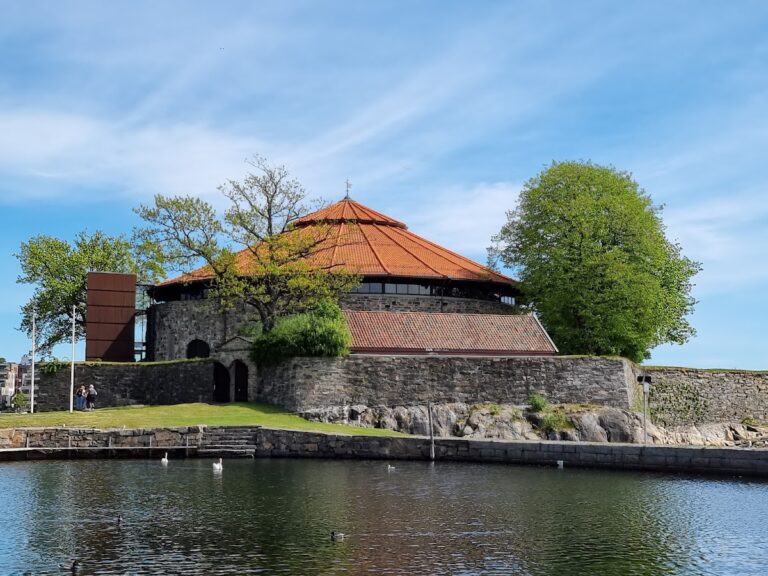
The fortress occupied an islet roughly 1 kilometer north of the former Christiansø Fortress on Gammeløya. Its defenses were arranged in a lower and an upper section. The lower section followed the shoreline with a defensive wall, while the upper section held a tower with a cupola, a domed structure over the tower, and two artillery batteries.
Tower and internal buildings
The tower served as the commander’s residence and contained the royal chambers. Other houses, both large and small, stood within the fortified area. A gallery, an internal passage or covered defensive walkway, ran inside the walls and formed part of the fortress’s defensive circulation.
Walls and armament
Stone formed the main structure of the fortress walls. Their outer faces were covered with turf and protected by a palisade, a defensive fence made of upright stakes or logs. Peat was taken in such quantities from a cemetery wall that coffins were nearly exposed.
When the fortress was completed, the lower section carried 14 cannons and the upper section carried 10 guns. Its original armament comprised 24 guns ranging from 2-pounder to 34-pounder pieces. By 1700, the number had risen to 50 cannons.
Garrison and surviving condition
The fortress was planned to house as many as 300 men, although its garrison changed with the season and the level of military danger. It reached up to 110 men in summer and about 30 in winter, while a garrison of 24 men is recorded for 1658.
Today Fredriksholm survives as ruins shaped by the British destruction of 1807, the partial rebuilding of 1808, and its final closure in 1874.
Nearby sites