Castle of Odemira: A Former River Fortification in Portugal


Site at a Glance
- Rating
- 3.8
- Popularity
- Very Low
- Country
- Portugal
- Primary era
- Medieval
- Eras represented
- Medieval
- Civilizations
- Portuguese
- Site type
- Military
- Remains
- Castle
On this page8 sections
History
The Castle of Odemira is a former military monument in Portugal, with its earliest references dating from the thirteenth and fourteenth centuries. It stands beside the Mira River at the point where the waterway ceased to be navigable, controlling an important route between the coast and the interior.
Early Occupation
The site may have begun as a fortified settlement during the Bronze Age and remained occupied through the Iron Age, when a defensive ditch was constructed. The settlement was probably abandoned in the first century during the Roman period. Another phase belongs to the Muslim period, when the settlement may have included a fortress. The early sequence remains uncertain, and the site has also been interpreted as a Roman oppidum, a fortified settlement or town, later occupied by Visigoths and Muslims.
Christian Rule and Medieval Fortification
Christian forces under Afonso Henriques, the first king of Portugal, captured Odemira from Muslim control in 1166 during the Christian Reconquista, the expansion of Christian-ruled territories in the Iberian Peninsula. The earliest written references to the castle belong to the period that followed the Christian reconquest.
Under Afonso III, Odemira received a charter in 1256. A charter was a formal grant defining a town’s rights, administration, and obligations. The town’s defenses were rebuilt in 1265. During the reign of Dinis, the town and castle domains were granted to the bishop of Porto in 1319, and a new town wall was built during this period.
During the reign of Dinis, or that of his successor Afonso IV, Odemira and its territory were granted to Manuel Pessanha, a Genoese naval commander appointed admiral of Portugal, and to his descendants. Odemira became a county during the reign of Duarte, placing it under the authority of a count. Sancho de Noronha, husband of Mécia de Sousa, became its first count. The county remained in the family until the reign of João IV, when its domains passed to Francisco de Faro and Noronha. Pedro II later granted them to the first Duke of Cadaval, a duke holding a higher-ranking noble title.
Decline and Modern Change
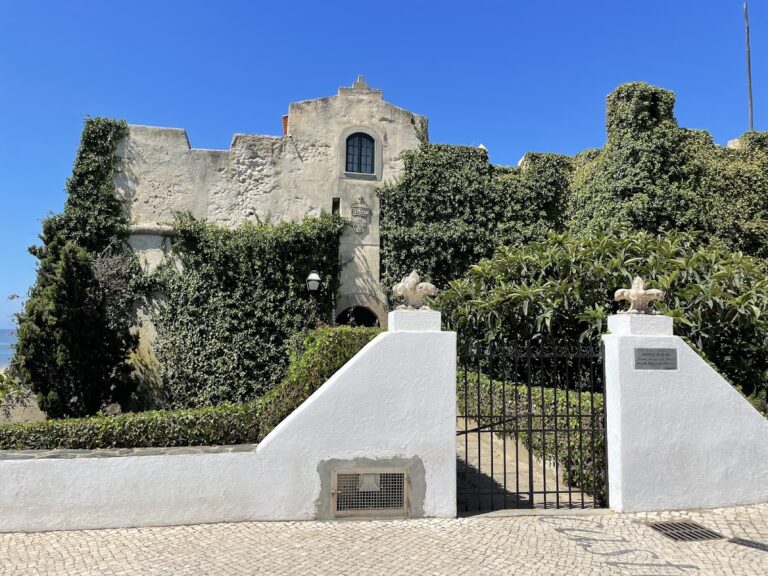
Manuel I issued a new charter for Odemira in 1510. From the fifteenth century, however, the castle began to decline and subsequently almost disappeared. In 1999, Odemira Municipal Library was built within the castle ruins. The surviving castle and wall fragments are undergoing classification by Portuguese public authorities.
Remains
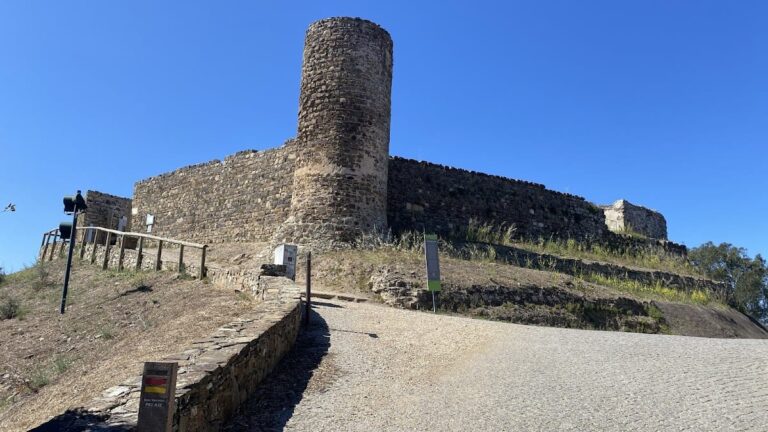
The principal remains lie beside the Cerro do Peguinho garden on the right bank of the Mira River and extend southward down the slope. The site occupies the town’s highest point, a promontory overlooking the Mira valley. Its surviving enclosure forms a broad plateau defined by fragments of the former wall, with a wedge-shaped plan and an approximately oval outline.
Enclosure and Wall Fragments
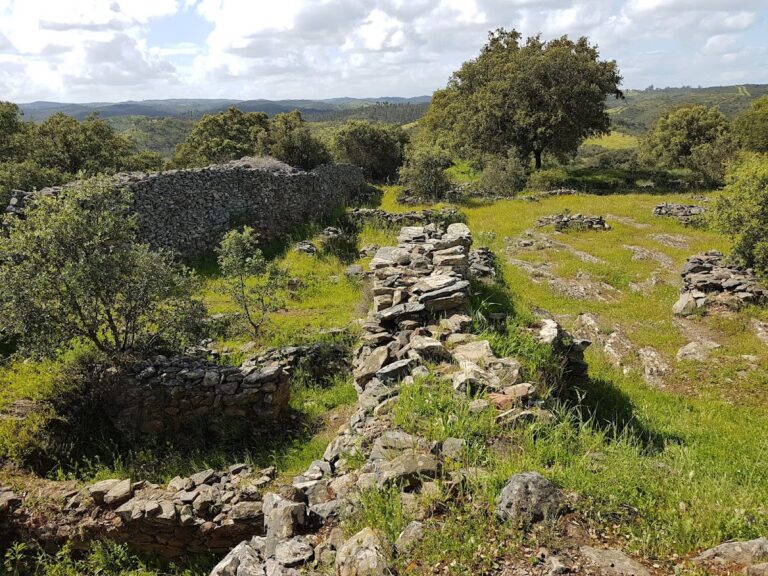
Fragments of the former enclosure wall outline the plateau and preserve part of the castle’s defensive boundary. A second circuit of walls may once have protected the settlement, while later changes to the urban fabric prevent the medieval boundaries from being identified. Some wall remains were incorporated into later buildings and used as structural foundations, including the bell tower of the Municipal Council.
Square Tower Base
A reconstructed section of the fortification is associated with the base of a square-plan tower. It forms part of the surviving evidence for the defensive structures that once occupied the elevated enclosure.
Municipal Library
The Municipal Library occupies part of the former castle enclosure and was constructed within the ruins in 1999. Its position reflects the later reuse of the castle remains within the town’s built fabric.
Nearby sites