Castelo de Nisa: A Medieval Fortress in Portugal


Site at a Glance
- Rating
- 3.9
- Popularity
- Very Low
- Country
- Portugal
- Primary era
- Medieval
- Eras represented
- Medieval, Early Modern
- Civilizations
- Crusader, Knights Templar, Portuguese
- Site type
- Military
- Remains
- Castle
On this page9 sections
History
Castelo de Nisa is a medieval castle in Portugal, built for the settlement of Nisa from 1290 and completed in 1296 during the late medieval period. Its construction followed the destruction of the earlier settlement of Nisa-a-Velha and formed part of the establishment of Nisa on a nearby site.
Nisa-a-Velha and the Founding of Nisa
Nisa-a-Velha stood northeast of the present settlement, on the elevation now occupied by the Chapel of Nossa Senhora da Graça. Human occupation there extended back to pre-Roman peoples, and the site possessed an older castle probably dating from the Christian Reconquista, the medieval process by which Christian rulers established control over territory in the Iberian Peninsula.
Nisa had received a charter, a grant of local rights and customary laws, before 1232. In that year, Sancho II referred to the settlement’s existing customs. During the succession crisis that followed the reign of Afonso III, Afonso strengthened his holdings at Castelo de Vide in 1280 and sought support from Nisa-a-Velha. Its inhabitants declared loyalty to Dinis, who was king of Portugal from 1279 to 1325. Afonso’s forces then raided, burned, and sacked the settlement, destroyed its castle, and killed many inhabitants.
After the crisis ended, Dinis ordered the settlement to be rebuilt on a nearby site. Its name and municipal status were transferred there, creating the settlement subsequently known simply as Nisa. Construction of the new settlement and its castle began in 1290 under Lourenço Martins, master of the Knights Templar in Portugal. The Knights Templar were a medieval military-religious order, and the works were completed in 1296.
Military Orders and Municipal Development
When the Knights Templar were suppressed, their possessions, including Nisa, passed to the Order of Christ in 1319. The Order of Christ was the Portuguese institution that inherited many Templar domains.
Afonso IV later ordered new walls around Nisa and Castelo Branco. Their construction was financed through taxes on grain, wine, and meat, as well as remaining funds from hospitals and leper hospitals and unclaimed property left by wills. The total amount allocated was stated as 600 pounds.
During the crisis of 1383–1385, a struggle over the Portuguese succession, Nisa and its castle were among the first places to support the Master of Avis, the future João I. The settlement was consequently granted the title “Notable.” Philip II of Portugal later confirmed the title during the Philippine dynasty, the period of Habsburg rule in Portugal.
From the Sixteenth Century to National Monument
Under Manuel I, king from 1495 to 1521, the defensive complex was described in a 1505 record concerning the Nisa commandery and in Duarte de Armas’s Book of Fortresses, produced around 1509. A commandery was an administrative and revenue-holding unit of a military order. Manuel I approved a new charter for Nisa in 1512, when the settlement was administered by a municipal council.
Spanish troops occupied Nisa for several days in June 1704 during the War of the Spanish Succession, the European conflict over the Spanish crown, and damaged its defenses. Later urban development contributed to their deterioration. A survey from 1827 already described the fortifications as ruined, and by the middle of the nineteenth century the castle and settlement defenses had fallen into neglect. The castle ruins were declared a National Monument by decree published on 4 July 1922.
Remains
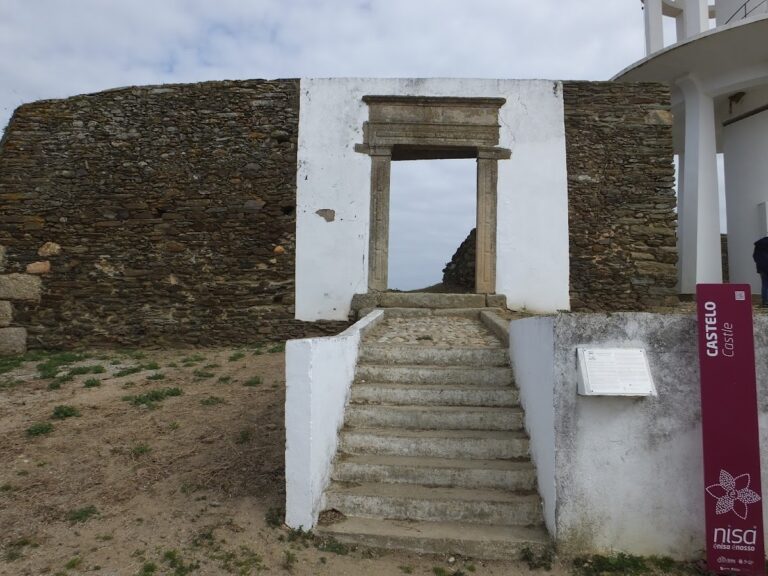
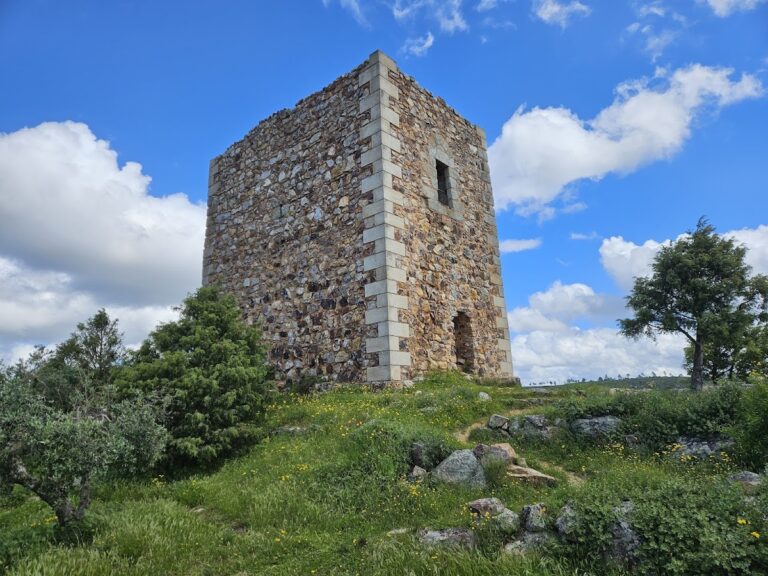
The surviving defensive complex consists of remnants of an extensive granite enclosure reinforced by towers. The sixteenth-century complex was dominated by a keep, the principal strong tower of a medieval castle, and also included a barbican, an advanced fortified enclosure protecting an entrance. The remaining defenses are in good condition and preserve parts of the castle’s fortified arrangement.
Enclosure and Towers
Sections of the former granite walls survive with their associated towers. Together they represent the defensive enclosure that surrounded Nisa and formed the principal physical framework of the castle complex.
Historic Gates
Porta da Vila
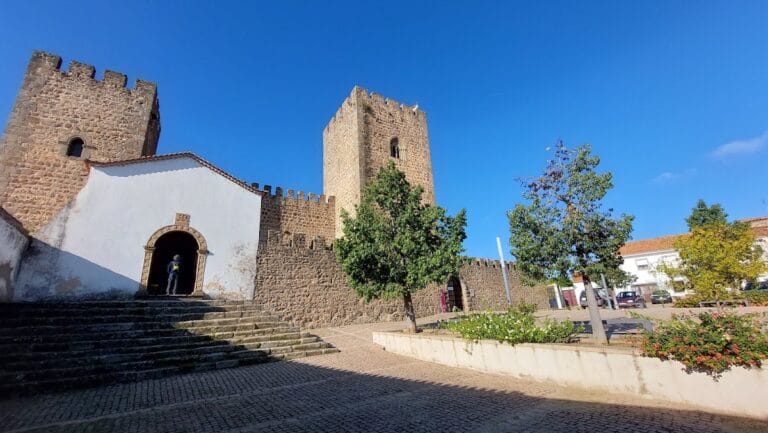
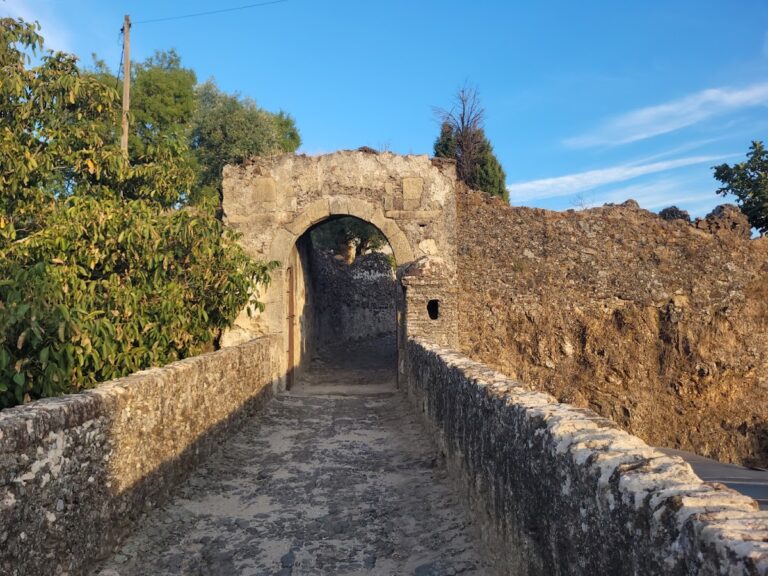
Porta da Vila has a semicircular arch and is flanked by two crenellated towers. Its surviving masonry forms one of the principal entrances preserved within the former defensive enclosure.
Porta de Montalvão
Porta de Montalvão has a pointed arch and stands beside another tower. It is one of the two original gates that remain from the historic fortifications.
Nearby sites