Mauensee Château: An Island Château in Switzerland


Site at a Glance
- Rating
- 3.4
- Popularity
- Very Low
- Country
- Switzerland
- Primary era
- Early Modern
- Eras represented
- Early Modern
- Civilizations
- Swiss
- Site type
- Domestic
- Remains
- Castle
On this page5 sections
History
Medieval Castle and Lordship
Mauensee Château is a historic château on an island in Lake Mauensee, Switzerland. The site was first mentioned in 1184 in a register belonging to Engelberg Abbey. By 1275, the château and the lordship of Mauensee had been divided equally between the Counts of Habsburg, a major European ruling dynasty with territories in the Swiss region, and the barons of Grünenberg.
The medieval castle on the island was destroyed in 1388 after the Sempach War, a late-fourteenth-century conflict between the Swiss Confederates and the Habsburgs that followed the Confederates’ victory in 1386. The lake and island later came into the possession of Lucerne in 1455. In 1457, Mauensee passed to the Sursee family of Schultheissen. A Schultheiss was a senior municipal official who presided over a town or administrative jurisdiction. The property subsequently passed to the Lucerne council family Pfyffer von Altishofen.
The Château of 1605
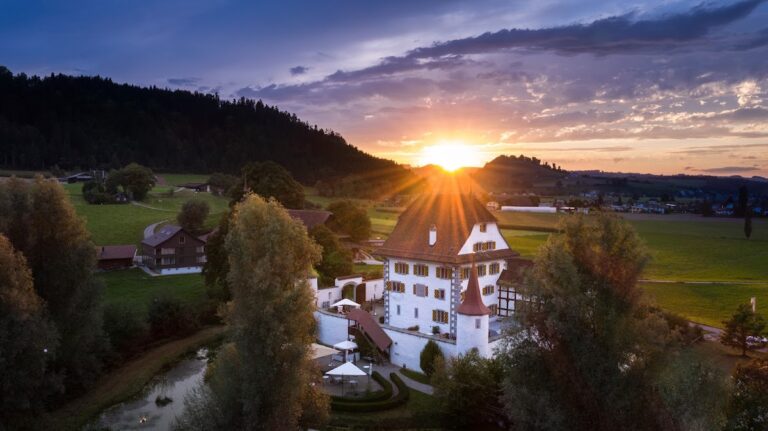
The present château was erected in 1605 by Schultheiss Michael Schnyder. The ownership chronology identifies Kaspar Pfyffer, a member of the Pfyffer von Altishofen family, as the person who commissioned the construction through his son-in-law Schnyder. The new building therefore replaced the medieval castle as the principal residence associated with the lordship.
Ownership changed repeatedly during the following centuries. In 1657, Mauensee belonged to the Lucerne patrician family Cloos. Lucerne patrician families were elite urban households with substantial political and administrative influence in the city and its territories, and the Cloos family became the most important holder of the lordship during the seventeenth century. In 1721, the family sold the lordship to Count Rudolf Riva. The property briefly returned to the Pfyffer von Altishofen family in 1807.
Nineteenth- and Twentieth-Century Changes
In 1811, the Zofingen family Eggstein acquired Mauensee and ordered the demolition of the chapel, the corner towers, and the enclosing wall. These changes altered the physical character of the island complex while leaving the 1605 château as its central surviving building.
Jost Bernhard Segesser von Brunegg purchased Mauensee from Rosine Eggstein, née Hunkeler, in 1846. In 1875, the property passed from the Segesser von Brunegg family to Auguste de Pourtalès, a painter from Neuchâtel. Karl von Schumacher acquired the château in 1942. He belonged to the Lucerne patrician Schumacher family and founded the weekly newspaper Die Weltwoche. After Karl’s death, his brother Pierre von Schumacher lived at Mauensee, followed later by Pierre’s widow, who retained the property in 1964.
In 1995, the château was inherited by the sisters Denyse von Streng-de Wolff and Alix Schnyder von Wartensee-de Wolff. The industrial family Sigg purchased and renovated it in 1998, and the château and island have remained in the Sigg family’s possession since then. Mauensee Château is listed among the culturally significant sites of Mauensee as a regionally important monument.
Remains
Mauensee Château stands on a small island in Lake Mauensee within the municipality of Mauensee in the canton of Lucerne. A narrow bridge links the island and the château with the lakeshore, defining the surviving approach to the site. The present building is the château erected in 1605, while the chapel, corner towers, and enclosing wall were demolished in 1811.
The surviving château represents the principal architectural remains of the island complex. Its position within the lake preserves the relationship between the building, the island, and the surrounding water, while the bridge provides the physical connection to the shore. The property can be viewed from the lakeshore, but the château is not open for visits.
Nearby sites