Torre Benzalá: A Medieval Rural Castle in Jaén, Spain


Site at a Glance
- Rating
- 3.9
- Popularity
- Very Low
- Country
- Spain
- Primary era
- Medieval
- Eras represented
- Medieval
- Civilizations
- Crown of Castile
- Site type
- Military
- Remains
- Castle
On this page8 sections
History
Torre Benzalá is a rural medieval castle in Spain, near Torredonjimeno in Jaén, dating from the period immediately after the Castilian conquest and the Pact of Jaén. That thirteenth-century agreement established a political and frontier relationship between the Crown of Castile and the Nasrid kingdom of Granada. The settlement remained inhabited in 1347, showing that the site continued to function after its foundation.
Medieval settlement
The castle formed part of a settlement whose later history included agricultural occupation. In the seventeenth century, Martín de Jimena Jurado, a Spanish historian and antiquarian, described Torre Benzalá as a depopulated settlement containing several farmsteads and a castle. His account also preserved a description of the castle’s triangular plan, with a tower at each vertex and a central keep. One of those outer towers may be the square tower that survives today.
Modern recognition and investigation
Torre Benzalá received a general protection order in 1949 and was declared of public utility in 1972. Under Spain’s 1985 heritage legislation, it became a Site of Cultural Interest, a legal designation for places with historical, archaeological, architectural, or cultural value. It is recorded as a monument under a declaration dated 22 June 1993.
In 2021, a photogrammetric survey using a remotely piloted aircraft was carried out at the site. Photogrammetry creates measurements and three-dimensional information from photographs, while the aircraft recorded the remains from above. The survey confirmed the authenticity of Martín de Jimena Jurado’s description and added new information about the castle. Torre Benzalá lies near the ruins of the Roman city of Bastora, within an archaeological landscape containing material from the Copper-Bronze Age, Iberian, Roman, and medieval periods.
Remains
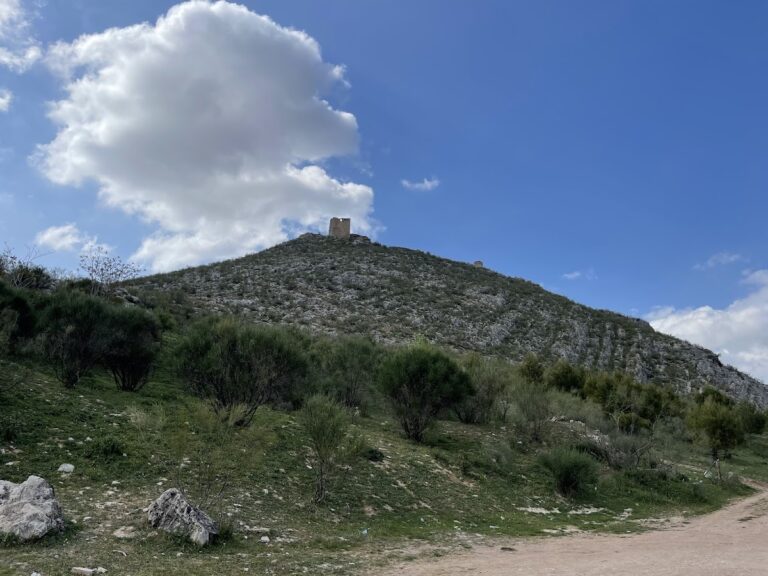
The remains occupy the summit of Ben-Zala hill at 544 metres above sea level, amid olive groves in the Aldea Las Casas area. The site lies north of Cortijo del Marqués, 430 metres away. Its surviving elements suggest a larger fortified complex than the standing structure alone indicates, although the overall condition is highly deteriorated.
Fortified structures
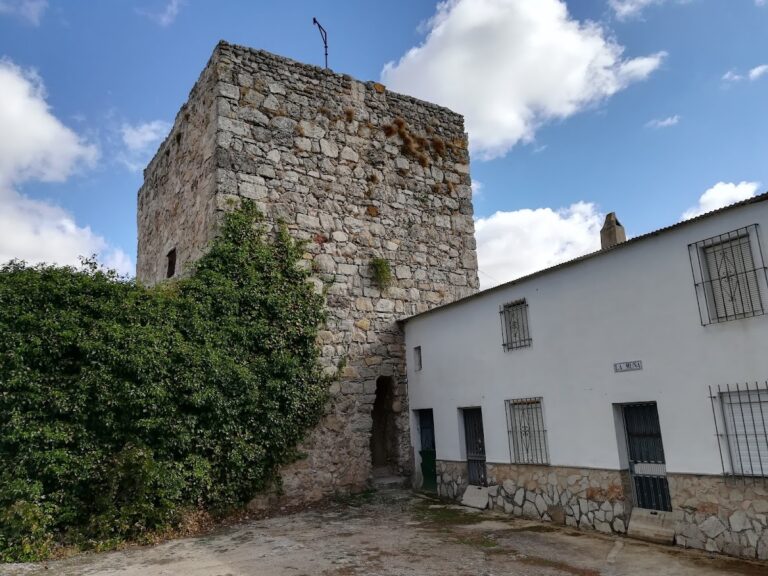
Surviving square tower
Only one square-plan tower remains standing. It is built of rubble masonry, with Roman stone reused in its construction, a practice confirmed by the photogrammetric study. Its position and form may correspond to one of the three vertex towers described by Martín de Jimena Jurado.
Keep foundations and earthworks
The site also preserves the foundations of a large tower, possibly the central keep described in the seventeenth-century account. A mound may contain the remains of a motte and other earthen fortification works. Sections of walls built with mortar survive alongside these foundations, helping indicate the extent and construction of the former castle.
Archaeological surroundings
Medieval pottery is abundant around Torre Benzalá. Lead sarcophagi, coins, and sculptures have reportedly been found at the site, while the surrounding archaeological area contains material from several earlier periods, including the Copper-Bronze Age, the Iberian period, and Roman occupation associated with the nearby city of Bastora.
Nearby sites