Imbsenburg: A Medieval Motte Castle in Germany
Site at a Glance
- Rating
- 3.8
- Popularity
- Very Low
- Country
- Germany
- Primary era
- Medieval
- External website
- Open
- Eras represented
- Medieval
- Civilizations
- Holy Roman Empire
- Site type
- Military
- Remains
- Castle
On this page6 sections
History
Imbsenburg is a former medieval motte castle near Wewer in Paderborn, Germany, built during the high Middle Ages. It belonged to the settlement of Oystinckhusen, also known as Östinghusen, which later became deserted. The castle and settlement formed part of an estate whose agricultural and feudal history continued after the fortified site had been destroyed.
Early settlement and the medieval estate
A gilded bronze fitting has led to the supposition that the settlement was occupied from the second half of the eighth century. By the late Middle Ages, the Heerse collegiate foundation, an ecclesiastical institution that held land and granted fiefs, had granted the estate to the Brobeck ministerial family. Ministerials were service nobles who performed administrative, military, or courtly duties for a higher lord or institution.
The fief consisted of a manorial estate measuring 10 hides, historical units of landholding and taxation, together with seven dependent farms. Ridge-and-furrow cultivation in the surrounding woodland preserves the pattern of raised medieval plough strips and intervening furrows, revealing part of the settlement’s former agricultural landscape.
Destruction and later name
The castle had been destroyed before 1401. During a legal dispute with the city of Salzkotten in 1608, Wilhelm von Krevet claimed that the Krevet family had peacefully held the Oistinghusen estate for five, ten, twenty, thirty, fifty, one hundred, and more years. The destroyed complex was referred to at that time simply as “at the castle.”
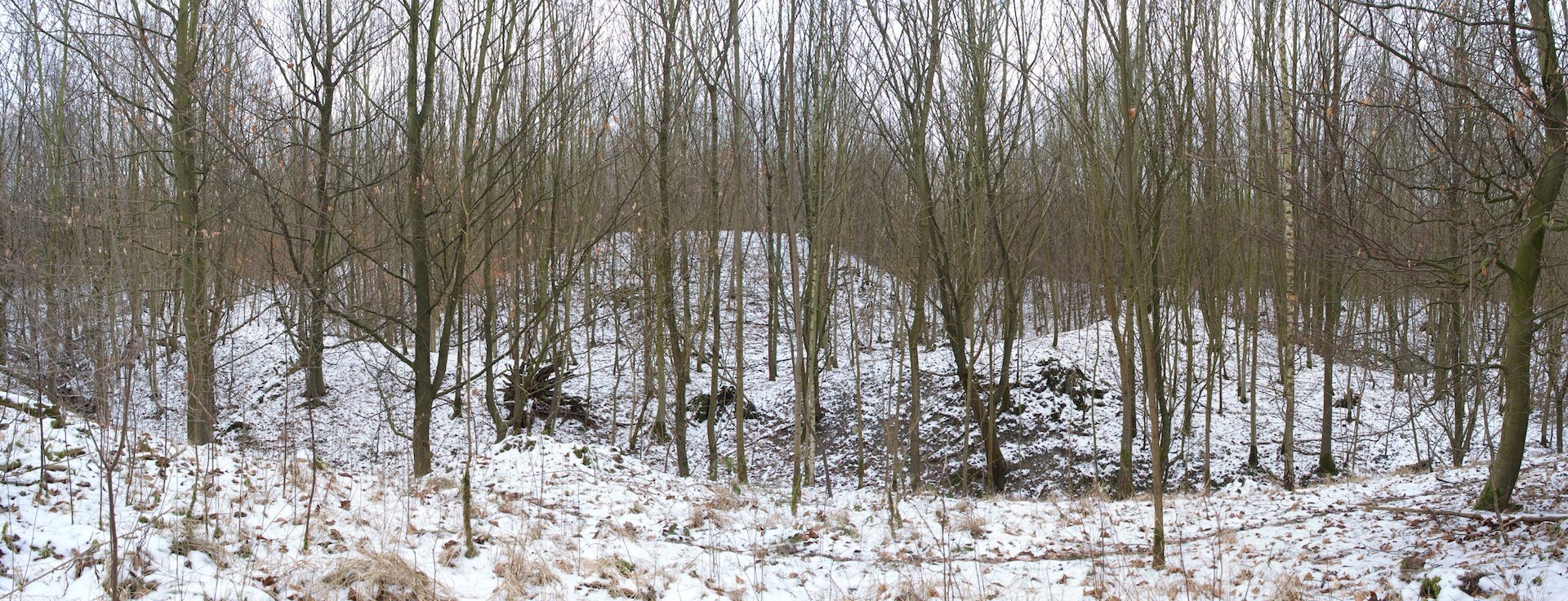
Imbsenburg is a later name, probably derived from the Imbsen family. After the dissolution of the Heerse collegiate foundation in 1810, the Imbsen and Brenken families were temporarily enfeoffed with Sammtholz. The castle and deserted settlement are now situated within woodland.
Remains
Castle earthworks
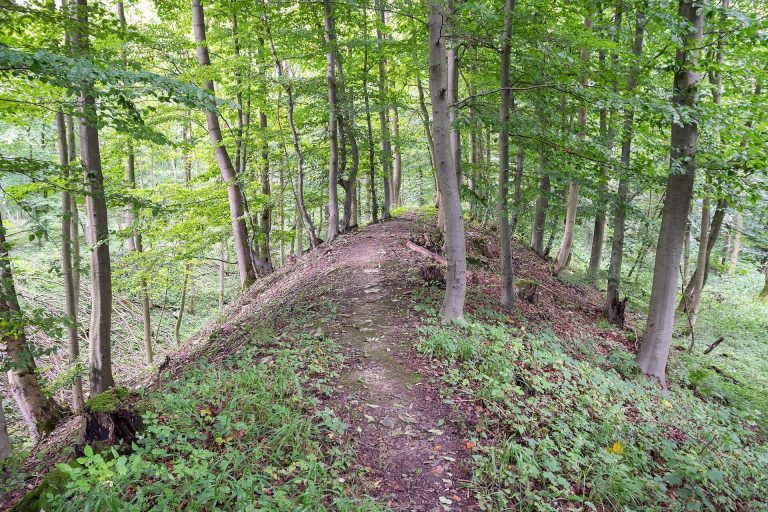
The castle stood approximately 1,000 metres west of the Wilhelmsburg estate in Sammtholz. Its central motte, an artificial mound designed to carry a tower or principal defensive building, measures about 15 by 20 metres and rises just under eight metres. It occupied the northwestern corner of an approximately rectangular outer bailey, the enclosed area surrounding the mound.
Embankments belonging to both the motte and the outer bailey bordered a ravine along the north and west sides. A cistern, a structure for collecting and storing water, occupied the bailey’s northwestern corner. Parts of the embankments and ditches survive and remain clearly visible.
Water management and approach
The stream bed near Imbsenburg had been dammed, making approach to the castle considerably more difficult from two sides. Together with the ravine, the dammed stream formed part of the site’s defensive setting and helped shape the surviving earthworks around the castle.