Château d’Hermance: A Medieval Seigneurial Residence in Switzerland


Site at a Glance
- Rating
- 3.8
- Popularity
- Very Low
- Country
- Switzerland
- Primary era
- Medieval
- Eras represented
- Medieval
- Civilizations
- Unclassified
- Site type
- Military
- Remains
- Castle
On this page7 sections
History
Château d’Hermance is a medieval seigneurial residence in Hermance, Switzerland, built by the lords of Faucigny, probably beginning around 1247. The castle formed part of a planned settlement and frontier network associated with Baron Aymon II of Faucigny, and its surviving remains are centered on the principal fortified tower known as the donjon.
Foundation and Faucigny expansion
The castle is first mentioned in a papal bull of 1247 concerning the establishment of a chapel. At the same time, the castle and the new settlement called the Upper Borough were part of developments promoted by Aymon II along the frontier with the County of Geneva. The castle and borough of Monthoux belonged to the same program, while Monthoux had been built shortly before 1245.
Château d’Hermance later became involved in a succession struggle within the ruling family. Béatrice de Faucigny, daughter of Count Pierre II of Savoy and granddaughter of Aymon II, contested the position of her uncle, Philippe of Savoy, the new count. After hostilities resumed following a truce in January 1269, Béatrice and her son Jean I were captured. Their release was secured by pledging Hermance, together with Monthoux and Châtelet du Crédoz, until an agreement could be reached.
A judgment issued in 1271 by Edmond, son of the King of England, and Philippe of Savoy required Béatrice to surrender the castles of Aubonne and Hermance, as well as all her fiefs in the Vaud region, to her aunt. Faucigny became permanently one of the possessions of the House of Savoy in 1355.
An administrative center
Beyond its original role as a seigneurial residence, Hermance served as the center of the Faucigny châtellenie, also called a mandement. This was a territorial district organized around a castle and supervised by a châtelain. The office combined local administration, collection of the lord’s revenues, and responsibility for maintaining the castle. A receiver of accounts could assist by preparing the annual financial statement.
The organization of the Barony of Faucigny in 1256, which became a bailliage in 1265, adopted the Savoyard châtellenie system introduced under Pierre of Savoy. A bailliage was a larger territorial administration directed by a bailiff or similar official. During the Dauphine period, when Faucigny was associated with the Dauphins of Viennois, the region was probably organized from 1342 to 1343 into about fifteen châtellenies, including Hermance.
The surviving administrative record names Mermet Cerveyntz and Hugues de la Grange for 1356 to 1357, followed by François Bailli of Geneva from 1357 to 1359. Henri de La Balme, also called Verneta, held the office from 1359 to 1369, and Pierre II de La Balme from 1369 to 1376. Jean de Villette served in 1376 to 1380 and again from 1381 to 1389, while François de Villette held office in 1380 to 1381. Marguerite Croysi, widow of Guillaume de Saint-Germain, followed from 1389 to 1395.
Pierre Pugin was châtelain from 1395 to 1401. In 1401, his daughters and heirs Claude, Rolette, Françoise, and Girarde held the associated rights. Hugonet, or Hugonin, d’Arles served from 1401 to 1411, Richard d’Arles from 1411 to 1418, and Pierre d’Arles, Richard’s son and heir, in 1418. Jacques Caret then held the office from 1418 to 1425, followed by Rolet de La Pierre from 1425 to 1427.
Later officeholders included Girard Bourgeois from 1433 to 1449, Louis d’Apponay from 1449 to 1456, and Jean Marcel in 1456 to 1457, 1458 to 1460, and 1462 to 1466. Guillaume Toreau served in 1457 to 1458, Guillaume du Châtelard in 1460 to 1461, and Jean de Compois, also written Compey, in 1461 to 1462. François-Jean de Rovorée, whose name also appears as Ravorée or Ravoire and who was lord of Cursinges, was châtelain from 1466 to 1473.
Jacques du Molard, judge and receiver of the seals of Faucigny, held the office at Hermance from 1432 to 1437 and again from 1445 to 1450. He also administered several other Faucigny châtellenies, including Gex, Ballon, Aye, and Cluses. The castle eventually lost its residential and administrative function and fell into ruin, leaving only the donjon.
Remains
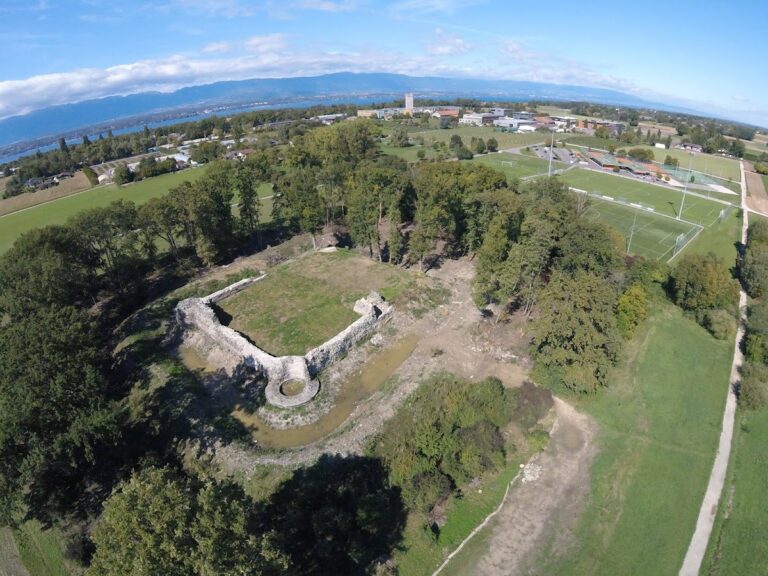
Château d’Hermance stands in the commune of Hermance in the canton of Geneva, on the southern shore of Lake Geneva. It occupies the right bank of the Hermance River, which runs along two sides of the castle. Across the lake’s southern shore is the Genevan Château de Beauregard. The castle and its borough formed a defended settlement enclosed by walls, with the river contributing to the site’s natural protection.
Defended castle and borough
Walls and entrance defenses
The surrounding defenses included curtain walls, meaning continuous protective walls enclosing the settlement. Around the borough, these walls were preceded by ditches and reinforced by associated towers. The towers protected the entrance, while the enclosing system connected the borough’s defense with the castle. This arrangement reflects the site’s combined function as a residence and a fortified settlement on the Faucigny frontier.
Medieval donjon
The medieval donjon, the principal fortified tower of a castle and often its strongest residential and defensive element, is the only part of Château d’Hermance that survives. It represents the remaining core of the former seigneurial residence, while the wider castle has become ruined. Its position within the defended complex can be understood through the surviving relationship between the tower, the river on two sides, and the walls that protected the adjoining borough.
Nearby sites