Jalali Castle: A Seljuk Defensive Fortress in Kashan, Iran


Site at a Glance
- Rating
- 4.3
- Popularity
- Very Low
- Country
- Iran
- Primary era
- Medieval
- Eras represented
- Medieval, Early Modern
- Civilizations
- Safavid, Seljuk, Zand
- Site type
- Military
- Remains
- Castle
On this page11 sections
History
Jalali Castle is a defensive fortress in Kashan, Iran, built in the eleventh century during the Seljuk era in the Razi architectural style. It was constructed on the western side of the city by Majd ed-Din Abolghassem Kashani on the order of Malik-Shah I, a major Seljuk sultan. Malik-Shah also ordered repairs to Kashan’s city walls and the fortification of two other castles, placing Jalali Castle within a wider defensive system.
Early fortifications and Seljuk sieges
Kashan’s surrounding walls had originally been built on the order of Zobeyde Khatun, the wife of Harun al-Rashid, an Abbasid caliph. She financially supported development in several cities of the Islamic world. Historical documents indicate that a moat surrounded Jalali Castle, adding an obstacle beyond its walls, towers, and ramparts.
The castle and Kashan’s broader fortifications resisted a three-month siege by Malek Seljuk in 1138. The attackers failed to capture the city and destroyed only villages outside it. In 1198, Miajegh, a Khwarazmian commander, also failed to take Kashan after a four-month siege, plundering nearby villages instead. During both attacks, mangonels, siege engines used to throw stones and incendiary projectiles, severely damaged the castle’s tower and ramparts. Repairs followed each siege.
Safavid use and rebellion
During the early Safavid era, the castle became a refuge and base for outlaws and bandits. Ismail I, the founder of the Safavid dynasty, ordered its destruction, although the order was not carried out for unknown reasons. Instead, construction and repairs strengthened the defenses.
During the reign of Muhammad Khodabanda, a Safavid shah, Mohammad Khan Torkaman rebelled against the weakened government and used Jalali Castle as his base. For twelve years, he controlled and terrorized Kashan and the surrounding villages. His men also killed Khayr al-Nisa Begum, the mother of Abbas I, in Isfahan.
After Abbas I came to the throne, he immediately suppressed the rebellion and killed Torkaman and his followers. A period of peace and stability then extended from Abbas I’s reign into the late Safavid era. During this time, the castle’s inner structures gradually fell into ruin, even as its defensive fabric remained in use.
Later damage and final military history
Jalali Castle was severely damaged during the Afghan invasion and partly repaired during the reign of Nader Shah. An earthquake in Kashan in 1778 caused further destruction to its towers and ramparts. Karim Khan Zand ordered repairs through Kashan’s governor, Abdolrazzagh Khan. The work included adding two gates to the five that already existed and digging the moat again.
The renewed moat was identified as the principal reason that Agha Mohammad Khan failed to capture Kashan. The castle’s last battle took place during the Persian Constitutional Revolution, an early twentieth-century movement seeking constitutional government, when the bandit Nayeb Hossein Khan Kashi and his sons were active. Jalali Castle is now in ruins.
Remains
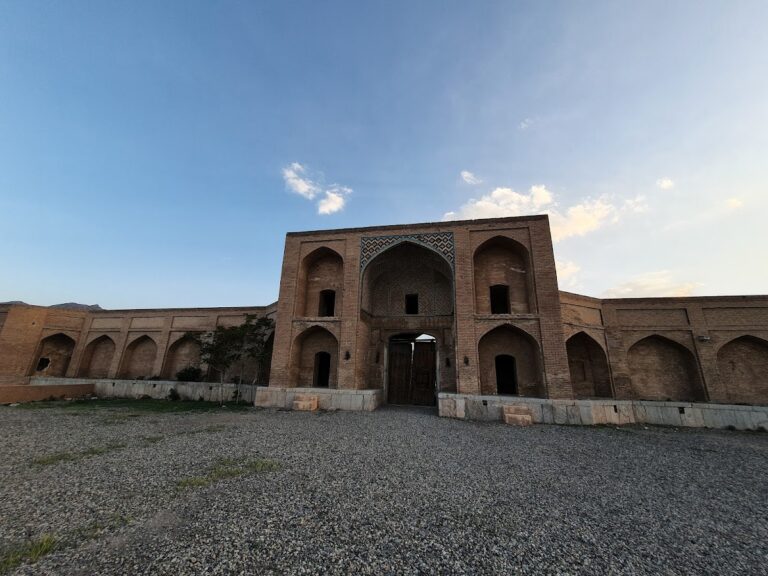
Jalali Castle stood on Kashan’s western side as part of a defensive landscape of city walls, towers, ramparts, gates, and a surrounding moat. Its construction used cob, mudbrick, and brick. Cob is an earthen building material made from clay or soil mixed with organic material. During the Safavid-era strengthening, the walls were approximately 4 metres thick and 6 metres high.
Defensive structures
Walls, towers, and ramparts
The surviving defensive elements include thick mudbrick walls, towers, and ramparts. These structures were repeatedly repaired after damage from siege stones and fire pots, then suffered further destruction in the 1778 earthquake. Their remaining earthen construction preserves the material character of the castle’s defensive system.
Gates and moat
The castle originally had five gates. Two more were added during the repairs ordered by Karim Khan Zand, bringing the total to seven. The most important entrance was the Dolat Gate, whose importance was connected with neighboring buildings, including the bazaar and a caravanserai, a roadside inn for travelers and caravans. Those neighboring buildings were later destroyed as Kashan expanded.
A moat surrounded the castle and was dug again after the earthquake of 1778. Its renewed presence formed part of the repaired defensive arrangement and was associated with the failure of Agha Mohammad Khan to capture Kashan.
Inner structures and cooling facilities
Inner structures
The castle’s inner structures gradually fell into ruin during the later Safavid period. The remains belong to a larger fortified complex whose surviving walls and towers were built with mudbrick. Their fragmentary condition reflects the castle’s long history of siege damage, earthquake destruction, repair, and subsequent decay.
Yakhchals
Yakhchals, traditional Iranian mudbrick cooling and storage structures used to preserve ice or other perishable goods, also remained within the castle. These surviving elements were constructed from mudbrick alongside the thick walls and towers, contributing to the physical record of the castle’s internal facilities.
Nearby sites