Schönstein Castle Ruins: A Romanesque Hill-Spur Castle in Germany


Site at a Glance
- Rating
- 4.9
- Popularity
- Very Low
- Country
- Germany
- Primary era
- Medieval
- Eras represented
- Medieval
- Civilizations
- Holy Roman Empire
- Site type
- Military
- Remains
- Castle
On this page9 sections
History
Schönstein Castle ruins in Germany are the remains of a Romanesque hill-spur castle built probably in the twelfth century by the Counts of Ziegenhain. The castle stood at Schönau, now part of Gilserberg in northern Hesse, and controlled the road through the Gilsa valley. Together with the castles of Jesberg and Densberg, it took part in the strategic struggles between Hesse and Mainz during the thirteenth and fourteenth centuries.
Ziegenhain rule and the Schönstein district
Schönstein enters the historical record in 1350, although an earlier grant indicates that it was already established by 1300. In that year, Count Gottfried VI of Ziegenhain granted the castle as a fief to Hermann of Löwenstein-Schweinsberg. In 1350, Gottfried’s son, Count Johann I, created the Schönstein administrative district at the castle.
The district brought together fourteen villages in the Gilserberg uplands. It included Lischeid, Moischeid, Winterscheid, and Gerwigshain, which Johann I had acquired from Haina Monastery, as well as Falkenhain, Frankenhain, Treisbach near Sebbeterode, Schönau, and Sachsenhausen, formerly associated with the Wasen court of Ziegenhain. Johann enlarged the castle complex in 1358.
In 1368, the castle and district were pledged to Gottfried of Linsingen and to Hans and Helwig of Gilsa of Roppershausen. They received authority to enlarge and strengthen the castle. The property and its district were pledged repeatedly in the following period, reflecting the political and financial pressures surrounding the Ziegenhain territories.
Destruction during regional wars
During the Sterner War, a regional conflict over territorial control in Hesse and neighboring areas, Landgrave Henry II of Hesse captured Schönstein after a long siege in 1371 or 1372 and destroyed it. The castle was rebuilt, but Hessian troops captured it again in 1399 and destroyed it once more. Although it was rebuilt again, the keep was not reconstructed after this second destruction.
In 1406, Counts Gottfried IX and Johann II of Ziegenhain pledged one-third of Schönstein Castle and its district to Ekkebrecht of Grifte. The counts redeemed the pledge in 1420 for 160 guilders, a payment later confirmed by Ekkebrecht’s widow, Elisabeth Schenck of Schweinsberg.
Transfer to Hesse and abandonment
Under the inheritance treaty of Johann II, the last Count of Ziegenhain, Schönstein and the entire County of Ziegenhain passed to the Landgraves of Hesse in 1450. The Landgraves were the ruling princes of the Landgraviate of Hesse. In 1469, during the Hessian Brothers’ War, a conflict between rival Hessian landgraves, Bohemian mercenaries serving Landgrave Ludwig II of Hesse-Kassel destroyed the castle. At that time Schönstein belonged to Ludwig’s younger brother, Landgrave Henry III of Hesse-Marburg. Densberg and Jesberg castles were also destroyed during the conflict.
Schönstein continued to serve as the seat of Hessian officials until 1543, and court sessions were held there. Otto Hund was the last official of the Schönstein district. The castle began to fall into ruin from 1557 onward. In 1601, inhabitants of Schönau assured Landgrave Maurice the Learned that stone from the ruined castle had been used to build the fortress of Ziegenhain rather than their own houses.
The surviving remains were secured in 1987 and 1988 by the Schwalmstadt Forestry Office and the Hessian State Office for Monument Protection.
Remains
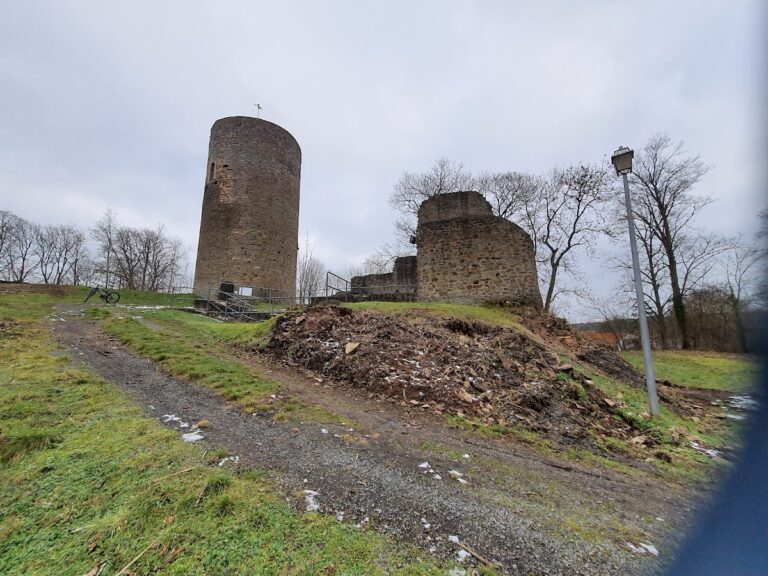
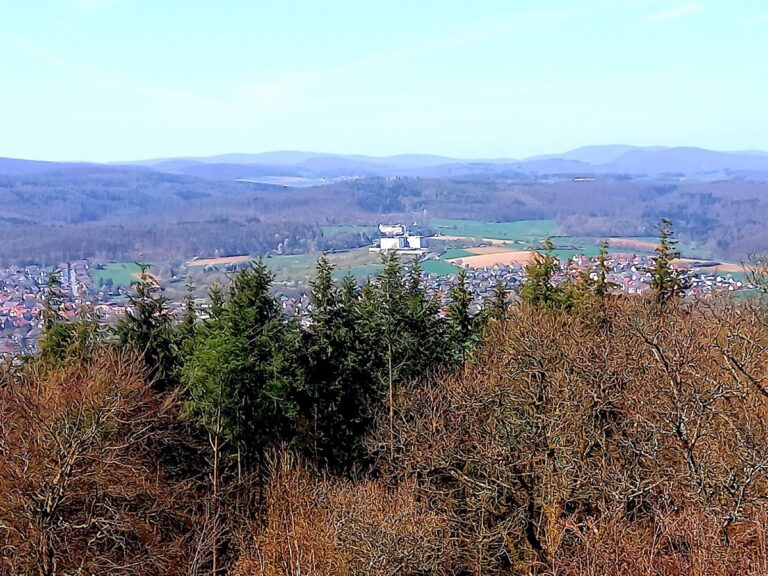
The ruins stand within the Kellerwald-Edersee Nature Park on the western spur of the 419-meter-high Schlossberg, part of the western slope of the Hemberg ridge. The ground falls steeply westward into the Gilsa valley, while the castle itself lies at approximately 360 meters above sea level. The settlement of Schönstein is 1.4 kilometers to the north, and Schönau is 1.1 kilometers to the southeast.
Plateau and defenses
The castle occupied a rectangular plateau measuring about 20 by 36 meters. A deep neck ditch, a defensive trench cut across the land connection between a hill spur and the higher ground behind it, separated the site from the rising hillside. Ramparts and ditches on the southwest provided further defenses. These features used the projecting elevated ground and its steep slopes to protect the relatively narrow approach to the castle.
Residential and fortified buildings
Palas
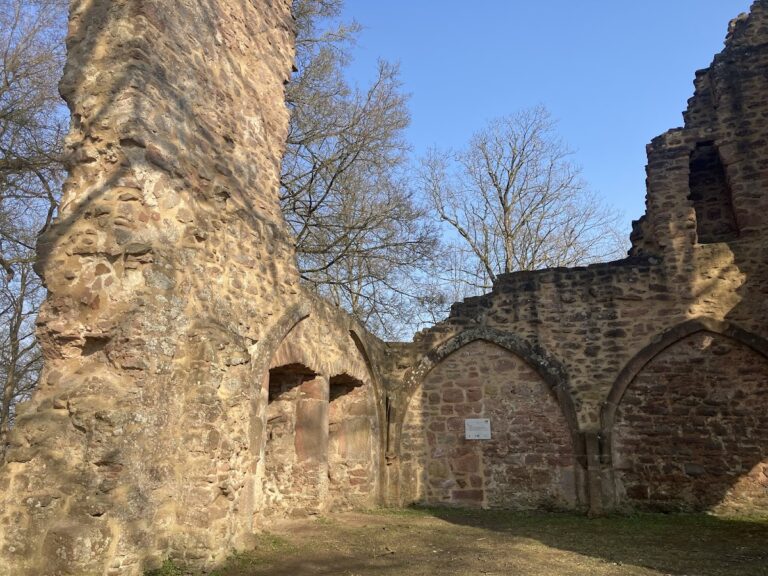
The principal building was the palas, the main residential and representative structure of a medieval castle. It stood three storeys high and measured 20 meters in length by 9 meters in width. The best-preserved walls probably belong to this building. They retain window openings and a fireplace, offering evidence of its domestic and representative functions. The buildings were constructed from locally available graywacke.
Keep
The castle also possessed a keep, its principal fortified tower and a major defensive or residential structure. It was destroyed during the castle’s two captures and was not rebuilt after the destruction of 1399. Its loss formed part of the castle’s altered appearance when the complex was reconstructed after the late fourteenth-century conflicts.