Dangan Castle: A Ruined Aristocratic Estate in County Meath, Ireland


Site at a Glance
- Rating
- 3.9
- Popularity
- Very Low
- Country
- Ireland
- Primary era
- Early Modern
- Eras represented
- Medieval, Early Modern
- Civilizations
- British, Norman
- Site type
- Military
- Remains
- Castle
On this page8 sections
History
Dangan Castle is a ruined former aristocratic estate in County Meath, Ireland, whose medieval castle was associated with the Wesley family during the Anglo-Norman expansion of Ireland after 1171. The family occupied the land from the period of the conquest, and the estate later became closely linked with the Wellesleys and Arthur Wellesley, the future 1st Duke of Wellington.
The Wesley estate and Dangan House
The medieval castle served as the family’s earlier residence. In the early eighteenth century, the childless Gerald Wesley left the estate to Richard Colley on the condition that he change his surname. Colley became the Right Honourable Richard Wesley, 1st Baron Mornington, and demolished the older castle to build Dangan House, the modern residence associated with the estate.
Richard Wesley invested heavily in the improvement and upkeep of the grounds, whose gardens covered 600 Irish acres, approximately 400 hectares. His son, Garret Wesley, 1st Earl of Mornington, succeeded him. Garret’s son Arthur Wellesley spent most of his childhood at Dangan Castle and in its gardens. Wellesley later became a British field marshal and defeated Napoleon at Waterloo in 1815.
Sale and the O’Connor period
The estate left the Wellesley family in 1781, when Arthur’s elder brother, Richard Wellesley, 1st Marquess Wellesley, inherited it and sold it to Thomas Burrowes of the East India Company. The company was an English and later British chartered corporation with extensive commercial and imperial operations in South Asia.
Roger O’Connor, an Irish nationalist and landowner, later acquired the estate from Burrowes on a permanently renewable lease. He claimed that he had obtained Dangan as a suitable residence for Napoleon Bonaparte after Napoleon’s expected defeat of Britain. Napoleon was the French military ruler and emperor whose wars dominated Europe in the early nineteenth century.
A serious fire in 1809 destroyed much of the building during O’Connor’s occupation. Insurance fraud was suspected, while about sixty years later O’Connor’s son, Francisco Burdett O’Connor, wrote that he had accidentally started the fire while melting lead for bullets.
In 1817, O’Connor, his estate manager, and workers were accused of conspiring to rob a mail coach. A guard was shot and killed during the incident. O’Connor was acquitted after a sensational trial, but he left the castle soon afterwards. The damaged building and grounds then deteriorated rapidly. By 1841, the interior had been converted into a flower garden, and the site was described as a recent hiding place for plunder and a resort of thieves.
Dangan Castle and the surrounding land were offered for sale in September 2013.
Remains
Dangan Castle stands beside Dangan Church on the Trim Road, outside Summerhill in County Meath. The ruined estate combines the surviving medieval tower with the remains of the early-eighteenth-century Dangan House and extensive grounds that once formed part of the residential landscape.
Castle and house remains
Medieval tower
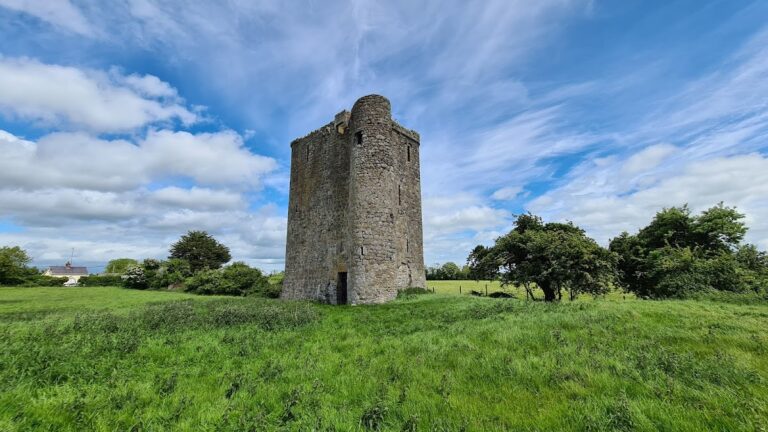
A ruined medieval tower is the surviving fabric of the earlier castle. It represents the residence that preceded Richard Wesley’s early-eighteenth-century house and remains as the principal physical reminder of the medieval phase of the estate.
Dangan House
Dangan House replaced the medieval castle as the estate’s principal residence. The 1809 fire destroyed much of the building, and by 1841 its outer walls remained. The former halls and chambers had by then been transformed into a flower garden, linking the ruined house to the designed grounds maintained by the Wesley family.
Gardens and lake
The estate’s gardens covered 600 Irish acres, approximately 400 hectares. An Irish acre was a historical Irish land measure larger than the standard statute acre. The grounds also contained a 26-acre lake, approximately 17 hectares, equipped with a fort, several islands, and several ships.
Nearby sites