Sprengelburg: A Medieval Hill Castle in Germany


Site at a Glance
- Rating
- 4.1
- Popularity
- Very Low
- Country
- Germany
- Primary era
- Medieval
- External website
- Open
- Eras represented
- Medieval, Modern
- Civilizations
- Holy Roman Empire
- Site type
- Military
- Remains
- Castle
On this page9 sections
History
Sprengelburg is a ruined hill castle in Germany, located between Eßweiler and Oberweiler im Tal in the Kusel district of Rhineland-Palatinate. The castle probably originated during the thirteenth century, with construction broadly dated to around 1200–1300. Built at the narrowest point of the Talbach valley, it controlled the road that formerly followed the valley floor below. Its medieval position gave the castle a practical role in overseeing movement through the valley.
The Mülenstein lords
The castle lords were the Mülenstein knights, vassals of the Rheingrafen, a noble family whose members held the title Rhine count in the region around the Middle Rhine and Nahe. Whether the Mülensteins also built Sprengelburg remains uncertain. Their family is recorded between 1317 and 1451.
The Mülensteins were described as robber knights who inflicted serious losses on merchants travelling along the road. Strasbourg merchants eventually destroyed the castle in retaliation for these raids, although the date of the destruction is unknown.
Destruction and later memory
Johannes Hoffmann, a state scribe and surveyor associated with Lichtenberg, recorded a local account in his 1595 Description of the Essweiler Valley. After the castle’s destruction, farmers repeatedly cleared and cultivated the grounds. Their harvests failed during wet, cold summers, and after a third attempt they abandoned the land when a “great darkness” occurred in the middle of a summer day. This event may have been the solar eclipse of 1441. The site became overgrown in the following years.
Hoffmann also preserved a tradition about the castle’s fall. Two Mülenstein brothers were attending a wedding in Eßweiler when disguised Strasbourg merchants entered Sprengelburg. The garrison mistook the merchants for the absent lords, allowing them to capture, plunder, and destroy the castle. One brother was later killed near Hinzweiler, where a cross was said to have been erected, while the other escaped to Grumbach.
After the failed cultivation attempts, Sprengelburg became completely overgrown. Until the 1970s, its remains lay beneath a wooded mound. The name “at the old castle” and remnants of the neck ditch kept knowledge of the site alive. Excavations began in 1976, carried out by students of the University of Maryland under Professor Higel. Reconstruction followed under the monument-preservation authority in Speyer, and the ruins have been designated a heritage monument since 1983.
Several local legends remain associated with the ruins. They tell of a hunchbacked dwarf who rides on people travelling past at night, a White Lady who emerges from the tower and tries to lure passers-by onward, and an underground passage beneath the Königsberg to Wolfstein. The passage has not been found. Mining tunnels in the Königsberg, created during mercury and barite extraction that continued until the 1950s, helped sustain the story.
Remains
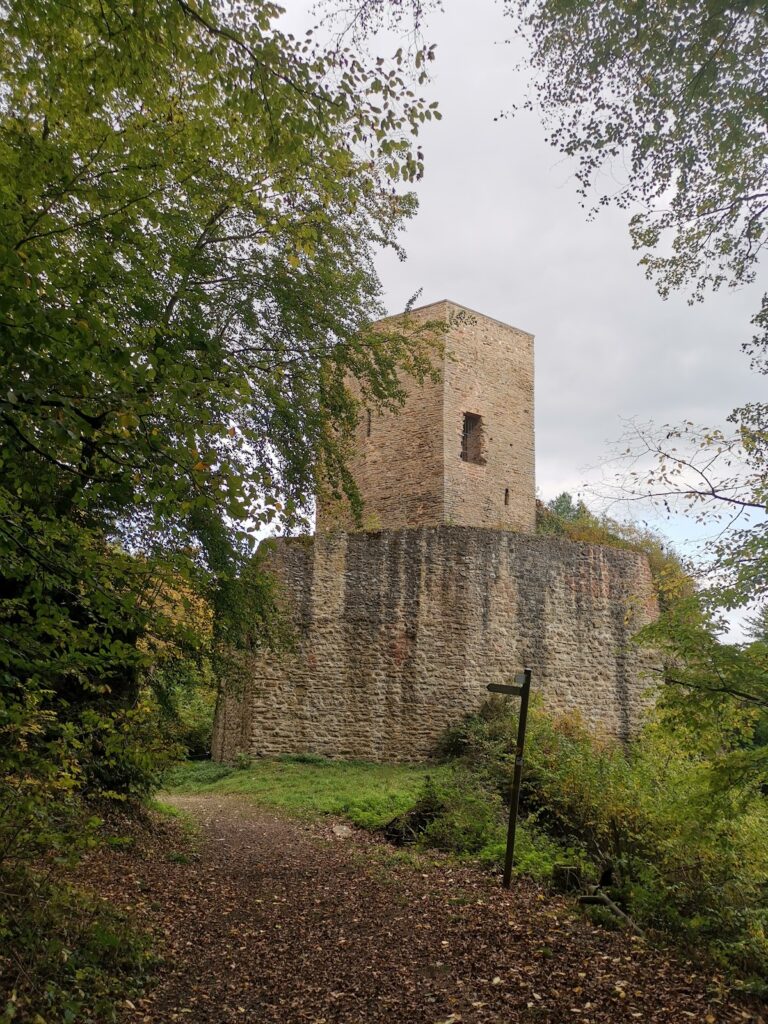
Sprengelburg occupies an outlier of the Königsberg between Eßweiler and Oberweiler im Tal, directly beside the present Landesstraße 372. The boundary between the two municipalities passes through the castle grounds. The surviving and reconstructed outer walls form a roughly rectangular enclosure measuring about 20 by 15 metres, with a round tower and the remains of a neck ditch defining the principal physical elements of the site.
Enclosure and defensive features
Outer walls and round tower
The outer walls enclose a rectangular area approximately 20 metres long and 15 metres wide. Excavation revealed a round tower about 8 metres in diameter. The tower was rebuilt after the excavations and now rises approximately 8.5 metres. An iron spiral staircase from the modern reconstruction leads to an observation platform inside the tower. Woodland around the site substantially restricts the view from it.
Entrance gate
A round-arched entrance gate was inserted into the rear part of the outer wall during the reconstruction. Stones recovered during excavation were partly reused in this work, linking the reconstructed entrance with material from the castle’s earlier remains.
Neck ditch
Parts of the castle’s neck ditch survive. This type of ditch was cut across the narrow connecting ridge of an elevated site. A section of the ditch has been built over by the L 372.
Archaeological discovery
During the summer of 1978, excavators discovered the skeleton of a woman inside the castle. The find forms part of the archaeological evidence recovered during the investigation of the buried and overgrown ruins.
Nearby sites