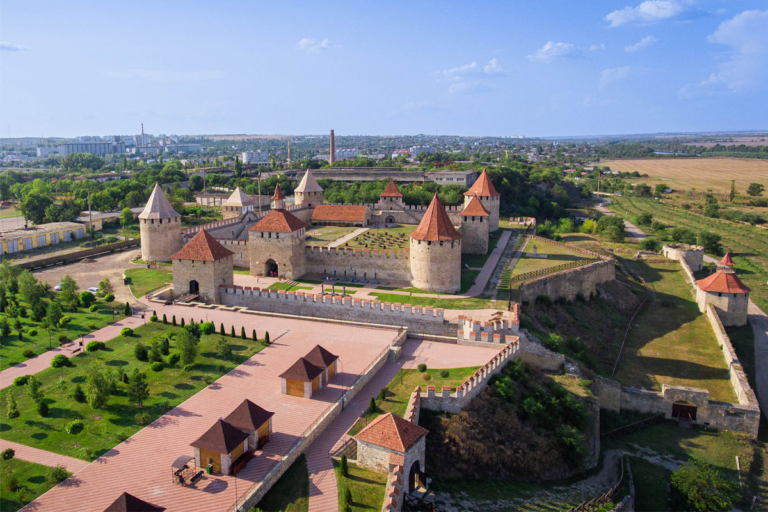
Tiraspol Fortress: A Russian Imperial Frontier Fortification in Moldova


Site at a Glance
- Rating
- 4.5
- Popularity
- Low
- Country
- Moldova
- Primary era
- Early Modern
- Eras represented
- Early Modern
- Civilizations
- Russian
- Site type
- Military
- Remains
- Fort
On this page11 sections
History
Tiraspol Fortress is an eighteenth-century Russian defensive installation in Tiraspol, Moldova, whose construction began in 1793 during the Russian imperial period. Planned under the direction of the field marshal Alexander Suvorov and the architect and military engineer Franz de Volan, it was intended to secure the left bank of the Dniester after Russia’s frontier with the Ottoman Empire moved to the river.
Planning the Dniester frontier
The Treaty of Jassy, which ended the Russo-Turkish War and repositioned the frontier between Russian and Ottoman possessions, placed the Dniester at the edge of Russia’s newly acquired territory. This territory became Ochakiv Oblast, an administrative division of the Russian Empire. Empress Catherine II ordered Governor Vasily Kakhovsky to examine its administration and urban planning.
In November 1792, Catherine II instructed Suvorov to inspect the frontier and determine how it could be protected from attack. Suvorov and de Volan jointly prepared a plan for strengthening the Dniester line at the future site of Tiraspol, and it was sent to St Petersburg in January 1793.
Construction and the growth of Tiraspol
The fortress was founded on 6 July 1793. Suvorov began work before state funding had been approved, borrowing 100,000 rubles and ordering the sale of his own villages. Catherine II later authorized more than 600,000 rubles from the treasury. The danger of another war with the Ottoman Empire accelerated construction, although supplies of building materials and food were difficult to maintain, and many soldiers became ill in the local climate.
Work was largely complete by the end of 1795. The fortress was prepared for a large garrison, with contemporary weapons and extensive food stores, but it never carried out the defensive role for which it had been built. A settlement grew beside the fortification. It had more than 2,500 inhabitants by 1795 and received city status on 27 January that year, becoming the county town of Novorossiya Governorate. From 1803, Tiraspol County formed part of Kherson Governorate.
Loss of military importance
The Treaty of Bucharest in 1812 moved the Russian frontier to the Prut River. Tiraspol Fortress consequently lost its position on the border and much of its military importance.
Between 1822 and 1826, the fortress held Vasily Raevsky, a Decembrist. The Decembrists were Russian military and political reformers, many of them officers, whose unsuccessful 1825 uprising challenged imperial rule. During Alexander Pushkin’s visit to Tiraspol, the poet intended to see Raevsky and reportedly received poems written by him in confinement.
Executions, wartime killings, and commemoration
In the 1930s, the fortress was used for the execution of Red Army soldiers who had been subjected to political repression. During the German-Romanian occupation, it became a place where Soviet civilians were killed en masse.
In the 1990s, the history faculty of Shevchenko Transnistrian State University exhumed and reburied victims. A mass grave beside the powder magazine contains more than 800 people. The fortress was also heavily damaged during construction of Tiraspol’s Suvorov microdistrict in the 1970s. A plan developed in the early 1990s to restore the remains as a tourist site was later suspended.
A plaque commemorating the fortress’s foundation was placed on the powder magazine of the Saint Vladimir Bastion on 13 October 2013. Restoration of the powder magazine began in spring 2014 and was completed by 14 October of that year.
Remains
Fortification layout
The original plan outlined a rectangle, but the completed design used a regular octagonal bastioned form. A bastion is a projecting fortification that allows fire along the adjoining walls. The earthworks incorporated concealed loopholes, and an earthen rampart approximately five metres high enclosed the fortress.
Gates and bastions
Three entrances served the fortress: the Western Gate, Bratslav Gate, and Kherson Gate. A plan from 1798 names the eight bastions as Vladimir, Pavel, Slava, Victorious, Peter, George, Nicholas, and Vasily. It also identifies the half-bastions John and Alexander. A half-bastion is a projecting work with one full flank.
Military buildings
The fortified precinct contained the military Church of Saint Andrew the First-Called, three artillery parks, a military hospital, a commandant’s house, powder magazines, barracks, stables, arsenals, and food stores. These buildings supported the garrison and the fortress’s defensive purpose.
Surviving remains
Powder magazine of the Vladimir Bastion
The remains lie in the southwestern part of modern Tiraspol, between Fedko Street and the Zakrepostnaya Slobodka district. Only a small portion of the original fortress survives, including the powder magazine of the Vladimir Bastion. A powder magazine was a fortified building for storing gunpowder and other ammunition. After restoration, the building was divided between a historical exhibition on Tiraspol Fortress and a church.