Strmol Castle: A Medieval Castle and Government Guesthouse in Slovenia


Site at a Glance
- Rating
- 4.7
- Popularity
- Medium
- Country
- Slovenia
- Primary era
- Medieval
- External website
- Open
- Eras represented
- Medieval, Early Modern, Modern
- Civilizations
- Habsburg, Holy Roman Empire
- Site type
- Military
- Remains
- Castle
On this page7 sections
History
Medieval origins and later renovations
Strmol Castle is a medieval castle in Slovenia near Cerklje na Gorenjskem. Named after the Strmol family who built it, the castle is first mentioned in the thirteenth century, although its foundation is not reliably documented. It is one of the few castles in Slovenia to have retained its Slovene name throughout its history.
Of the twelve medieval manors in the area of the modern Municipality of Cerklje na Gorenjskem, Strmol Castle is the only one to have survived intact to the present. Its tall keep preserves a late-medieval core, while Renaissance and Baroque renovations gave the complex much of its present appearance.
Wartime violence and restitution
In January 1944, the Yugoslav Partisans, the communist-led resistance movement that fought the Axis powers and their collaborators during the Second World War, abducted and murdered the castle owners Rado Hribar (1901–1944) and Ksenija Gorjup Hribar (1905–1944) in a forest near Mače. After the war, the communist government confiscated the castle.
A restitution claim was submitted in 1992, and the castle was returned to the heirs in 2004. The bodies of Rado Hribar and Ksenija Gorjup Hribar were found above Mače in December 2015. Strmol Castle is a monument of national importance in Slovenia and serves as a guesthouse and conference site for the Government of the Republic of Slovenia.
Remains
Castle and defensive enclosure
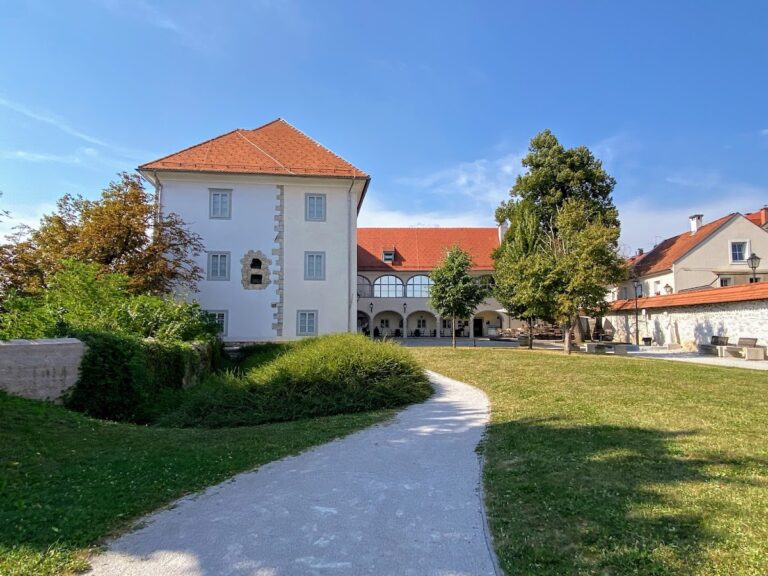
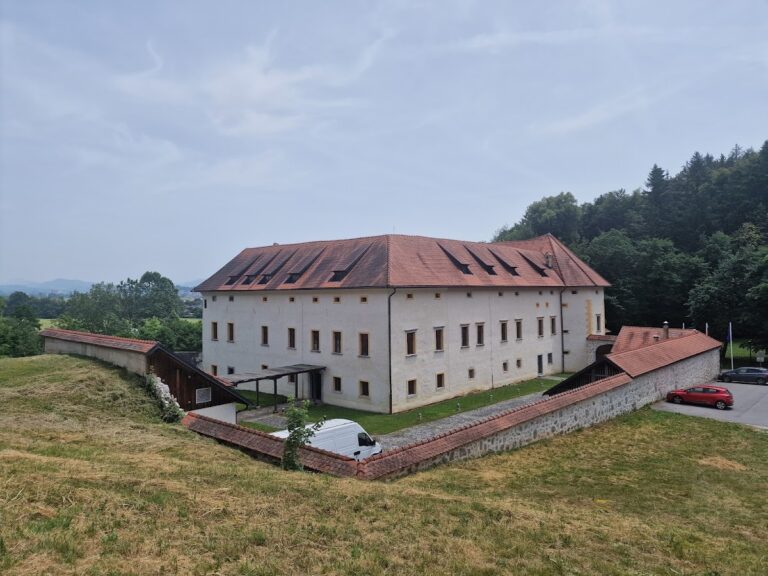
The complex stands at the foot of Dvorjanski hrib, or Mansion Hill, near the villages of Češnjevek, Grad, and Dvorje. Its central keep is enclosed by a low, rectangular Renaissance defensive wall with square corner turrets. The fortifications formerly included a drawbridge over a moat. Historic furniture and works of art survive inside the castle, where the medieval core is incorporated into the later Renaissance and Baroque building.
Park layout
The surrounding park was established in the late seventeenth century. Its original design included an orchard on the slope below the castle, four fishponds on the lower plain, and a walking path with benches leading from the building. The historic layout has changed little, although one pond survives. The present arrangement includes an access path rising toward a square, walled courtyard behind the castle and another path descending from the opposite side of the courtyard toward a nearby road. An informal park with an artificial lake and non-native trees occupies the area between the paths.
Baroque sculpture
The courtyard wall carries Baroque female figures and putti, small childlike decorative figures, made by Angelo PuttaPozzi. The northern entrance steps contain his Atlas statues, which depict Atlas supporting a heavy burden. These sculptures and other decorative elements came from the former Zalog, or Wartenberg, manor near Moravče and were moved to Strmol in the 1960s.