Castle Landskron: A Ruined Royal Hill Castle in Oppenheim, Germany


Site at a Glance
- Rating
- 4.5
- Popularity
- Medium
- Country
- Germany
- Primary era
- Medieval
- Eras represented
- Medieval, Early Modern, Modern
- Civilizations
- Electoral Palatinate, German, Holy Roman Empire
- Site type
- Military
- Remains
- Castle
On this page11 sections
History
Castle Landskron is a ruined hill castle in Germany near Oppenheim, built as a royal stronghold in the early thirteenth century and positioned to monitor the Rhine Valley. It is also known as Reichsburg Oppenheim, a term describing a castle under the authority of a king or emperor rather than solely a local lord.
Early royal fortifications
A Salian or Hohenstaufen fortification probably occupied the site before Castle Landskron. The Salian dynasty and the House of Hohenstaufen were ruling dynasties of the medieval German kingdom and Holy Roman Empire. In 1118, troops commanded by Adalbert, Archbishop of Mainz, destroyed the earlier stronghold, which was described as a praesidium, or fortified position, held by King Henry V. Henry V was both a medieval German king and Holy Roman Emperor, while Adalbert was one of the most powerful ecclesiastical officials in the kingdom.
The castle itself was probably constructed in the early thirteenth century. The oldest surviving written reference to it as Reichsburg Oppenheim dates from 1244, placing it within the system of royal authority that gave the fortress its early political role.
Conflict with Oppenheim and Palatine ownership
The citizens of Oppenheim destroyed the castle in 1257 and again in 1275 during disputes with its castle officials over civic privileges. Rudolf of Habsburg, the first Habsburg king of the Romans, compelled the citizens to rebuild the stronghold by 1281.
In 1375, Emperor Charles IV pledged the castle to Ruprecht of the Palatinate, a member of the Palatine ruling house, and Ruprecht expanded it. His grandson Ruprecht III later became its owner and died at the castle. Castle officials known as Burgmannen held their positions as fiefs from the authority controlling the fortress, first the king and later the Elector Palatine. They were responsible for its defense and operation. The Scharfenstein family held such an office until it passed by marriage to the Kämmerer von Worms family in 1357.
Reconstruction, destruction, and changing names
Elector Friedrich V ordered a palace-like reconstruction in 1615. Friedrich V was the Elector Palatine, and his rebuilding transformed the complex shortly before the Thirty Years’ War, a major European conflict fought from 1618 to 1648. In 1621, a fire that swept through Oppenheim burned the rebuilt castle.
After the war, the complex acquired its present name, Castle Landskron, in 1668. French troops commanded by Ezéchiel du Mas, known as Mélac, blew up the keep in 1689 during the War of the Palatine Succession, a conflict fought from 1688 to 1697 that included French attacks in the Palatinate. In the years that followed, the citizens of Oppenheim used the ruins as a quarry.
Municipal ownership and conservation
The ruins became the property of the city of Oppenheim during the nineteenth century. In 1875, the city built a viewing platform on the remains of the keep. The state of Rhineland-Palatinate acquired Castle Landskron in 1978, and extensive renovation and archaeological investigation took place between 1990 and 1994.
Remains
Castle Landskron occupies the Oppenheim hill as a south-facing hill castle, with the Rhine Valley extending to the south. Substantial wall remains survive across the complex, and the reconstructed portions preserve traces of the architectural styles associated with its successive rebuilding periods. The surviving structures also include the three-storey residential and representative building, the damaged keep, and the medieval well.
Residential and defensive structures
Palas
The three-storey Palas, the castle’s principal residential and representative building, was built in the sixteenth century. It remains among the preserved parts of Castle Landskron and forms part of the evidence for the complex’s later architectural development.
Keep
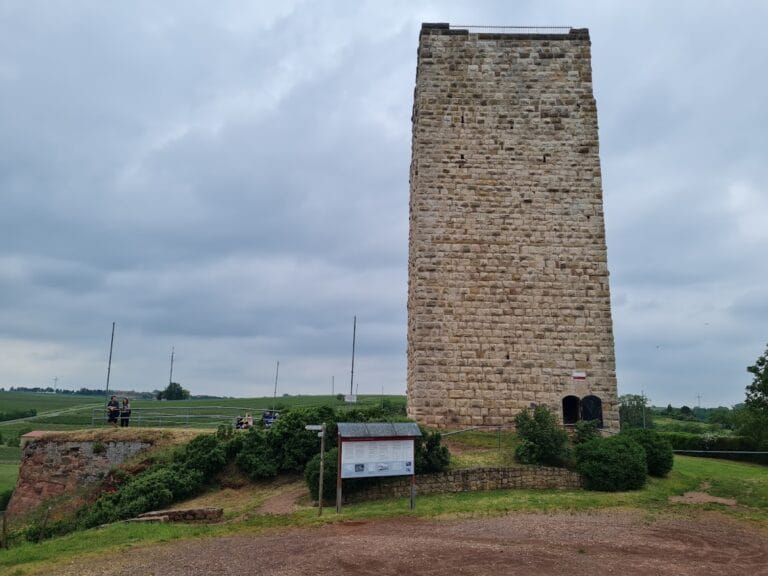
The castle keep, known in German castle architecture as a Bergfried, survives only as a stump. A Bergfried was the principal defensive tower of a medieval German castle. The viewing platform built by the city in 1875 stands on the keep’s foundations.
Castle well
The thirteenth-century castle well reaches nearly 40 metres below the complex. Its water column is approximately 2.5 metres high, and a submersible electric pump now raises the water.
Views from the hill
The elevated ruins provide views across the Bergstrasse toward the 517-metre-high Melibokus in the Odenwald, as well as Worms Cathedral, Ludwigshafen’s BASF industrial area, and Mannheim’s telecommunications tower. With binoculars, the Hornisgrinde in the Black Forest, about 140 kilometres away, can also be seen.