Burg Hatzfeld: A Medieval Hilltop Castle in Germany


Site at a Glance
- Rating
- 4.3
- Popularity
- Low
- Country
- Germany
- Primary era
- Medieval
- External website
- Open
- Eras represented
- Medieval
- Civilizations
- Holy Roman Empire
- Site type
- Military
- Remains
- Castle
On this page9 sections
History
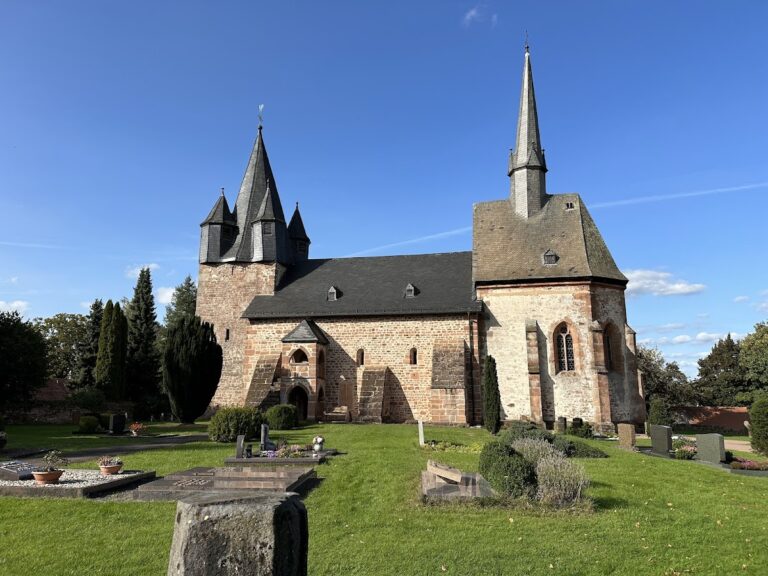
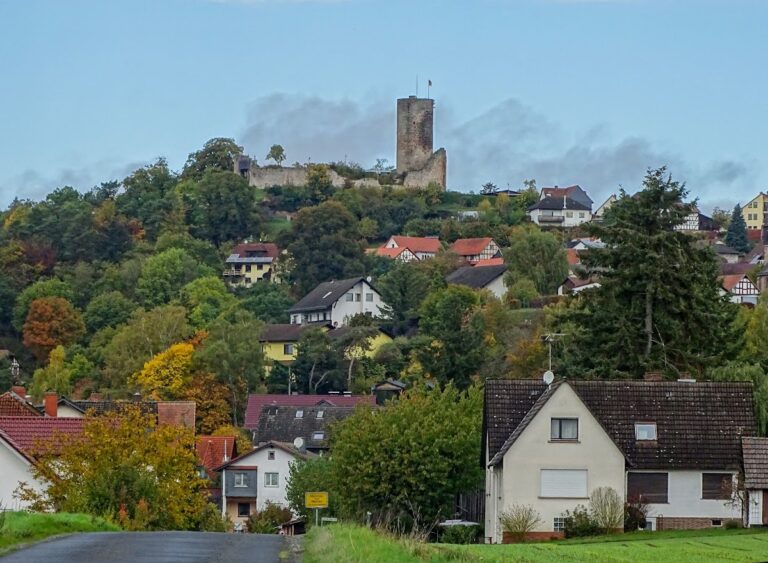
Burg Hatzfeld is a ruined medieval hilltop castle in Hatzfeld, Germany, built in the thirteenth century as the ancestral seat of the Lords of Hatzfeld. The family’s original noble court, first mentioned in 1138, stood across the Eder at the site of the present Emmaus Chapel, formerly the Romanesque village church of St. Cyriacus in Nieder-Hatzfeld. The family later established the castle on a mountain spur, where it was first recorded in 1282.
From noble court to Hessian fief
From 1194, the Lords of Hatzfeld aligned themselves more closely with the Electorate of Mainz than with the Landgraviate of Hesse. The Electorate of Mainz was an ecclesiastical principality of the Holy Roman Empire ruled by an archbishop who also held the rank of elector. In 1311, however, the family had to accept Burg Hatzfeld as a Hessian fief, meaning property or territorial rights held from a superior lord in return for service and allegiance.
The civic settlement below the castle developed on the slope facing the Eder after receiving imperial permission in 1340. Its town court remained a fief of the Archbishopric of Mainz, leaving Hatzfeld divided between competing territorial powers. The Lords of Hatzfeld acted as active and militarily assertive representatives of Mainz in the surrounding area, particularly at Burg Mellnau. Around 1387, they expanded their small lordship by acquiring Bringhausen in the Birken area, now Birkenbringhausen near Frankenberg, together with Eifa.
Siege and shared family ownership
In 1379, Hesse besieged the town and castle. Parts of Burg Hatzfeld suffered severe damage, but the attackers did not take the fortress. The castle was held as a shared family inheritance, known as a Ganerbschaft, in which several branches jointly owned the property. This arrangement repeatedly produced disputes over residence, authority, and limited space.
The first recorded castle truce, made in 1331, divided the castle between the two existing family branches and allowed a second residential building to be constructed beside the first. Tensions later culminated in mutual imprisonments in 1383. A new truce appointed a common official to seek friendly settlements in future disputes. The agreement of 1419 regulated the castle guard, or organized watch, maintained by armed servants.
Conflicts over the restricted space broke out again in 1491 and 1497. Two further truces reassigned the residential buildings, which had by then been enlarged by an additional smaller house. The last documented castle truce dates from 1545. These agreements, known as castle truces, governed the rights, residence, administration, defense, and dispute settlement of the co-owners.
Decline and later preservation
In 1464, the Landgraves of Hesse became mortgage holders of the Mainz administrative district of Battenberg and thereby also of Hatzfeld. When the Hatzfeldt-Hatzfeldt line died out in 1570, Hesse reclaimed half of the lordship as a reverted fief and acquired the remainder through purchases in 1588 and 1772. The Hatzfeldt-Wildenburg branch entered imperial service, became imperial counts, and in 1748 attained the rank of imperial princes through its Silesian lordship of Trachenberg. Imperial counts and imperial princes were noble ranks within the Holy Roman Empire.
The castle began to decline during the sixteenth century. An inventory from 1570 describes it as partly deserted, although a small section was still inhabited in 1707. In 1842, parts of the ruin were demolished on the instructions of the Darmstadt Grand Ducal Directorate of Public Works. In recent years, the Association for Castle and Local History in Hatzfeld has cleared the site, and progressive restoration has taken place since 1991. The castle hill and ruin remain in the possession of the Hatzfeld family, whose owner is Sebastian, Count of Hatzfeld.
Remains
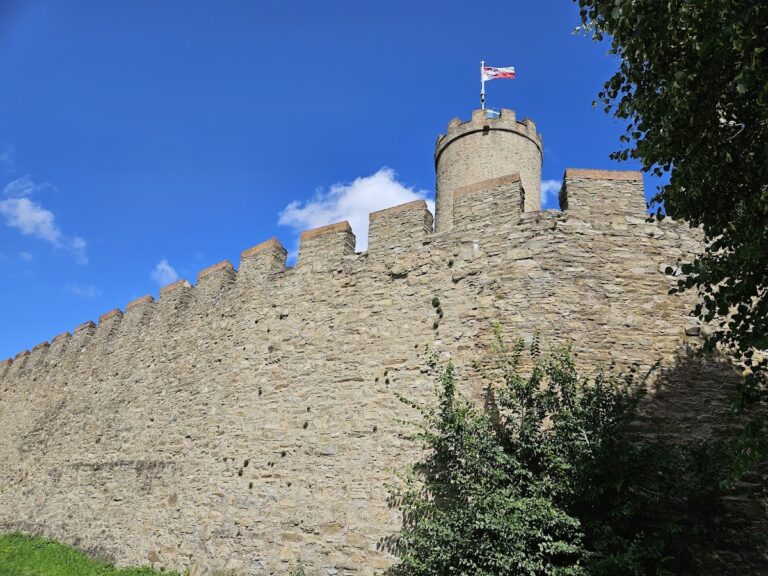
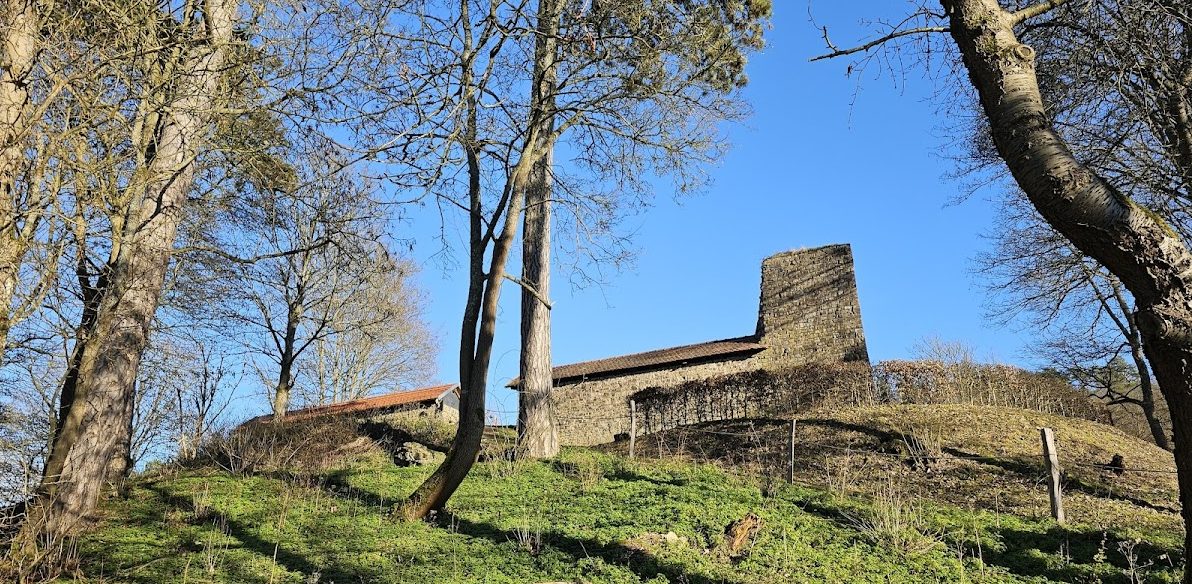
Burg Hatzfeld occupies a projecting mountain spur above the Eder valley, on a slope east of Hatzfeld in Hesse’s Waldeck-Frankenberg district. At approximately 435 metres above sea level, it is both a hilltop castle and a spur castle, a fortress built on a projecting high point. The ruined complex includes the castle gate, a southeastern flanking tower, tower remains, and the residential buildings created and enlarged during the castle’s period of shared family ownership.
Castle structures
Residential buildings
When the castle was divided in 1331, it contained one residential building. The agreement permitted the construction of a second residence alongside it. By the late fifteenth century, the residential buildings had been enlarged with a smaller additional house. Their arrangement reflects the practical consequences of the castle’s shared inheritance, as several family branches required separate accommodation within the fortified complex.
Flanking tower and gate
The documented remains include a southeastern flanking tower, the interior of a tower, and the castle gate. Together, these features represent the defensive and access-related elements of the hilltop complex. The site survives as a ruin and has undergone progressive restoration since 1991.
Archaeological finds
Excavations at the medieval fortified complex have recovered dress fasteners, clay figures, and vessels. These objects provide evidence of everyday life at Burg Hatzfeld during the medieval period and add material detail to the history of the castle’s occupants.
Nearby sites