Burgruine Brandenburg: A Medieval Double Castle in Germany


Site at a Glance
- Rating
- 4.7
- Popularity
- Low
- Country
- Germany
- Primary era
- Medieval
- External website
- Open
- Eras represented
- Medieval
- Civilizations
- Holy Roman Empire, Landgraviate of Thuringia
- Site type
- Military
- Remains
- Castle
On this page10 sections
History
Burgruine Brandenburg is a medieval summit castle and double castle in Germany, located in the municipality of Gerstungen in Thuringia. Built around 1200, it developed under the influence of the Landgraves of Thuringia and became an administrative center for several settlements by the end of the thirteenth century. Its position above the Werra Valley also connected it with an important route between Bad Hersfeld and Eisenach.
Origins and territorial administration
Archaeological finds show that the ridge was occupied during the pre-Roman Iron Age, long before the medieval castle was built. The castle itself is generally dated to around 1200. By 1224, Count Ludwig II of Wartberg was using the additional name “of Brandenburg,” suggesting that the castle already existed by that time.
The Counts of Wartburg, who administered the Wartburg for the Landgraves of Thuringia, are recorded from 1138. In 1279–1280, Albert II of Brandenburg sold the lordship and castle to Landgrave Albert II of Thuringia. The landgrave later transferred the castle to his son Apitz in 1290. Albert II was the last member of his family to hold the title of count, and by 1288 the family had entered the ordinary ministerial nobility, a lower rank of service nobility.
By the end of the thirteenth century, Brandenburg had become an administrative center for Lauchröden, Sallmannshausen, and Unterellen. Its court exercised jurisdiction over these settlements. The surrounding territory was associated with the Wettin lands, territories controlled by a major German ruling dynasty, and with the Wartburg office of Saxony-Eisenach.
Wommen initially belonged to the castle district. In 1268, Burgrave Burghard of Brandenburg transferred part of its property to Kaufungen monastery. The remaining goods and rights passed to the von Kolmatsch family in 1364 and were sold by Reinhard of Brandenburg in 1401.
The formation of the double castle
By the beginning of the fourteenth century, Brandenburg had become a double castle made up of autonomous Lower and Upper Castles, also known as the West and East Castles. Apart from brief intervals, the two parts had separate owners and developed as distinct fortified installations.
Feudal conflicts at the end of the thirteenth century brought destruction to the complex. The East Castle was rebuilt at the beginning of the fourteenth century. In 1322, Fritsche and Heinrich von Heringen received it as a fief from the landgrave. The von Heringen family held the castle until 1359, followed by the von Witzleben, von Weberstadt, and von Kolmatsch families. From 1415, the East Castle was held by the nobles of Herda zu Brandenburg. Their family line ended in 1895, after which the castle passed to the rulers of Saxe-Weimar-Eisenach.
The West Castle became a separate fortified installation at the beginning of the fourteenth century and was probably held as a pledge by the city of Erfurt. Fritsche and Heinrich von Heringen received it as a landgrave’s fief in 1322. In 1383, the von Heringens pledged the West Castle to Erfurt, whose municipal government stationed a permanent garrison there.
From 1390, ownership of the West Castle passed successively to the Marshals of Thamsbrück, the von Nesselrode family, and the von Boineburg-Honstein family. In 1405, it came into the possession of Helwig von Ruckus. Through the marriage of his daughter Gertrud to Georg I von Reckrodt, the castle passed to the von Reckrodt family in 1411. The von Reckrodts retained it until their line died out in 1703.
Abandonment and protection
The West Castle was abandoned in the middle of the sixteenth century. The East Castle continued longer but was abandoned after the Thirty Years’ War, the European conflict fought from 1618 to 1648. From the seventeenth century onward, the complex deteriorated as local residents dismantled it for building material. Masonry, roofs, and floors were reused in houses, estates, and other construction in Lauchröden and neighboring communities.
Demolition ended in 1841, when Grand Duke Carl Friedrich of Saxe-Weimar-Eisenach placed the ruins under protection. The construction of the Thuringian Railway improved access to the Werra Valley, and by around 1870 Brandenburg had become an excursion destination.
Technical safety work in 1906–1907 focused chiefly on the East Castle, where surviving towers and wall fragments were at risk of collapse. Further work continued during the 1920s. In 1924, the Werra Valley Association, founded at Eschwege in 1883, established a Brandenburg branch. Architectural study of the ruins followed, including documentation and a scale model reconstructing the double castle as it appeared in the fifteenth century.
Twentieth-century conservation
After the Second World War and the division of Germany, Brandenburg lay in the eastern part of the country. From 1962, its proximity to the inner-German border along the Werra led the authorities of the German Democratic Republic to fence off the castle and prohibit visits, including by residents of Lauchröden. Supervised access was restored in 1988.
Residents of Lauchröden then initiated conservation work. Between 1990 and 1994, the Brandenburg Association worked with the state of Thuringia after surveys identified structural damage. The West Castle’s keep and the East Castle’s Kemenate, a heated medieval residential building, were secured while retaining original materials as far as possible. Archaeological investigation accompanied the work and provided evidence for the building history.
In 1994, responsibility for monument conservation passed to the Foundation of Thuringian Palaces and Gardens. The Brandenburg Association continued to administer the site and develop it for visitors. The ruins remain in the foundation’s care.
Remains
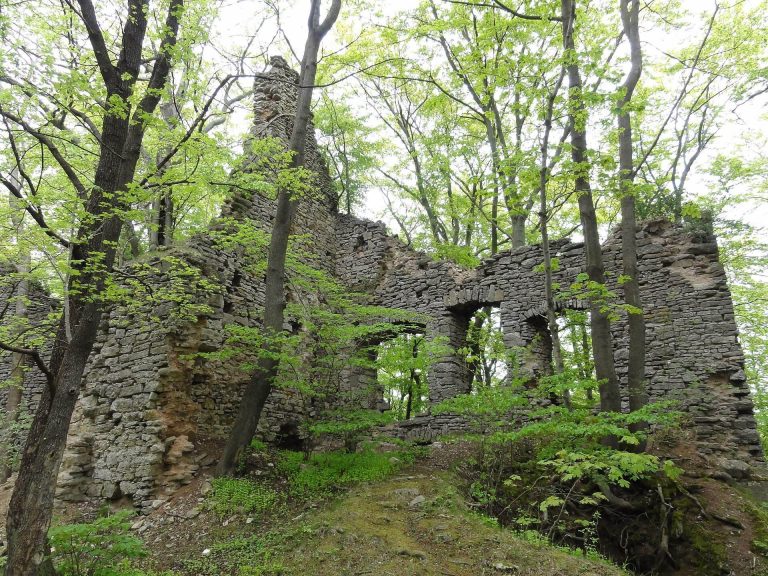
Burgruine Brandenburg occupies a high hill at 274.6 metres above sea level in the central Werra Valley. The West and East Castles stand on separate parts of the summit and retain distinct remains. The surviving complex consists chiefly of sections of the ring walls, three towers, the West Castle’s keep, and several exposed underground features in the East Castle.
The two castle sections
West Castle
The West Castle preserves a keep, the principal fortified tower, together with fragments of its surrounding fortifications. Its remains form the surviving core of the western installation, which became a separate fortified site in the early fourteenth century. The keep was secured during conservation work between 1990 and 1994, when structural measures sought to preserve the existing materials and stabilize the ruin.
East Castle
The East Castle contains surviving towers and wall sections, along with a Kemenate, two cellars, and a cistern. A cistern is a structure used to collect and store water. The Kemenate now houses a museum devoted to Brandenburg’s history. The cellars and cistern were exposed and examined during the post-1990 conservation and archaeological work, which also helped clarify the building history of this part of the complex.
Walls, groundworks, and surrounding routes
The castle interior and the historic moats around it were cleared of dense uncontrolled vegetation after 1990. The removal of vegetation from the moat and masonry allowed the walls and other remains to be investigated and stabilized. The site is now characterized by ruinous walls, towers, the secured keep, and excavated or exposed underground structures.
Hollow-way roads on the slopes behind the double castle preserve evidence of a high-medieval route from Bad Hersfeld to Eisenach. The route included fords at Sallmannshausen, Herleshausen, and Neuenhof. Brandenburg may therefore have controlled a western approach into Thuringia and provided escort protection along the Werra Valley between Gerstungen and Eisenach. The castle also stands near the eastern castles of Neuenhof and Wartburg and is connected with the surrounding landscape by walking paths.