Festung Hohentwiel: A Fortress Ruin in Germany


Site at a Glance
- Rating
- 4.7
- Popularity
- Medium
- Country
- Germany
- Primary era
- Early Modern
- External website
- Open
- Eras represented
- Medieval, Early Modern
- Civilizations
- Duchy of Württemberg, Holy Roman Empire
- Site type
- Military
- Remains
- Fort
On this page20 sections
History
Festung Hohentwiel is a ruined fortress in Germany above Singen, developed from a fortified Swabian ducal site established around 914 during the uprising of Duke Burchard II against King Conrad I. Conrad besieged the stronghold unsuccessfully in 915, and Burchard was formally invested with the Duchy of Swabia by Conrad’s successor, Henry I, around 920. Hohentwiel later became a ducal residence, a monastery center, and eventually a Württemberg state fortress.
Swabian ducal residence
Under Duke Burchard III, Hohentwiel became a Swabian ducal residence in the middle of the tenth century. A monastery dedicated to Saint George and an associated school were founded in 970. The exact positions of the early residence and monastery remain uncertain. They may have occupied the summit or the Hohentwiel Terrace, while the mountain itself may have contained a more limited refuge fortress.
After Burchard III died in 973, his widow Hadwig retained control of Hohentwiel until her death in 994. Royal documents described her as dux, a Latin title meaning duke or military leader. Around 973 she summoned Ekkehard II, a monk of the Abbey of Saint Gall, to teach her Latin. Emperor Otto III visited Hohentwiel twice while questions concerning Hadwig’s inheritance and claims to royal property were being settled. His presence also indicates that the residence had developed into a comfortable and substantial court.
The monastery was transferred to Stein am Rhein around 1005. Hohentwiel consequently lost its position as a regional cultural center. The name appears in the Saint Gall monastery chronicle of Ekkehard IV as castellum tuiel, in connection with the siege of 915. Later Latin documents used Duellium or Duellum, while Tuiel and Twiel preceded the first recorded use of Hohentwiel in 1521. The meaning of the name remains uncertain, although more recent linguistic interpretations have suggested an Alemannic derivation connected with an Indo-European root meaning “to swell.”
Medieval lords and territorial rivalry
Hohentwiel was probably associated with the Zähringer family in 1079, when Adelheid, the wife of the anti-king Rudolf of Rheinfelden and mother-in-law of Berthold II of Zähringen, died there. An anti-king was a rival claimant opposing a recognized king. In 1086 Abbot Ulrich von Eppenstein of Saint Gall took control of Hohentwiel. After his death in 1121, the Lords of Singen possessed it between 1122 and 1132 and adopted the name Lords of Twiel. Their legal position is uncertain, since they may have held the stronghold as owners or as royal or ducal fiefs.
After the Zähringer family became extinct in 1218, the Lords of Klingen took an interest in Hohentwiel. Ulrich von Klingen sold it to Albrecht von Klingenberg on 16 February 1300 for 940 marks of silver. The Klingenberg family then retained it for seven generations. Caspar von Klingenberg acquired lordship over Hohenklingen in 1419 and the bailiwick of the Saint George monastery in 1433. A bailiwick was an office concerned with protecting and administering an institution or territory, and Caspar’s acquisition restored the Klingenberg family’s protective relationship with the monastery after more than four centuries.
Rivalry between the Klingenberg and Werdenberg families brought armed forces to Hohentwiel. Johann von Werdenberg, the Society of the Shield of Saint George, and Württemberg troops besieged the site on 11 October 1464. Hans von Rechberg died during the wider conflict, and Eberhard von Klingenberg sought mediation from Archduke Sigismund of Austria. Peace was concluded at Biberach on 28 January 1465, after which Eberhard became Sigismund’s vassal.
A Klingenberg agreement of 1475 prohibited the sale of the jointly held castle. Financial pressure nevertheless drew several family members into the service of competing powers. Albrecht and Caspar the Elder entered the service of Eberhard the Elder of Württemberg in 1483, while Bernhard von Klingenberg did so in 1486. Caspar the Elder entered Austrian service in 1485, and Albrecht followed in 1489. Württemberg and Habsburg interests consequently competed directly in the Hegau. Hohentwiel was not attacked during the Swabian War of 1499.
Ulrich of Württemberg and the state fortress
In 1511 Duke Ulrich of Württemberg obtained the right to use Hans Heinrich von Klingenberg’s share of Hohentwiel. When the Swabian League expelled Ulrich from Württemberg in 1519, this arrangement allowed him to take refuge at Hohentwiel. In 1521 he acquired the use of the site as a base for reconquering his duchy, under an agreement that was supposed to return it to Hans Heinrich von Klingenberg two years after a successful reconquest.
Ulrich assembled support for his campaign in early 1525. Around 500 Swiss mercenaries were stationed at Hohentwiel, while between 6,000 and 8,000 troops gathered in the surrounding area. The campaign was abandoned near Stuttgart after the capture of the French king Francis I at Pavia led to the recall of the Swiss troops.
After Ulrich recovered Württemberg, Hohentwiel was not returned to the Klingenbergs. On 24 May 1538 he bought the entire site for 12,000 gulden and selected it as one of seven state fortresses intended to secure Württemberg. Francis I of France provided financial assistance for the expansion, and Duke Christoph enlarged the fortress in 1550. The former aristocratic and administrative residence was transformed into a predominantly military installation with a permanent garrison.
The fortress reached its maximum development in 1735 after further expansions in 1653, 1700, and 1735. From 1658 it served both as a Württemberg state prison, meaning a prison operated by the territorial government, and as a refuge for the ducal family. It was placed on a war footing during the War of the Spanish Succession, a European conflict fought from 1701 to 1714 over the succession to the Spanish throne, although Hohentwiel saw no fighting in that war.
Prison, decline, and destruction
During the War of the Austrian Succession, Duke Carl Eugen and his brothers Ludwig Eugen and Friedrich Eugen were sheltered at Hohentwiel from August to October 1741. The jurist Johann Jacob Moser was held there as a political prisoner from 1759 to 1764. From the second half of the eighteenth century, the fortress lost military importance. Buildings in the Lower Fortress were demolished without subsequent reconstruction, reflecting this change in its role.
During the French Revolutionary Wars, French forces compelled Hohentwiel to surrender on 1 May 1800. The Württemberg commanders Bilfinger and Wolf had initially invoked Württemberg’s neutrality. The garrison received free withdrawal on the following day, after which the fortress was plundered. The French government ordered its demolition in August 1800, and the fortifications were dismantled between October 1800 and March 1801.
Duke Friedrich II had Hohentwiel cleared and made safer for visits in 1804. After the Treaty of Paris in 1810, the surrounding territory became part of Baden, while Hohentwiel remained a Württemberg crown possession and exclave, a territory separated from the main territory of the state that controlled it. Negotiations to resolve this territorial situation failed in 1847, and Hohentwiel came under the city of Tuttlingen in 1849. Proposals to rebuild the fortress or restore its military function were repeatedly considered after 1821, but they did not recreate the stronghold.
Modern interpretation and conservation
An air-observation post operated on Hohentwiel during the First World War and again during the Second World War. In 1945 the old casemates, vaulted military chambers, were used as shelters for nearby residents. French tanks approaching Singen shelled the site on 27 April, damaging the Rondell Augusta and Wilhelmswacht.
Hohentwiel came under the administration of Singen on 1 January 1969. The ruins are now administered by the State Palaces and Gardens of Baden-Württemberg and function as an open-air museum. A week-long festival is held each July. It continues a performance tradition that began with unsuccessful festivals in 1906 and 1907, resumed in 1921, and used the Karlsbastion from 1922. Nazi-sponsored German festivals were held at the fortress from 1935 to 1939.
Joseph Victor von Scheffel’s 1855 novel Ekkehard strongly influenced popular ideas about Hohentwiel. Its fictional romance between Ekkehard II and Hadwig, together with its depiction of a Hungarian attack and other events, was treated by many readers as historical fact. Some later signs at the ruins consequently gave buildings historically incorrect labels. The fortress has been repeatedly repaired and stabilized since its destruction. Modern conservation addresses mortar washed from historic masonry by rain, frost damage, vegetation, and the danger of walls sliding. Measures include mechanically tying walls together and anchoring them to the rock with rock bolts.
Remains
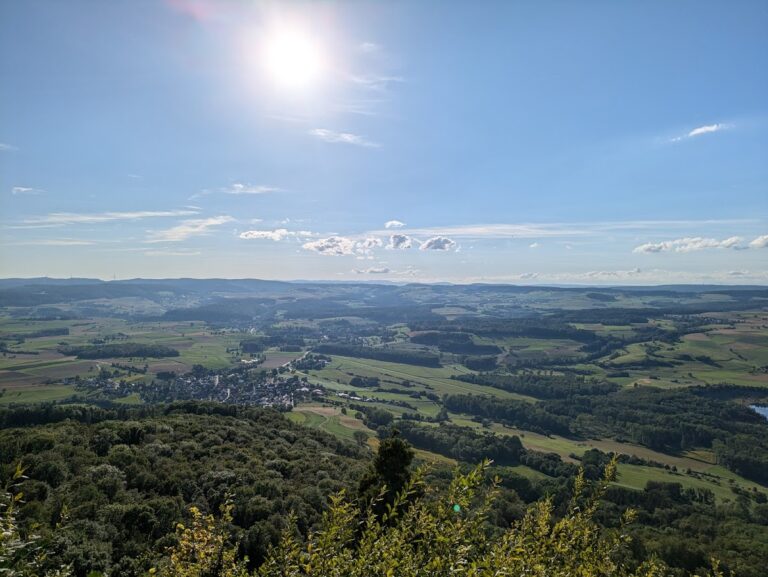
Festung Hohentwiel occupies the summit of the extinct volcanic Hohentwiel, a volcanic dome rising to 686 metres above sea level. The rock rises about 260 metres above Singen on the mountain’s eastern foot and commands the Hegau and the area toward Lake Constance. At its greatest extent in 1735, the fortress covered approximately 9 hectares and 92 ares. The Upper Fortress occupied 2 hectares and 18 ares, the Lower Fortress 2 hectares and 12 ares, and the surrounding earthworks 5 hectares and 62 ares. The surviving complex is a large ruin organized around lower and upper defensive areas, terraces, gates, barracks, storage buildings, and artillery positions.
Medieval castle
Early fortifications
The form of the first fortifications, documented from 914, is uncertain, although they may have used timber and earth. The location of the early ducal residence and Saint George monastery is also unresolved, with the summit and the Hohentwiel Terrace both forming possible settings. Masonry preserved in the western wall of the area called the Herzogsburg is attributed to the fourteenth or fifteenth century.
Castle entrance and residential building
The late-medieval castle can be reconstructed from the castle-peace agreement of 1475 and an inventory compiled on 21 June 1521. A gatehouse opened into a forecourt, followed by a bridge and footbridge leading to an outer tower that protected the entrance to the main castle. The main castle occupied about 30 by 23 metres. At its rear stood a multistorey building measuring approximately 11 by 22 metres, probably extending over several floors.
The building contained chambers for women, servants, boys, priests, and private occupants, as well as a living room, archive or document room, spinning room, well room, and covered defensive passage. A chapel and castle kitchen formed part of the medieval complex. The inventory listed 44 beds, including two in the well room and eleven broad beds on the defensive passage, apparently intended for several occupants. Chests, a cupboard, small lockable cabinets, and tables were concentrated in the living rooms.
Supplies and weapons
The castle’s water supply came from a cistern. Water was carried daily by donkey from the Eselsbrunnen on the western approach. In 1475 the stores included about 7,000 litres of wine, ten pigs, and large quantities of grain, legumes, lard, salt, and other provisions. The 1521 inventory lists greatly increased food and wine stocks, three wine cellars, granaries, livestock, carts, horses, and donkeys.
Maintenance was supported by complete masonry and carpentry tool sets, with a complete blacksmith’s equipment set added by 1521. The armament grew from four windlass crossbows, five hand guns, and arquebuses in 1475 to 25 crossbows, six hand guns, 54 arquebuses, two field culverins, and eleven smaller falconets in 1521. By 1616 the fortress possessed 47 heavy guns and 612 hand firearms.
Württemberg military works
Upper Fortress
Beginning in 1521, the Klingenberg castle was extensively rebuilt for military use. The central building was retained, and its walls later became the inner wall of the Herzogsburg. The summit was levelled into two plateaus. Barracks occupied the eastern plateau, while excavated material raised the western plateau. A wall enclosed the summit.
In 1522 the Upper Fortress received a cellar measuring 220 by 60 feet and a vaulted structure measuring 200 by 24 feet. Another vault, a grain ditch with a storage mound, and three cisterns were added in 1523. Around 1526 the eastern enclosure received the artillery towers Wilhelmsturm and Gutgenug, while the western side received the gun tower Scharfes Eck. A covered passage connected the eastern towers with the barracks. A windmill stood on the summit by 1527, although it never functioned properly.
Between 1553 and 1554 Duke Christoph converted the old Klingenberg castle into the Renaissance residence called the Herzogsburg. Its three wings enclosed an almost rectangular courtyard. A representative gate was added to the forecourt in 1559, together with a wine press house and a building for wagons. The Rondell Augusta, a circular gun tower 25 metres in diameter, later dominated the western approach. Its date is uncertain, but its position made Scharfes Eck redundant, suggesting construction no earlier than Christoph’s reign and possibly under his successor, Duke Ludwig.
Later upper defenses
Between 1627 and 1634, additional projecting defensive platforms, or bastions, were built, particularly along the eastern side. Two bastions were constructed there, and Schmittefelsen was converted into another. A windmill was erected in 1635. Between 1639 and 1645 a church was built using an inventory assembled from objects seized in the surrounding area.
The Upper Fortress is organized around the Long Building, a barracks with an arcaded passage, and the Parade Ground, which contains the cisterns and connects with the gun tower Gutgenug. A passage in the barracks leads to the Wilhelmswacht, the eastern bastion. The Upper Bakery stands at the southern end of this area, with the church’s longhouse to its north. On the western side are the Herzogsburg and its bathhouse. The southern edge is formed by the Eberhardswacht, which continues westward into the Rondell Augusta, while the arsenal lies to the north. The northernmost section is the Friedrichsbastion on Schmittefelsen, and a portal leads into the Upper Fortress.
Lower Fortress and approach
Lower Fortress defenses
The former Klingenberg forecourt had become the Lower Fortress by 1588, when a wall with half-round towers for small artillery protected it. The date of this transformation is uncertain. The fortification of Schmittefelsen may belong to the early construction phase. A first Meierhof, an agricultural estate serving the fortress, was built below the stronghold in 1593.
After the Thirty Years’ War, the repeatedly damaged Lower Fortress was rebuilt. The gate building was renewed and moved inward, the Eugenstor was built farther west, and a new cellarer’s building was added and later used as officers’ accommodation. Economic and residential facilities also expanded. A residence was later converted into an apothecary, and an inn was established.
The entrance system was reorganized with a crownwork around the forecourt, including the western section now called the Karlsbastion, and access through the new Karlstor. Construction of an additional fort in the Lower Fortress was halted under Austrian pressure. Later work continued the defensive ring between the small southern bastion called the Triangel and the Rondell Augusta, creating the St. Erdmann defensive terrace. The terrace initially contained an orchard. A garden on the Ludwigsbastion helped increase the fortress’s self-sufficiency during sieges.
Gates and service buildings
The surviving route through the Lower Fortress begins at the Alexandertor and its tunnel. It continues past the heavily ruined Karlstor and Karlsbastion, then through the Eugenstor. Along the route are the gate building called Radschinen, the staff officers’ building, the Old Press House, the apothecary, the sutler’s shop, and the barracks. The church was also used as a storehouse, the former mill became soldiers’ accommodation, and the Wilhelmswacht became a sutler’s shop. A windmill tower, a tower at the ducal residence, a hospital, and further service buildings were added over time. A buried entrance associated with the structure called the Karponniere survives in the Lower Fortress.
The ascent toward the Upper Fortress passes the bakery and a service building, followed by the remains of a gate tower, the structure called Salzbüchsle, and the forge. The Friedrichsbastion occupies the northern section on Schmittefelsen. These surviving elements connect the lower approach with the summit’s residential, storage, and defensive areas.
Later physical features and records
Post-demolition repairs
Much of the fabric remaining after 1801 was removed or damaged, and local inhabitants took building material during and after the demolition. In 1804 rubble was cleared, loose stones were removed from walls, roads were made passable for wagons, and bridges to the Upper Fortress were repaired. The church tower was repaired around 1845 and used as a viewing tower, when the first viewing platform was also built. The bridges were closed in 1847 and renewed in reduced form in 1849. The deteriorated staircase of the Rondell Augusta was repaired around 1900, the south wall of the Upper Fortress was renovated in 1912, and a parapet wall made the Karlsbastion safer in 1920.
Commemorative features
The ruins include commemorative relief medallions of Otto von Bismarck and Joseph Victor von Scheffel, both made by Theodor Bausch. A leather-bound guestbook known as the Willkommbuch was made from high-quality paper produced in Zurich and presented by Duke Eberhard III during the ceremonial reoccupation of Hohentwiel in June 1652. Over 148 years it accumulated about 900 visitor verses and maxims in German, French, Latin, Greek, and Hebrew. Its opening motto was Tout avec Dieu, meaning “Everything with God.”
The guestbook records visits by Duke Eberhard Ludwig in 1702, Duke Carl Alexander in 1734, and Duke Carl Eugen with his brothers in 1741. It also preserves the custom, established under Duke Ulrich, of visitors carrying a 40-pound stone up the mountain in return for a welcome drink from a gold cup. Entries were made by fortress officers, clergy, young nobles on educational tours, women from 1734 onward, and members of the bourgeoisie during the eighteenth century.