Arch of Augustus Aosta: Roman Victory Monument in Italy
Site at a Glance
- Rating
- 4.5
- Popularity
- Medium
- Country
- Italy
- Primary era
- Classical
- Eras represented
- Classical, Medieval, Early Modern
- Civilizations
- Roman
- Site type
- Civic
- Remains
- Arch
On this page6 sections
History
The Arch of Augustus Aosta is a Roman monument in Aosta, Italy, erected in 25 BC to commemorate Rome’s victory over the Salassi, an ancient Alpine people who came into conflict with Rome in the region of the later Aosta Valley. Its construction was undertaken by Aulus Terentius Varro Murena, a Roman magistrate and military commander of the late Republic and early imperial period.
Roman foundation
The arch stood on the principal east-west street of Augusta Praetoria Salassorum, the Roman colony established at the site of modern Aosta. It was positioned near the eastern entrance through the city wall, the Porta Praetoria, and a short distance from Bourg Saint-Ours, the quarter associated with the Collegiate Church of Saint Ursus.
Medieval and later history
During the medieval period, the monument was known as Saint-Voût. The meaning of this name remains uncertain, although it became associated with an image of the Savior placed beneath the arch. In the twelfth century, a local noble family used the structure as a residence. In 1318, a small fortification for a corps of crossbowmen was installed inside it.
A wooden crucifix was placed beneath the arch in 1449 as a votive offering, an object dedicated in response to a religious vow or appeal, connected with protection from the catastrophic flooding of the Buthier. In 1716, numerous leaks threatened the monument’s structural integrity, so the attic that had formerly crowned the arch was replaced by a slate roof.
Restoration and consolidation took place in 1912 under the direction of Ernesto Schiaparelli, an Italian archaeologist, Egyptologist, and heritage official. The monument’s modern appearance results from this intervention. The crucifix now shown beneath the vault is a copy, while the original is preserved in the Museum of the Treasures of Aosta Cathedral.
Remains
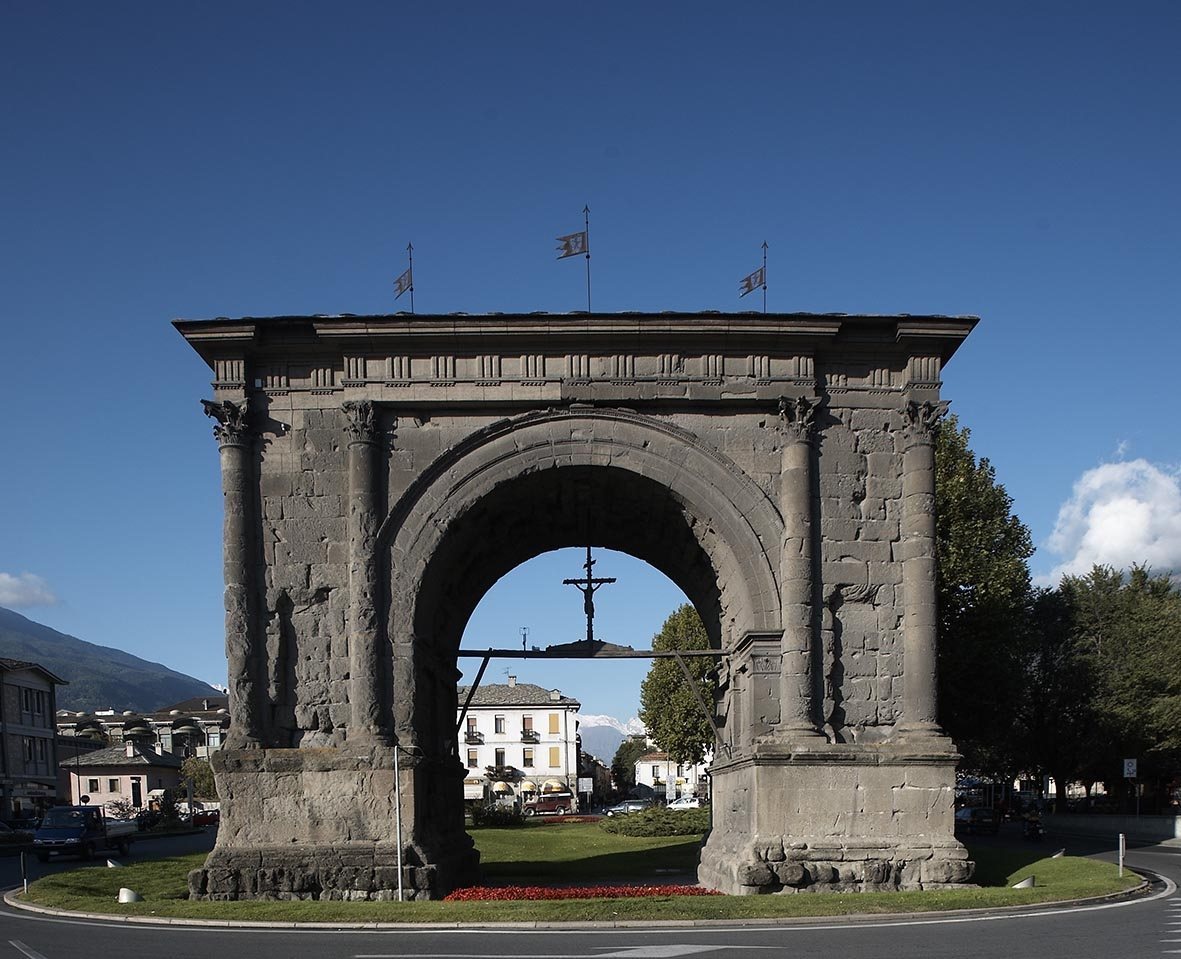
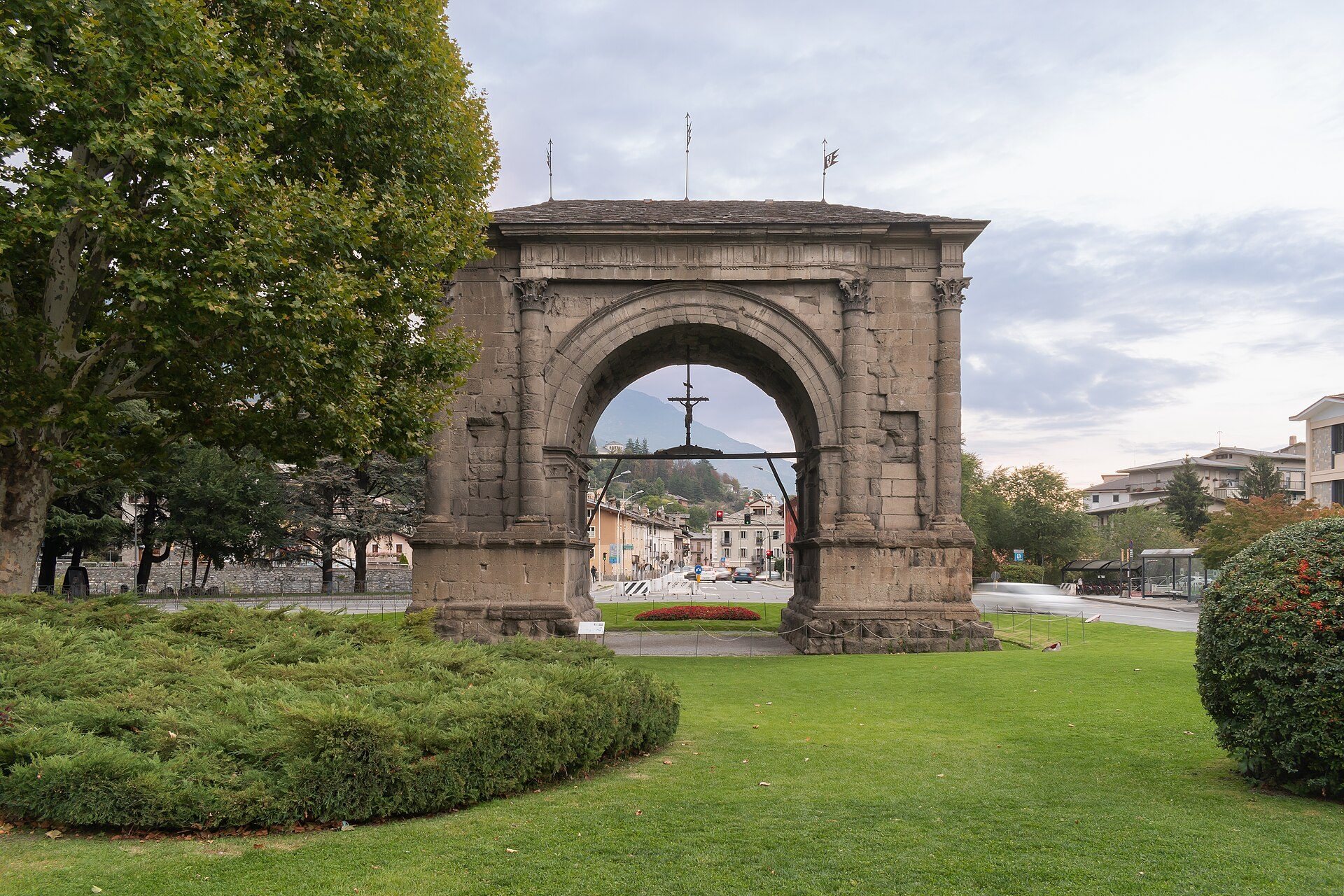
The arch is built from conglomerate blocks and consists of a single opening covered by a barrel vault. Its height to the keystone is 11.4 metres. The Buthier flows a short distance to the east, providing part of the monument’s physical setting.
Classical structure
Ten engaged or semi-engaged columns decorate the facade and sides of the monument. Their capitals are Corinthian, an architectural order especially known for ornate capitals. Above them, the entablature uses the Doric order, whose characteristic metopes and triglyphs appear in its decoration. The arch therefore combines Corinthian columns with a Doric entablature.
Crucifix beneath the vault
The wooden crucifix beneath the vault is a modern copy of the one installed in 1449. Its original remains in the Museum of the Treasures of Aosta Cathedral, while the copy preserves the crucifix’s place beneath the arch and its connection with the historical appeal for protection from the Buthier’s flooding.