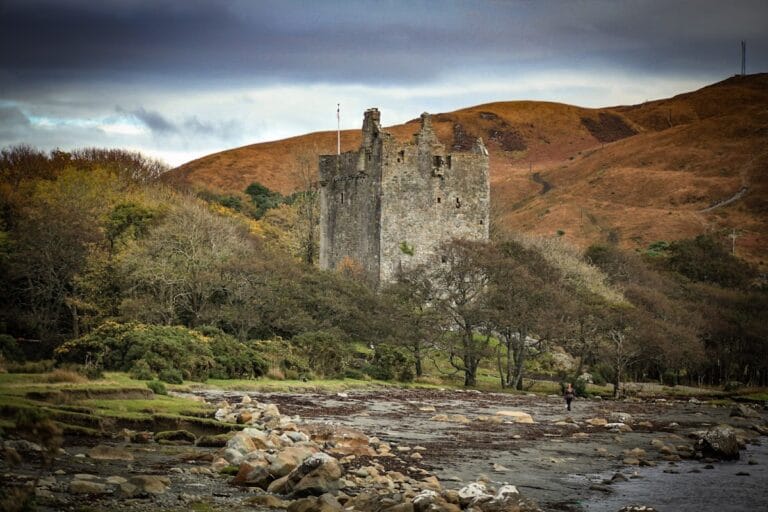
Ardtornish Castle: Fortress and Seat of the Lords of the Isles


Site at a Glance
- Rating
- 4.9
- Popularity
- Very Low
- Country
- United Kingdom
- Primary era
- Medieval
- External website
- Open
- Eras represented
- Medieval
- Civilizations
- Kingdom of Scotland
- Site type
- Military
- Remains
- Castle
On this page6 sections
History
Ardtornish Castle is a ruined medieval fortress in Scotland, built by Clan Donald during the 14th century on the Morvern peninsula. It occupied an important position on the sea routes of the western coast and became one of the principal seats of the chiefs of Clan Donald, whose leaders held the powerful Lordship of the Isles.
Early fortress and Clan Donald
A fortress stood at Ardtornish by the mid-12th century under Somerled, a Gaelic-Norse ruler whose power extended across the western Scottish Isles and mainland territories. The surviving castle is associated with a later construction by Clan Donald, probably dating from the 14th century.
From the early 14th century until the late 15th century, Ardtornish served as a residence and strategic centre for the chiefs of Clan Donald. Its position beside the Sound of Mull connected the castle with important maritime routes and with the island territories governed through the Lordship of the Isles.
The Lords of the Isles
John of Islay, Lord of the Isles and the sixth chief of Clan Donald, died at Ardtornish in the 1380s. His funeral procession travelled by sea from the castle through the Sound of Mull to Iona.
John’s son and successor, Donald of Islay, issued charters at Ardtornish. At least two of these survive, one written in Latin and another in Gaelic. Tradition also connects the castle with Donald’s campaign to support his claim to the Earldom of Ross. His galley fleet was said to have carried island vassals from Ardtornish to the west coast of Ross-shire, where the invasion began. The campaign culminated in the indecisive Battle of Harlaw in 1411.
The Treaty of Ardtornish-Westminster
In 1461, John of Islay, the fourth and last Lord of the Isles, met commissioners of Edward IV of England at Ardtornish. Their negotiations produced the Treaty of Ardtornish-Westminster, an English-backed political agreement proposing the division of one-third shares of the Scottish kingdom among John of Islay, his kinsman Donald Balloch of Dunnyvaig and the Glens, and James Douglas, 9th Earl of Douglas. In return, the parties would support Edward IV and receive financial payments until the proposed conquest.
The English government revealed the treaty to the Scottish government in 1474. John of Islay consequently lost the Earldom of Ross the following year, and his final forfeiture as Lord of the Isles came in 1493.
Later ownership and abandonment
After the forfeiture, Ardtornish’s lands remained in Crown hands for a period before passing to the chief of Clan MacLean of Duart Castle. The MacLeans, a Scottish Gaelic clan based on the island of Mull, had already acquired extensive estates in Morvern.
Ardtornish Castle was probably abandoned around the end of the 17th century, when the Campbell Earls of Argyll took Ardtornish and the other MacLean estates in Morvern. The site is now protected as a Scheduled Monument, an archaeological or historic site safeguarded under United Kingdom law because of its national importance.
Remains
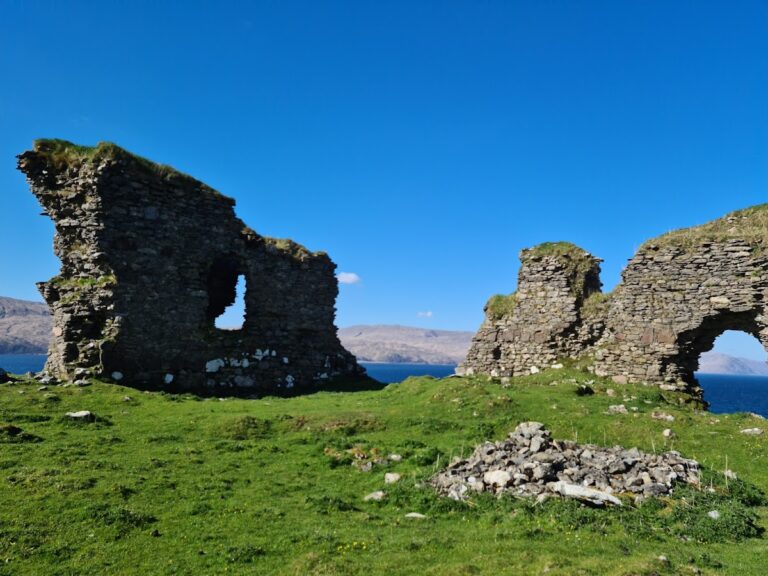
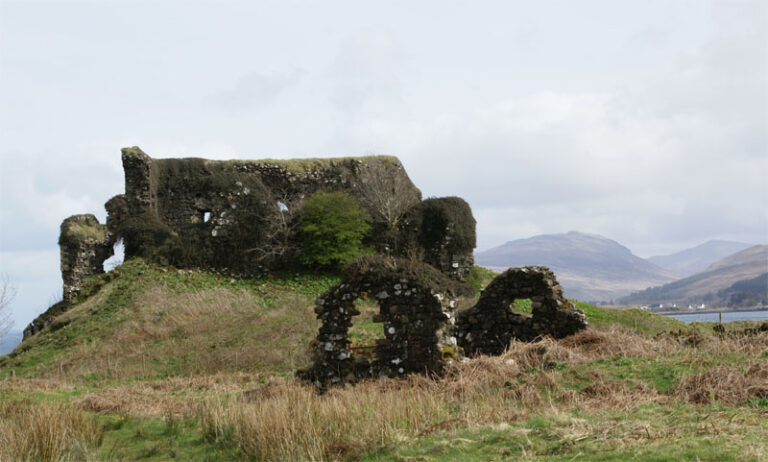
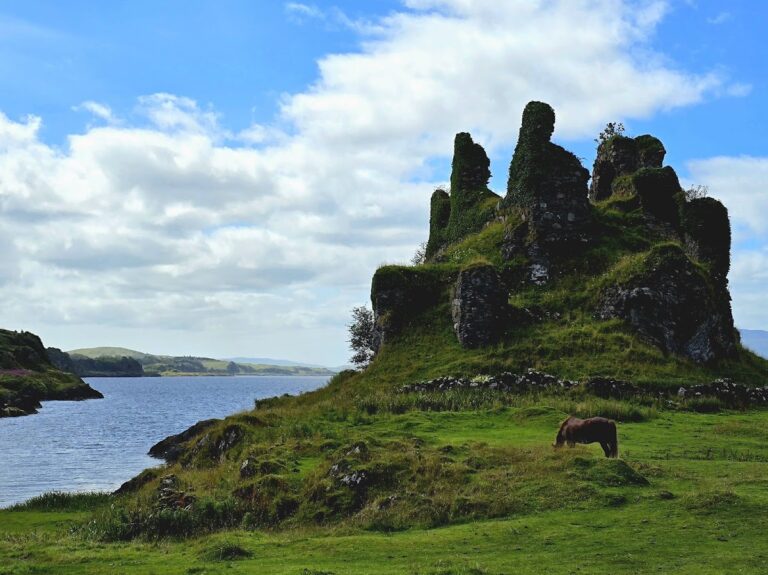
Ardtornish Castle survives as a ruin within the grounds of the Ardtornish estate on Scotland’s west coast. The remains occupy the seaward end of a promontory extending south into the Sound of Mull, approximately 1.6 to 2 kilometres south-east of Lochaline. The castle’s position at the end of this projecting landform places its surviving fabric directly within the maritime setting that shaped its historical role. The remains are in a ruined condition.