Bukovina: A Medieval Hilltop Castle near Hostim, Czechia

Site at a Glance
- Rating
- 4.4
- Popularity
- Very Low
- Country
- Czechia
- Primary era
- Medieval
- Eras represented
- Medieval
- Civilizations
- Holy Roman Empire, Margraviate of Moravia
- Site type
- Military
- Remains
- Castle
On this page12 sections
History
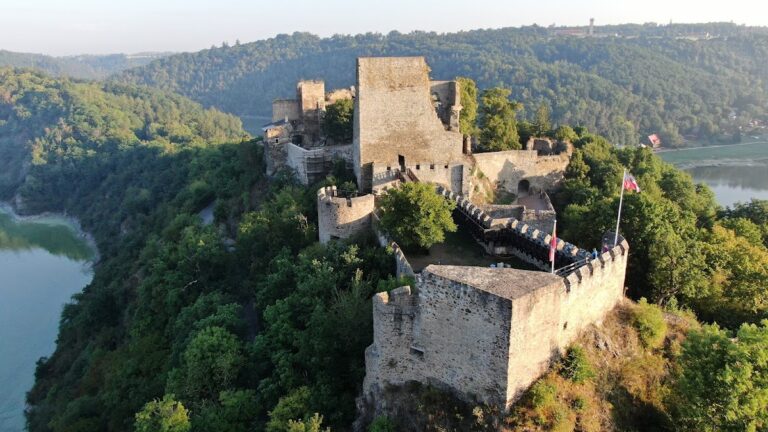
Bukovina is a ruined medieval hilltop castle near Hostim in Czechia, probably established in the early fourteenth century to protect the Haberner Way, an important route between Bohemia and Moravia. The castle became the lordly seat of the Bukovina lineage and occupied a strategic position above the Nedveka valley.
Early records and construction
The site is first recorded in 1173 as the seat of Hrut of Bukovina. Reliable information then becomes scarce, apart from a fourteenth-century forgery. The castle was probably founded around 1320–1325. Rebuilding or enlargement probably began during the first quarter of the fourteenth century and was completed in 1337.
In 1337, Gerhart of Bukovina was documented as the castle’s owner. He belonged to an Austrian family that had entered service in the Czech lands. By the middle of the fourteenth century, five or six men from the second generation of the Bukovina lineage, together with their families, shared the castle. The family also held a stronghold at Hostim, and this division of the lineage apparently led to the construction of an additional palace on Bukovina’s southern side.
The Bukovina lineage and its estate
In 1350, Hartleb, Jindřich, and Smil of Bukovina held the castle and an estate that included the stronghold, court, and village of Hostim. The estate also comprised the villages of Bukovina, Jiřice, Našiměřice, Mašůvky, Chvalovice, Bojanovice, Hrušovany, and Zárubice.
The Bukovina lineage became extinct in 1417 after the death of Ludvík of Bukovina, and the estate passed to their relative Jan Vajtmilar of Žerotice. By the early fifteenth century, Jan of Bukovina was apparently the only surviving member of the lineage.
War, destruction, and abandonment
During the Hussite Wars, the religious and political conflicts associated with the followers of Jan Hus, the castle and the villages of Bukovina and Hostim were burned. The nearby village of Bukovina remained deserted after the fighting.
In the middle of the fifteenth century, the Lords of Lichtenburg acquired the Bukovina estate. In 1463, Hynek Bítovský of Lichtenburg rebelled against George of Poděbrady, the fifteenth-century King of Bohemia, during a feud with the Lords of Kunstadt. The king confiscated Hynek’s Zornstein Castle and sent royal troops to besiege it in 1464. They captured the castle the following year.
Hynek Bítovský was associated with the Hostim stronghold and Bukovina Castle in 1464. He died in 1472, and the Bukovina estate remained with the Lords of Lichtenburg until 1563, although the Hostim stronghold served as its administrative seat. Bukovina was recorded as deserted in 1481 and may already have been abandoned before the Lords of Lichtenburg formally acquired it. It is uncertain whether royal troops destroyed the castle during Hynek Bítovský’s rebellion. The castle was probably never rebuilt after its destruction during the Hussite Wars, and archaeological investigation has found no settlement traces from the second half of the fifteenth century.
Later recognition
Over time, the castle’s name was forgotten. Until the nineteenth century, the site was generally described only as a deserted castle. The ruin has been legally protected as a cultural monument since 1958 and is listed as a Czech cultural monument under registration number 21209/7-6345.
Remains
Setting and defensive enclosure
Bukovina occupied the end of a plateau above the Nedveka valley, beside an extensive forest. The castle stood at about 393 metres above sea level in the Jevišovka Nature Park and the Jevišovice Hills. The Štírák, also called Škorpión, rises to the northeast at 421 metres.
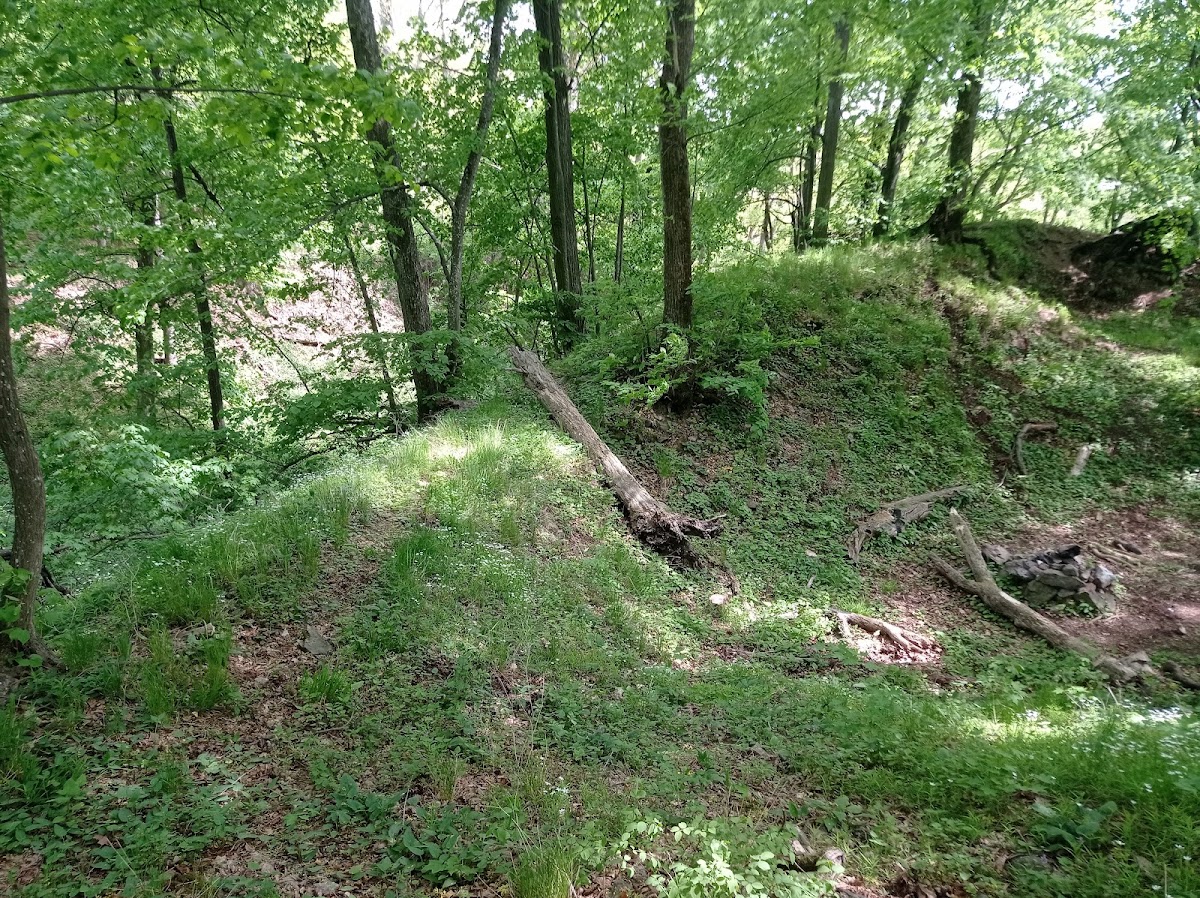
The castle formed a compact, single-part enclosure bounded chiefly by a curtain wall, the enclosing defensive wall connecting fortified structures, which was approximately 2.5 metres thick. A curved ditch 16–30 metres wide separated the castle from the forefield and the former village of Bukovina. On the narrower northeastern side, an outer rampart and a second ditch about 10 metres wide strengthened the approach. The rampart and ditches remain clearly visible, while only limited masonry survives above ground.
Round defensive tower
A round bergfried, an independent medieval defensive tower, was built into the northern curtain wall. It had an outer diameter of about 10 metres and an inner diameter of about 3 metres. A gate stood at the tower’s foot. Small sections of both the tower and the curtain wall survive.
Palaces and residential towers
Earlier southeastern palace
An earlier palace occupied the southeastern corner of the castle. Its surviving form is represented by two depressions, marking the position of this first residential building within the original castle core.
Later southern palace
A larger palace was later built farther downslope beyond the original core. Its two-room basement contained rooms connected by a small portal. The building measured approximately 11–13 metres in width and 40 metres in length, making it among the largest castle palaces in Moravia. Masonry from the southern room survives, together with the vaulted passage leading to the northern room.
Southwestern donjon
A third residential building stood on the southwestern projection of the site. It was a square donjon, a substantial tower that could also provide residential accommodation, with reinforced corners. Its form is known from a drawing made in 1787. Together, the square residential tower and the round northern bergfried gave Bukovina two comparatively unusual tower types.
Nearby sites