Bewcastle Castle: A Medieval Border Fortress in Cumbria


Site at a Glance
- Rating
- 4.3
- Popularity
- Very Low
- Country
- United Kingdom
- Primary era
- Medieval
- Eras represented
- Medieval
- Civilizations
- English
- Site type
- Military
- Remains
- Castle
On this page8 sections
History
Bewcastle Castle is a medieval castle ruin in Bewcastle, United Kingdom, near the Scottish border. The first castle was built around 1092 on the site of the earlier Roman fort of Fanum Cocidi, probably as a timber-and-earth stronghold. Its builders appear to have reused the northern and eastern ditches of the Roman fort, linking the medieval fortress to an older military landscape.
Early castle and destruction
The first castle was destroyed in 1173. A stone replacement was built between 1361 and 1371 by John de Strivelyn. Stone from Fanum Cocidi was reused in the work, and the northeastern corner of the Roman fort was completely demolished to provide building material. This rebuilding created the principal later form of the castle, although the fortress itself subsequently entered another period of decline.
Royal connections and later destruction
By the beginning of the fifteenth century, Bewcastle Castle had again fallen into decay. Edward IV, king of England from 1461 to 1470 and again from 1471 to 1483, granted it as a fief to his brother, the Duke of Gloucester, who later became King Richard III. The buildings were repaired during this period, and the gatehouse was probably added then.
From the end of the fifteenth century, the castle belonged to the Musgrave family. Oliver Cromwell, the leading parliamentary commander and political figure during the English Civil Wars who later ruled England as Lord Protector, ordered its destruction in 1641. During the seventeenth century, the ruins remained in poor condition as much of the stone was reused in other buildings. The site is now used as grazing land for sheep and llamas.
The name Bewcastle
Tradition partly connects the modern place-name with Bueth, a supposedly eleventh-century Anglo-Saxon lord who fought the Normans during the Norman Conquest and was said to have built the first castle. This explanation is considered unreliable because it may have developed from antiquarian claims associated with the local aristocracy and their supposed ancestors. A charter of 1272 calls the fortress “Bothecaster.” The first element probably comes from the Old Norse word búð, meaning a booth or temporary building, while “castle” probably refers to the Roman fort beneath the medieval fortress. The Ordnance Survey gives the name as “Bew Castle.”
Remains
Layout and landscape
Bewcastle Castle occupies the site of Fanum Cocidi and is enclosed by a dry moat, a defensive ditch without permanent water. The northern and eastern parts of this moat follow the ditches of the earlier Roman fort. The castle stands at about 152 metres above sea level. Grassland surrounds the remains, with relatively flat terrain to the southwest and hills to the northeast.
Gatehouse
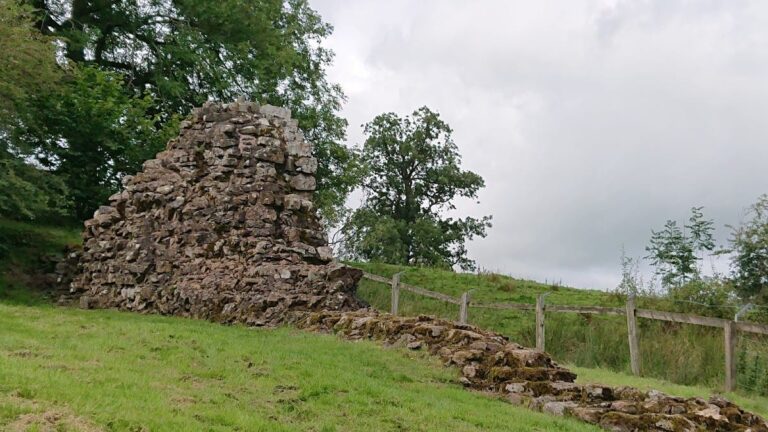
The gatehouse is the most complete surviving part of Bewcastle Castle. It remained almost completely intact after the later destruction of the fortress and the removal of stone for reuse. Its structure includes an internal garderobe, a medieval latrine that projects from a building wall. The gatehouse probably belongs to the period of repairs associated with Edward IV’s grant to the Duke of Gloucester.
Stone castle and Roman materials
The later castle was built in stone taken partly from the Roman fort. The demolition of Fanum Cocidi’s northeastern corner supplied material for the medieval construction, while the remaining castle buildings survive mainly as ruins. The surviving fabric therefore reflects both the fourteenth-century stone fortress and the earlier Roman military site on which it was established.