Burg Lichtentann: Medieval Hill Castle and Court Seat in Austria
Site at a Glance
- Rating
- 4.5
- Popularity
- Very Low
- Country
- Austria
- Primary era
- Medieval
- Eras represented
- Medieval
- Civilizations
- Holy Roman Empire
- Site type
- Military
- Remains
- Castle
On this page10 sections
History
Burg Lichtentann is a medieval hill castle ruin in Austria, near Henndorf am Wallersee in Salzburg, built by the Lords of Tann during the political instability of the Holy Roman Empire’s Interregnum in the 13th century. The Lords of Tann were a leading Salzburg noble family whose members served the archbishops of Salzburg as ministeriales, service nobles with official, military, and administrative duties. Their work included acquiring the territory around Lake Wallersee for Salzburg, although Henndorf County had originally been held as a fief of the Bavarian dukes.
Construction under the Lords of Tann
The Lords of Tann originated from Muntigl near Bergheim. During the Interregnum, a period between 1254 and 1273 when the imperial throne was disputed and central authority in the Holy Roman Empire was weak, Eckhart VI of Tann began building Lichtentann without the permission of Archbishop Friedrich II of Walchen. In 1272, Eckhart was required to surrender the castle to the archbishop for five years.
Eckhart VI’s son, Eckhart VII of Tann, was ordered in 1314 to halt further expansion at Lichtentann. Despite this restriction, the castle complex was completed. The associated water castle of Altentann formed part of the same network of Tann possessions in the Wallersee area.
Courts, confiscations, and the Tann Feud
When Niklas and Eckhart X of Tann divided their possessions, Henndorf County was reorganized into the courts of Lichtentann–Köstendorf and Altentann–Seekirchen. Both courts held high jurisdiction, meaning that they could hear serious criminal cases and impose the death penalty. The two courts shared an execution site at Eggerberg.
After the death of Eckhart XI, the son of Niklas of Tann, Archbishop Ortolf of Weißeneck confiscated Lichtentann, the Köstendorf court, and much of the Tann family’s property as reverted fiefs. A reverted fief was property returned to its superior lord when the holder’s hereditary or legal claim ended. The archbishop cited a feudal acknowledgment from 1302. Eckhart X, who held Altentann, received Tetelham Castle near Waging am See as compensation, together with Lichtentann Castle and the Köstendorf court for his lifetime.
When Eckhart X died, Archbishop Ortolf tried to take control of his possessions in 1355. Eckhart XII of Tann responded by allying with Duke Stefan II of Lower Bavaria, and twenty Salzburg and Bavarian nobles supported him in the major conflict known as the Tann Feud. After Duke Rudolf IV of Austria arbitrated the dispute, Eckhart XII surrendered the castles and courts of Altentann and Lichtentann to the archbishop.
An agreement with Archbishop Pilgrim II of Puchheim allowed Eckhart XII to receive Altentann and its court again as a fief. In 1369, however, he finally renounced Lichtentann and the Köstendorf court. After Eckhart XII’s death, Archbishop Pilgrim II confiscated all the Tann possessions in 1391.
Archiepiscopal administration and decline
The two Tann castles later became residences for Salzburg archiepiscopal administrators, who governed the courts of Lichtentann–Köstendorf and Altentann–Seekirchen on behalf of the archbishops, who were both senior church leaders and territorial rulers. In 1607, the Lichtentann administrative district and the Köstendorf court were united with the Altentann district. The Neumarkt manorial office was incorporated in 1612, creating the Neumarkt district court, which was divided among the offices of Neumarkt, Henndorf, and Seekirchen.
Altentann Castle burned in 1680. Its administrator moved to a separate court building in Neumarkt in 1699, and that building is now the district court. After these changes, the castles fell into disrepair and served as sources of building material. By 1825, both castles were privately owned by the Moser brewing family.
Remains
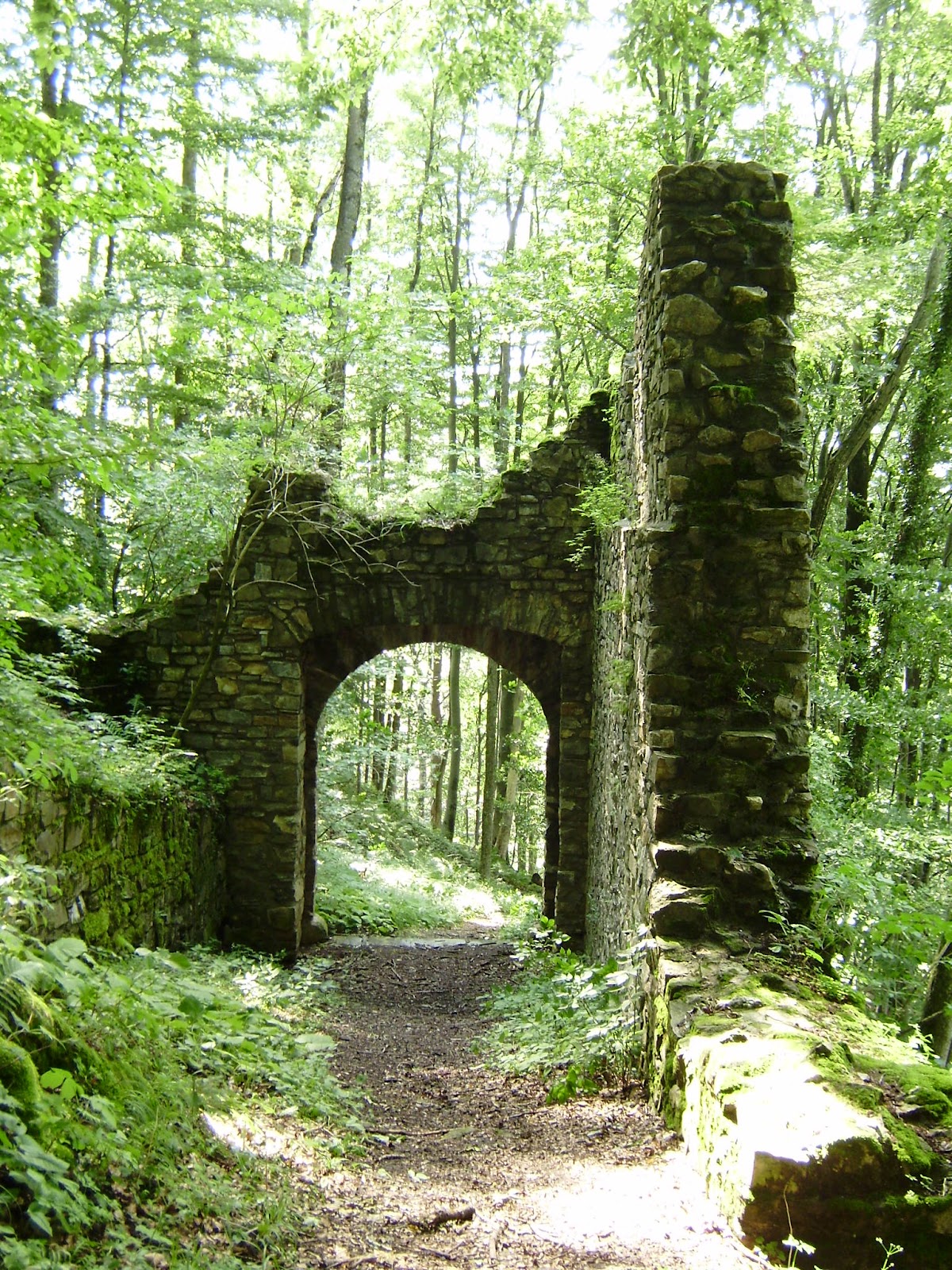
Burg Lichtentann survives as a castle ruin on a hill at 736 metres above sea level in the municipality of Henndorf am Wallersee. It lies east of Henndorf near the ascent toward the Heimkehrerkreuz and the Große Plaike, which reaches 1,031 metres. The surviving physical arrangement includes the entrance area, an outer gate, the castle wall, and an inner courtyard. The gate complex has been partially reconstructed.
Entrance and gates
Castle entrance and outer gate
The entrance area forms the approach to the surviving castle complex. Its outer gate is part of the documented gate arrangement, which has undergone partial reconstruction. Together, the entrance and gate mark the principal access point into the ruin.
Enclosure and inner space
Castle wall
The castle wall defines part of the surviving enclosure and connects the entrance arrangement with the interior of the ruin. It remains as part of the fragmentary castle fabric on the hill.
Inner courtyard
Inside the enclosure, the inner courtyard preserves the central open space of the castle complex. It forms the interior counterpart to the entrance, outer gate, and castle wall that survive at Burg Lichtentann.