Château de Beaurevoir: A Fortified Castle in France


Site at a Glance
- Rating
- 4.1
- Popularity
- Very Low
- Country
- France
- Primary era
- Medieval
- Eras represented
- Medieval
- Civilizations
- French
- Site type
- Military
- Remains
- Castle
On this page9 sections
History
Château de Beaurevoir is a former fortified castle in France, built at the beginning of the fourteenth century as a seigneurial residence in the medieval fortification tradition associated with the French monarchy and its successors. It later became the possession of the counts of Luxembourg-Ligny and is remembered especially for the imprisonment of Joan of Arc there in 1430.
Medieval Origins and Joan of Arc
The site was mentioned during the second half of the twelfth century before the castle was constructed in its later form. The early fourteenth-century fortress served as a residence for its seigneurial owners and passed into the hands of the counts of Luxembourg-Ligny.
In 1430, Jean II de Luxembourg, a nobleman of the Luxembourg-Ligny branch of the House of Luxembourg, imprisoned Joan of Arc at Beaurevoir after her capture. Joan of Arc was a fifteenth-century French military and religious figure who became a symbol of French resistance during the later stages of the Hundred Years’ War. Jean II subsequently sold her to the English.
Royal Possession and Destruction
After the castle passed to the French Crown, it was contested during the sixteenth century by Catholics and Protestants. The site was later coveted by the Spanish. In 1674, Louis XIV ordered the castle to be dismantled. His reign, which lasted from 1643 to 1715, was marked by strong royal centralization and an expansion of monarchical authority.
During the eighteenth century, Château de Beaurevoir belonged to the marquises of Nesle. After the French Revolution, the keep associated with Joan of Arc’s captivity and part of the surviving ramparts passed to a private owner, who dismantled the structures that remained. The Tour Jeanne d’Arc was classified as a French historical monument by decree on 10 December 1920, and the castle grounds received the same heritage protection through registration on 4 June 1937.
Remains
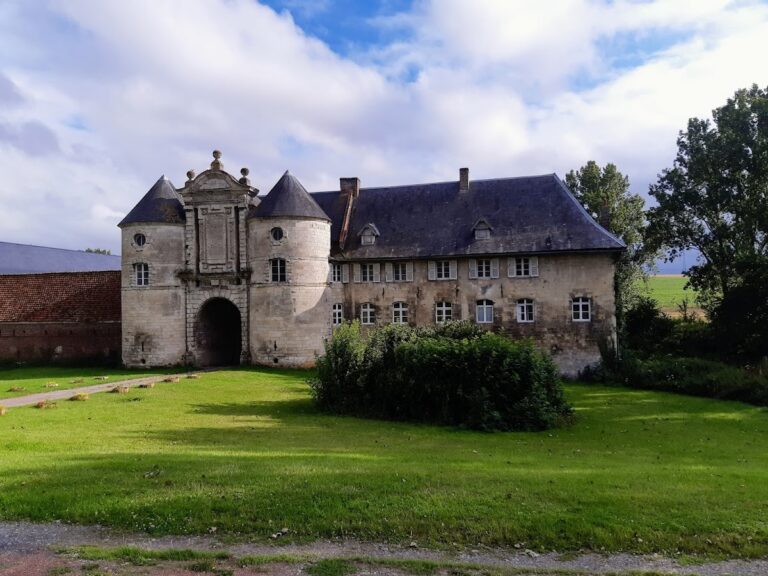
The remains stand southwest of the village of Beaurevoir in the Aisne department. The surviving site is organized around the Tour Jeanne d’Arc, a cylindrical keep on a raised mound, together with fragments of the residential buildings, portions of the ramparts, and broad surrounding ditches. The castle’s early fourteenth-century design combined French and English fortification principles, including projecting defensive galleries and a keep linked to the curtain walls, the defensive walls connecting towers and other fortified structures.
Keep and Defensive Works
Tour Jeanne d’Arc
The Tour Jeanne d’Arc is a cylindrical keep standing on a motte, a raised mound supporting a fortified structure. It is the principal surviving tower and is associated with Joan of Arc’s imprisonment in 1430. The keep was connected to the curtain walls as part of the castle’s defensive system.
Ramparts and Ditches
Part of the ramparts survives around the former castle site. The fortifications included machicolations, projecting galleries or openings through which defenders could attack assailants at the base of a wall. The surrounding ditches are approximately 40 metres wide and 10 metres deep, preserving the scale of the castle’s defensive enclosure.
Residential Remains
Residential Buildings
Fragments of the residential buildings remain alongside the tower and defensive works. These surviving pieces form part of the fabric of the former seigneurial residence, whose fortress was once described by the traveller Dubuisson as a massive stronghold with numerous towers. He compared its machicolations with those of Château Gaillard and the arrangement of its keep and curtain walls with the Château de Bouvreuil at Rouen.