Burg Perlenberg: A Staufen-Period Hilltop Castle in Germany


Site at a Glance
- Rating
- 4.1
- Popularity
- Very Low
- Country
- Germany
- Primary era
- Medieval
- Eras represented
- Medieval
- Civilizations
- Holy Roman Empire
- Site type
- Military
- Remains
- Castle
On this page8 sections
History
Burg Perlenberg is a ruined hilltop castle in Germany near Bann, in the Kaiserslautern district of Rhineland-Palatinate. Probably begun around 1200, it is regarded as a project of the Staufen period, the era of the Hohenstaufen dynasty, whose rulers promoted castles and imperial political centers during the twelfth and thirteenth centuries. The castle was likely intended to form part of the defensive system around the Imperial Palace of Lautern, a residence and administrative center used by the Holy Roman Emperor and his court while travelling through the empire.
A Project of the Staufen Period
Burg Perlenberg was probably planned to control the road connecting Kaiserslautern and Landstuhl. Its carefully worked ashlar masonry, made from precisely cut stone blocks, supports its association with the high-quality construction of the Staufen period. The castle was probably never completed, leaving only a small part of its principal fortified tower, or keep, to indicate the intended scale and character of the project.
The names Perleburg and Perlenburg are not secure evidence for the castle’s medieval name. The form Perleburg comes from a 1542 document concerning a boundary dispute between the Electoral Palatinate and the Sickingen family. That document gives the name Birleberg. By then, the castle had already fallen into ruin.
Rediscovery and Protection
Christian Mehlis rediscovered and investigated the site through archaeological excavations in 1901. The remains were probably later used as a quarry. In 1913, numerous ashlar blocks were still reported around the site, although most have since disappeared. Further excavations and stabilization work took place between 1959 and 1963. Burg Perlenberg is now owned by the state of Rhineland-Palatinate.
Remains
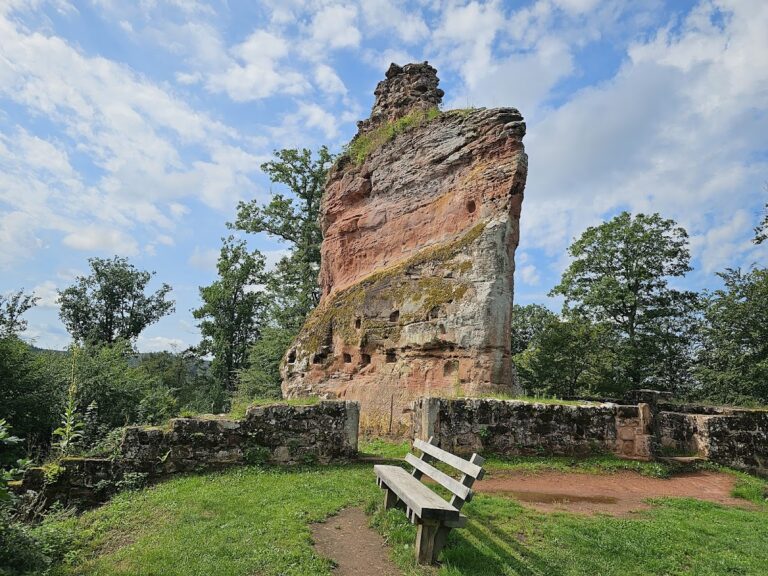
The ruin occupies a small plateau on the Kleiner Berg at about 371 metres above sea level. The elevated position, with steep slopes around the plateau, suited a hilltop castle designed to exploit the terrain for defence and strategic control. The site lies near the Roman-period hill settlement on the Großer Berg and is now within a natural forest reserve.
The Keep
Square Keep
Only the stump of a square keep survives. Its sides measure approximately 9 metres, while the walls are about 1.5 metres thick. A profiled base supports carefully dressed bossage ashlar, stone blocks whose outer faces project in a rough or cushion-like form. The masonry is exceptionally fine despite the limited survival of the structure. The keep’s dimensions and construction have been compared with those of the keeps at Landeck and Wildenberg, while its base has also been compared with the shield wall at Landeck, a particularly strong wall intended to protect the most exposed side of a fortification.
Local Tradition
Alleged Subterranean Passage
Local tradition holds that a subterranean passage connected Burg Perlenberg with the Einsiedeln Commandery of the Teutonic Order in Kaiserslautern. The Teutonic Order was a medieval religious-military order whose commanderies served as local administrative and residential centers. Archaeological investigation has not confirmed the passage. The tradition is linked with Hummerplatz, a forest path along the former Sickingen boundary where the ground is said to sound hollow when stamped.
Earlier castle guides described an extensive distant view from the summit plateau. Tall trees now surround the site, while the surviving keep stump and its carefully finished masonry remain the principal visible evidence of the unfinished castle.