Castillo de Ciria: A Medieval Fortress in Spain


Site at a Glance
- Rating
- 4.6
- Popularity
- Very Low
- Country
- Spain
- Primary era
- Medieval
- Eras represented
- Medieval
- Civilizations
- Crown of Castile
- Site type
- Military
- Remains
- Castle
On this page5 sections
History
Frontier origins and medieval control
Castillo de Ciria is a medieval fortress in Spain, associated with Muslim movement through the area and positioned to watch the route between the ancient settlements of Bilbilis and Numancia. Bilbilis and Numancia belonged to Hispania, the Roman-era name for the Iberian Peninsula, giving the route a wider historical setting and making Ciria a place for movement and surveillance.
Ciria later became involved in agreements and warfare connected with the frontier between Castile and Aragon. In 1395, Henry III of Castile, known as “the Sufferer,” granted Ciria to Juan Hurtado de Mendoza along with Ágreda, Vozmediano, and Borobia. The arrangement met resistance from Ágreda. In 1430, the king of Aragon seized the castles of Ciria and Borobia, but they returned to Castilian control after peace agreements between Aragon, Castile, and Navarre were signed at Naples in 1437.
Noble inheritance and later status
In 1443, Aldara, the niece of Álvaro de Luna, brought Ciria to her marriage with Carlos de Arellano as her dowry. Álvaro de Luna was a powerful Castilian nobleman who held the office of constable, a senior military position. The later noble history of Ciria continued in 1771, when the title Marquis of Ciria was created for José Pedro de Luna. Its succession subsequently passed to Luis Marichalar, Viscount of Eza, and to his descendants, including the current Count of Ripalda. A marquis, viscount, and count are ranks of European nobility.
The castle is listed as a Spanish Bien de Interés Cultural, a high-level heritage designation for sites recognized as having cultural importance.
Remains
Hilltop wall and defensive features
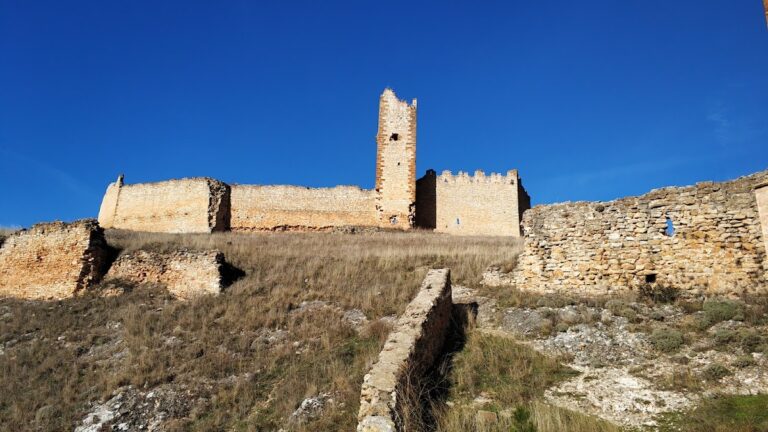
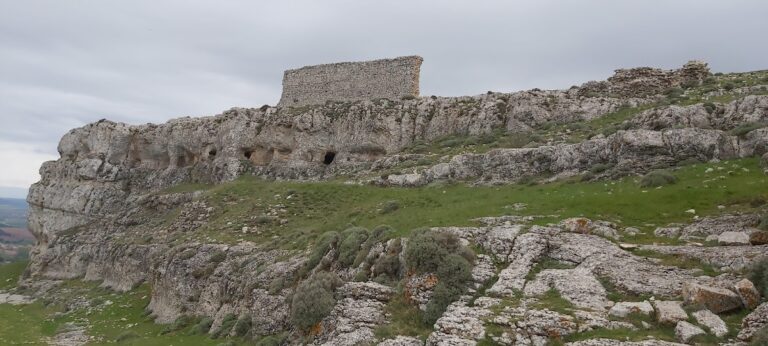
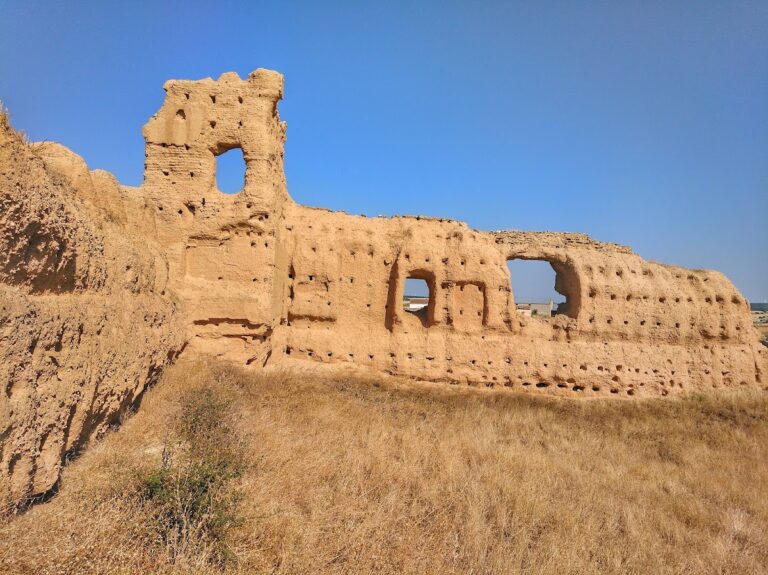
The surviving structure stands on the summit of a hill and follows a rectangular plan. Its total preserved length is approximately 10 metres, while the wall measures about 1 metre in width. The masonry consists of roughly worked stones arranged in two faces around an inner fill of irregular limestone blocks. Lime-and-stone mortar, containing small quartzite stones, binds the structure and also coats its exterior.
Approximately thirty merlons remain along the preserved wall. Merlons are the raised sections of a defensive wall, and some of those at Ciria end in diamond-shaped points. The structure also retains as many as ten arrow slits, narrow openings through which defenders could shoot, together with an entrance doorway. The surviving interior is small, broken, and irregular in height. The fortress has no keep, the principal fortified tower of a castle, and no flanking towers.