Thuriès Castle: A Medieval Fortress in Pampelonne, France


Site at a Glance
- Rating
- 4.5
- Popularity
- Very Low
- Country
- France
- Primary era
- Medieval
- Eras represented
- Medieval
- Civilizations
- County of Toulouse, French
- Site type
- Military
- Remains
- Castle
On this page7 sections
History
Thuriès Castle is a former medieval fortress in Pampelonne, France, built in the thirteenth century on a strategic route linking Toulouse with Rodez and Lyon. Its position gave it importance within the political and military landscape of the County of Toulouse and the French Crown.
Alaman and the French Crown
The castle first appears in written records in 1275, when it belonged to Sicard Alaman, a powerful figure in the County of Toulouse. Alaman was a trusted associate of Raymond VII, the medieval count of Toulouse, and later acted as regent until Raymond’s daughter, Jeanne of Toulouse, came of age.
In 1290, the seneschal of Toulouse purchased the fortress for the King of France. A seneschal was a royal administrative and judicial official, so the transaction placed Thuriès within the expanding authority of the French Crown. The same official ordered the foundation of Pampelonne, a bastide, or planned fortified settlement, named after Pampelune in Spain, which he had previously governed.
Conflict and Decline
Thuriès became more strategically important during the Hundred Years’ War, when the Albigeois, the region around Albi, belonged to the French Crown while the Rouergue, broadly corresponding to modern Aveyron, was held by the English.
Between 1380 and 1385, the English-paid routier known as the Bastard of Mauléon captured the castle by trickery. A routier was a medieval mercenary or free-company soldier who operated independently or under contract. He held Thuriès for five years, using it as a base for profitable raids, before surrendering the fortress for a ransom.
Later records describe the castle as being in poor condition. Its final ruin is attributed to dismantling ordered by Richelieu, the seventeenth-century French cardinal and chief minister of Louis XIII, who was associated with the removal of fortifications that might challenge royal authority. The ruins have been registered as a French historic monument since 30 August 1927, and the municipality is now the owner.
Remains
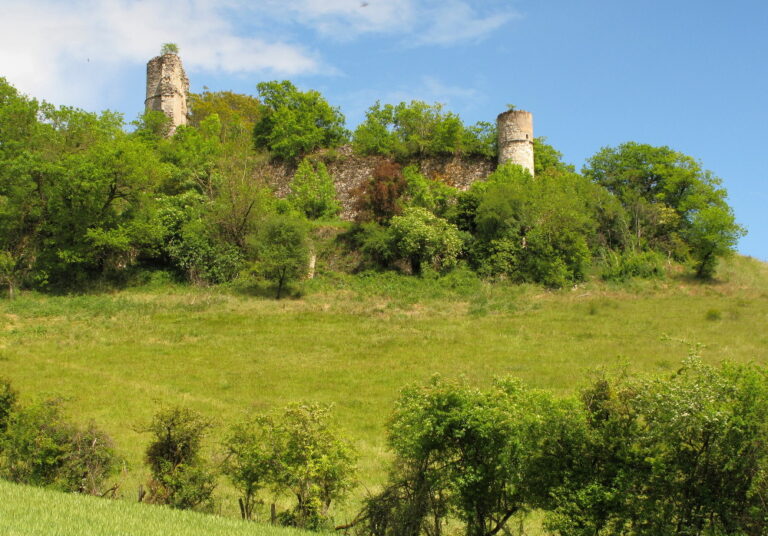
The ruins stand on a rocky peak above a meander of the Viaur, the river separating the departments of Tarn and Aveyron. The position was naturally suited to defence because one side of the peak is extremely steep and cannot be climbed. The surviving fortress fabric consists of vaulted cellars and a semi-cylindrical tower with a projecting spur.
Surviving Fortress Structures
Semi-Cylindrical Tower
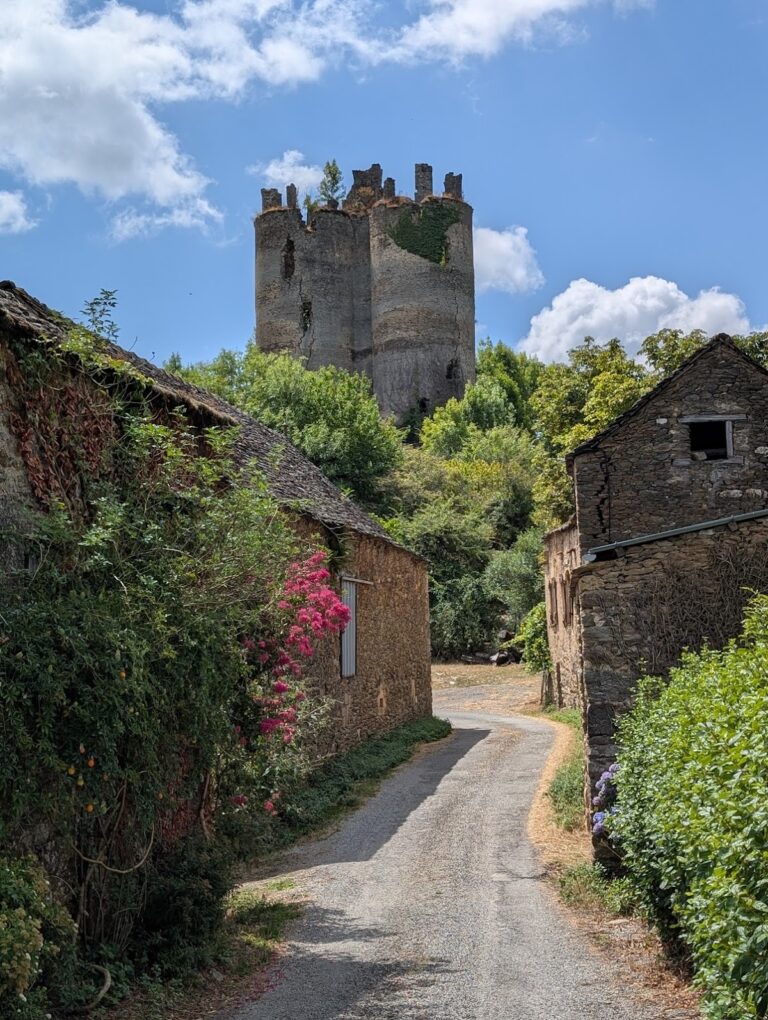
The semi-cylindrical tower was probably the castle’s keep. Its projecting spur strengthened the tower’s external form, while its floors were not vaulted. It remains as the principal vertical element of the ruined fortress.
Vaulted Cellars
Vaulted cellars survive among the remains of the castle. Their preserved ceilings provide part of the evidence for the fortress’s former arrangement and complement the surviving tower on the rocky summit.
Nearby sites