Burg Schallmauer: A Baroque Manor House in Hürth, Germany


Site at a Glance
- Rating
- 3.8
- Popularity
- Very Low
- Country
- Germany
- Primary era
- Early Modern
- Eras represented
- Early Modern
- Civilizations
- Holy Roman Empire
- Site type
- Domestic
- Remains
- Manor House
On this page6 sections
History
Burg Schallmauer is a Baroque manor house in Hürth, Germany, built in 1714 on the site of an earlier country residence. Its history is connected with the canons of Cologne Cathedral, the noble Schall von Bell family, and the later destruction and relocation of nearby settlements through lignite mining.
Origins and the first residence
The name Burg Schallmauer derives from the Schall von Bell family, which owned marshland in the area and lived at Gleuel Castle. The earlier name “Schallmoor” was later transformed into “Schallmauer.”
In the mid-sixteenth century, Friedrich of Saxe-Lauenburg, a canon of Cologne and Bremen, commissioned a small country residence for the canons of Cologne Cathedral. A canon was a cleric appointed to serve a cathedral, while the cathedral chapter was the corporate body responsible for the cathedral’s administration and religious life.
Destruction and rebuilding
Dutch troops destroyed the residence in 1673 during the Dutch War against Louis XIV. This conflict, fought from 1672 to 1678, brought several European powers into war against France and its Bourbon king. The ruined estate remained the property of the Cologne Cathedral Chapter and was assigned to a canon from the von Geyr family.
That canon bequeathed the estate to his nephew, Rudolf Adolf von Geyr. In 1714, von Geyr commissioned the manor house that stands today. Its builder was probably the Bonn palace architect of the period.
Mining and changing surroundings
Around 1930, Burg Schallmauer and the nearby hamlet of Aldenrath passed to the lignite-mining company Roddergrube AG, later known as Rheinbraun. Aldenrath lay about 500 metres northwest of the manor and consisted of 12 houses with 73 inhabitants. It was eventually demolished for the Berrenrath open-pit mine, where lignite was extracted through a large surface excavation.
The nearby Aldenrath Castle was demolished in 1936, while Burg Schallmauer remained standing. It consequently stood beside the relocated settlement of Berrenrath, which was moved in 1959 onto land exhausted by the Gotteshülfe mine at the former hamlet site.
The manor entered private ownership in 1978 and became the property of media manager Helmut Thoma in 1993. Burg Schallmauer is designated as both an architectural heritage monument and an archaeological monument in North Rhine-Westphalia.
Remains
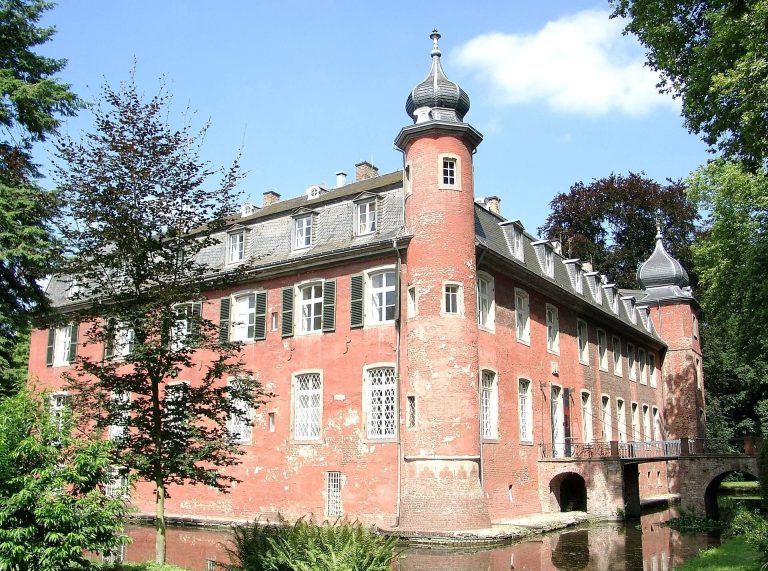
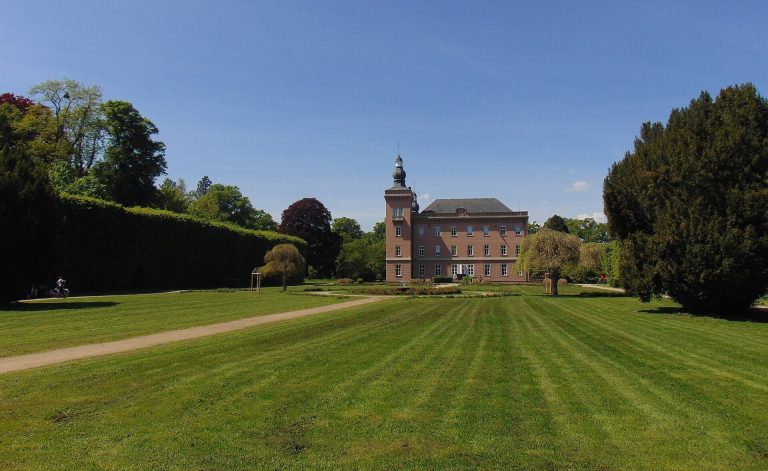
Burg Schallmauer consists of a restrained, three-storey manor house in a simple Baroque style. The building is plastered and presents the comparatively modest architectural character of the 1714 reconstruction.
The manor house
The present structure occupies the site of the earlier country residence destroyed in 1673. Its three-storey form, plastered exterior, and restrained Baroque design define the surviving building and preserve the physical location of the former residence associated with the Cologne Cathedral Chapter.