Kohren Castle: A Medieval Hill Castle in Germany


Site at a Glance
- Rating
- 4.3
- Popularity
- Very Low
- Country
- Germany
- Primary era
- Medieval
- Eras represented
- Medieval
- Civilizations
- Holy Roman Empire
- Site type
- Military
- Remains
- Castle
On this page11 sections
History
Kohren Castle is a medieval hill castle in Germany, located in Kohren-Sahlis, Saxony. It developed from a fortified site associated with a Sorbian settlement in the Early Middle Ages, and its construction is conventionally dated to around 1000. The castle later became the center of a noble lordship and was repeatedly rebuilt, damaged, abandoned, and dismantled.
Early fortified site
In 974, Emperor Otto II, a tenth-century Holy Roman Emperor, granted the forest between the Saale and Mulde rivers to the Bishop of Merseburg. Kohren was not named in that grant, but a chronicle written around 1010 by Thietmar of Merseburg stated that Chorin was among the properties included. Thietmar stayed at Kohren for ten days in 1018 and confirmed everyone who came to him, a Christian rite administered by a bishop. His stay indicates that a fortified estate or castle district center existed there by that time.
The Lords of Kohren and destruction in 1220
The noble, free-imperial Lords of Kohren appear as owners of the castle in 1190. They had established their lordship during the German eastward expansion, a period in the second half of the twelfth century when German political control and settlement extended farther east.
In 1216, the Lords of Kohren supported Leipzig in its struggle for regional supremacy against Dietrich, the Margrave of Meissen. Leipzig and its allies, the imperial knights of the Pleißenland, were defeated. These knights held their territories directly from the emperor rather than from a territorial prince. Dietrich ordered Kohren Castle destroyed in 1220.
Rebuilding and changing lordships
The castle had probably been rebuilt by 1240, and the visible masonry belongs to this rebuilding phase. The West Tower was erected first, followed about fifty years later by an enlargement of the castle and the construction of a second keep, the principal defensive tower of a medieval German castle. The reason for the expansion is unknown. Various noble families subsequently held Kohren, including the Lords of Schönburg and Leisnig and the Vogts of Plauen.
The direct imperial status of the Lords of Kohren had ended by the beginning of the fourteenth century, and the family was last recorded in 1303. In 1357, Friedrich of Schönburg transferred Geithain and Kohren to the Lords of Reuss, a noble ruling house of central Germany.
Abandonment and later reuse
Tradition holds that Kunz von Kaufungen stayed at the castle on the night before the abduction of the Wettin princes in July 1455. Kaufungen was a Saxon nobleman associated with that abduction, while the Wettins were a prominent German ruling dynasty. The castle was reportedly demolished after his execution to erase memories of the raider.
The Lords of Einsiedel are securely documented as owners during the second half of the fifteenth century. They moved their residence to Gnandstein, after which Kohren Castle ceased to serve as their home. By 1568, it was described as deserted and uninhabitable.
The Einsiedel family sold the Kohren and Sahlis estates in 1602. The castle buildings were then dismantled for building materials. In 1604 and 1605, stones were quarried from the old castle along a length of about 40 metres and taken for use in a church wall.
During the Thirty Years’ War, the major European conflict fought from 1618 to 1648, the castle was briefly returned to a defensible condition. The extent of this work is unknown. Several houses were built on the grounds after the war, but difficult living conditions led to their gradual abandonment. The last castle house was demolished in 1900.
Excavation and heritage status
The local castle association excavated Kohren Castle in 1928, followed by work by the Dresden State Museum of Prehistory in 1965. The site is designated as a heritage monument in Saxony.
Remains
Hilltop layout
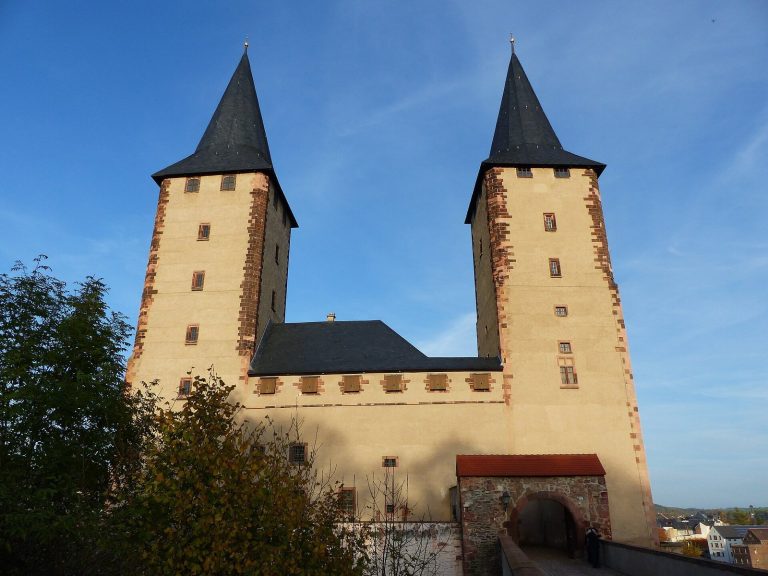
Kohren Castle occupies the Burgberg, a hill in Kohren-Sahlis, Saxony. The surviving hilltop remains comprise two keeps and sections of the surrounding defensive walls. Together, these masonry fragments preserve the basic fortified character of the site and continue to shape the town’s skyline.
Surviving defensive structures
West Tower
The West Tower is the earlier of the two keeps. It was built during the rebuilding completed by about 1240, after the castle’s destruction in 1220. Its elevated entrance was designed to make access more difficult, a defensive arrangement characteristic of medieval German keeps. The tower now survives as a ruin within the castle remains.
Second keep and surrounding walls
A second keep was added approximately fifty years after the West Tower, when the castle was enlarged. Both towers retain elevated entrances, and sections of the surrounding defensive walls remain alongside them. The masonry visible today derives from the post-1220 rebuilding and later enlargement, while the former railway route directly below the western side of the castle has since become a cycle path.