Castello di Lusuolo: A Medieval Fortress Overlooking the Magra Valley




Site at a Glance
- Rating
- 4.3
- Popularity
- Low
- Country
- Italy
- Primary era
- Early Modern
- External website
- Open
- Eras represented
- Medieval, Early Modern
- Civilizations
- Grand Duchy of Tuscany, Holy Roman Empire
- Site type
- Military
- Remains
- Castle
On this page10 sections
History
Castello di Lusuolo is an early medieval fortress in Italy, located in the village of Lusuolo, now part of Mulazzo in Tuscany. Construction began in the twelfth century under Corrado Malaspina the Elder, and the stronghold controlled an ancient crossing of the Magra River and the regional route later associated with the Via Francigena.
The Malaspina lordship
The castle belonged to the Malaspina, a medieval and early-modern noble family that controlled territories and castles across Lunigiana and nearby regions. It formed part of the Ghibelline Malaspina dello Spino Secco branch. Ghibelline describes the faction traditionally aligned with imperial authority during the medieval struggles between the Empire and the papacy.
Around the middle of the fourteenth century, the castle and other possessions passed to Azzone Malaspina, Corrado’s great-grandson. Because Azzone had no male heirs, the fief was divided. The fragmentation reduced the fortress’s importance and left it more exposed to attack.
Dante and the Malaspina territories
The Malaspina dello Spino Secco branch gave refuge to Dante Alighieri, the Florentine poet who wrote the Divine Comedy, during his exile from Florence. Dante’s presence in Mulazzo, and specifically at Lusuolo Castle, has traditionally been treated as historically necessary because Mulazzo served as the capital of the Malaspina territory, although no direct documentary proof establishes his stay at the castle.
Livio Galanti dated Dante’s arrival to no later than 12 April 1306. The Acts of the Peace of Castelnuovo, signed on 6 October 1306, place the poet in Lunigiana. An astronomical prophecy in the Divine Comedy has been interpreted as referring to a journey made in 1300.
Wars for control of Lunigiana
During the fifteenth century, Florence, Genoa, and Milan repeatedly competed for control of Lunigiana. The castle survived Genoese attacks at the beginning of the century under Tuscan protection, but a Genoese invasion in 1449 brought a long siege by the Ligurian Campofregoso family. The fortress was destroyed and then became the booty of Galeotto di Campofregoso, a condottiero, or military commander who led mercenary troops for Italian states and rulers.
In 1467, the Malaspina recovered the damaged and impoverished castle with assistance from the Marquis of Fosdinovo and Galeazzo Maria Sforza, Duke of Milan. The fortress then remained entangled in family disputes over divisions and rights, as well as continuing interference from Milan and Florence.
Florentine annexation and later transformation
During the second half of the sixteenth century, repeated uprisings by his subjects led Ercole Malaspina to seek the protection of Francesco I de’ Medici, Grand Duke of Tuscany. In 1575, Ercole donated the entire lordship to Francesco, and Lusuolo was permanently annexed to the Florentine state.
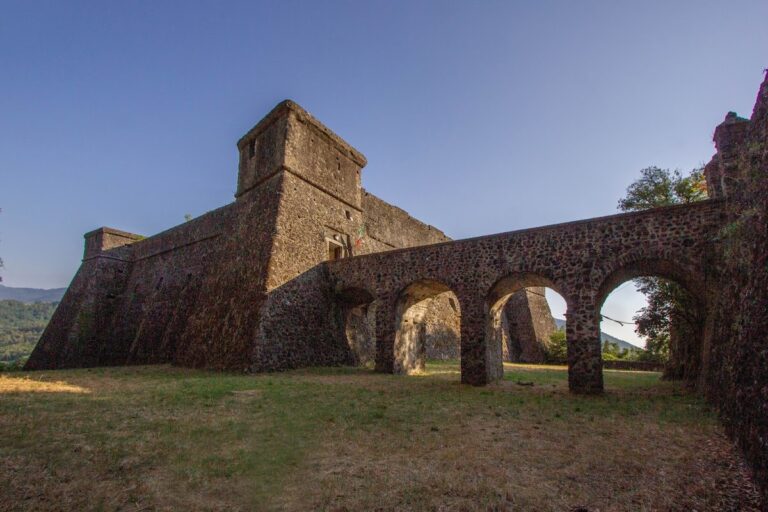
After the annexation, the castle was rebuilt and enlarged. In the early seventeenth century, it was converted into a fortress adapted to withstand artillery. By the end of that century, progressive dismantling began after Pontremoli was incorporated into the Grand Duchy of Tuscany, reducing Lusuolo’s strategic value to the Florentine government.
The complex has since been restored and now houses the Museum of the Emigration of the People of Tuscany. Castello di Lusuolo is designated Italian national heritage.
Remains
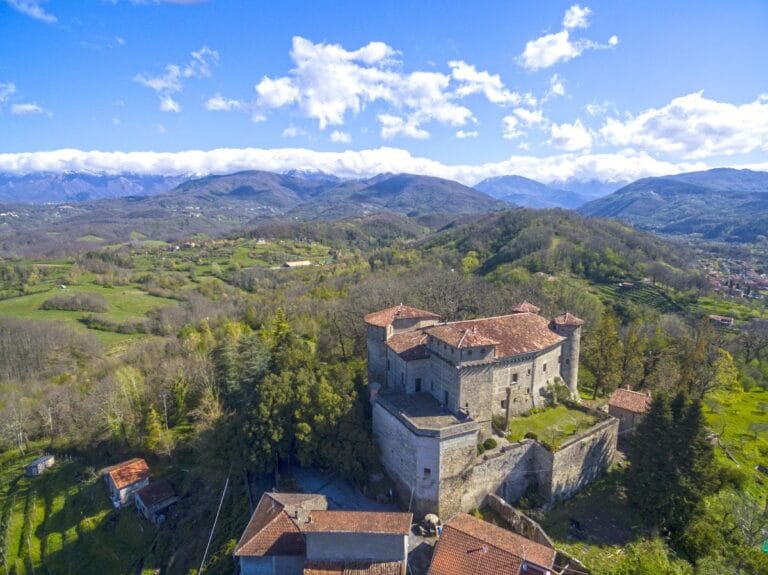
The fortress and its fortified village occupy a hill above an ancient ford of the Magra River. Their position allowed control of the valley floor and of the Via Francigena, a major medieval pilgrimage and travel route linking western Europe with Rome and, on some itineraries, southern Italy. Repeated rebuilding has made the construction sequence difficult to define, while the original functions of several spaces within the enclosing walls remain uncertain.
Walls, tower, and entrance
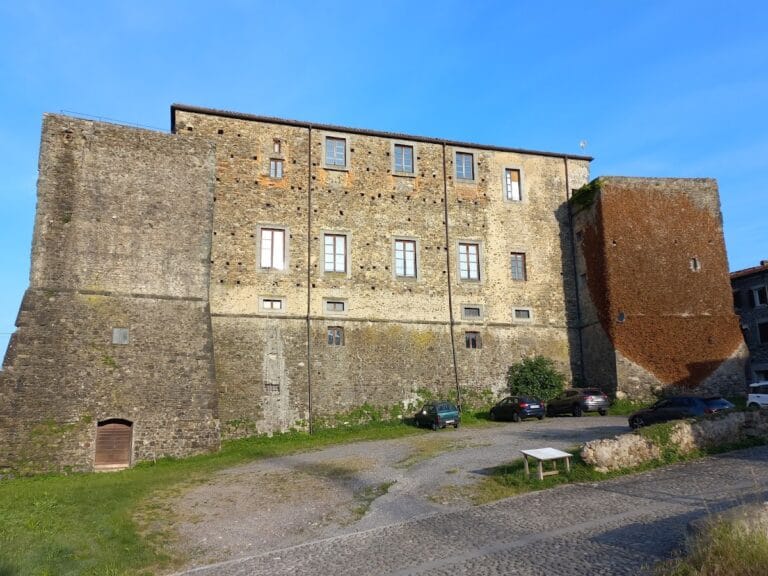
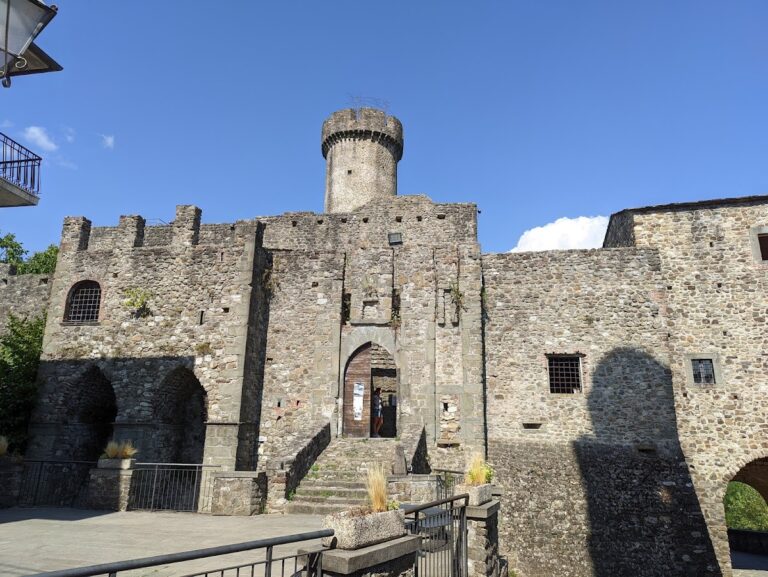
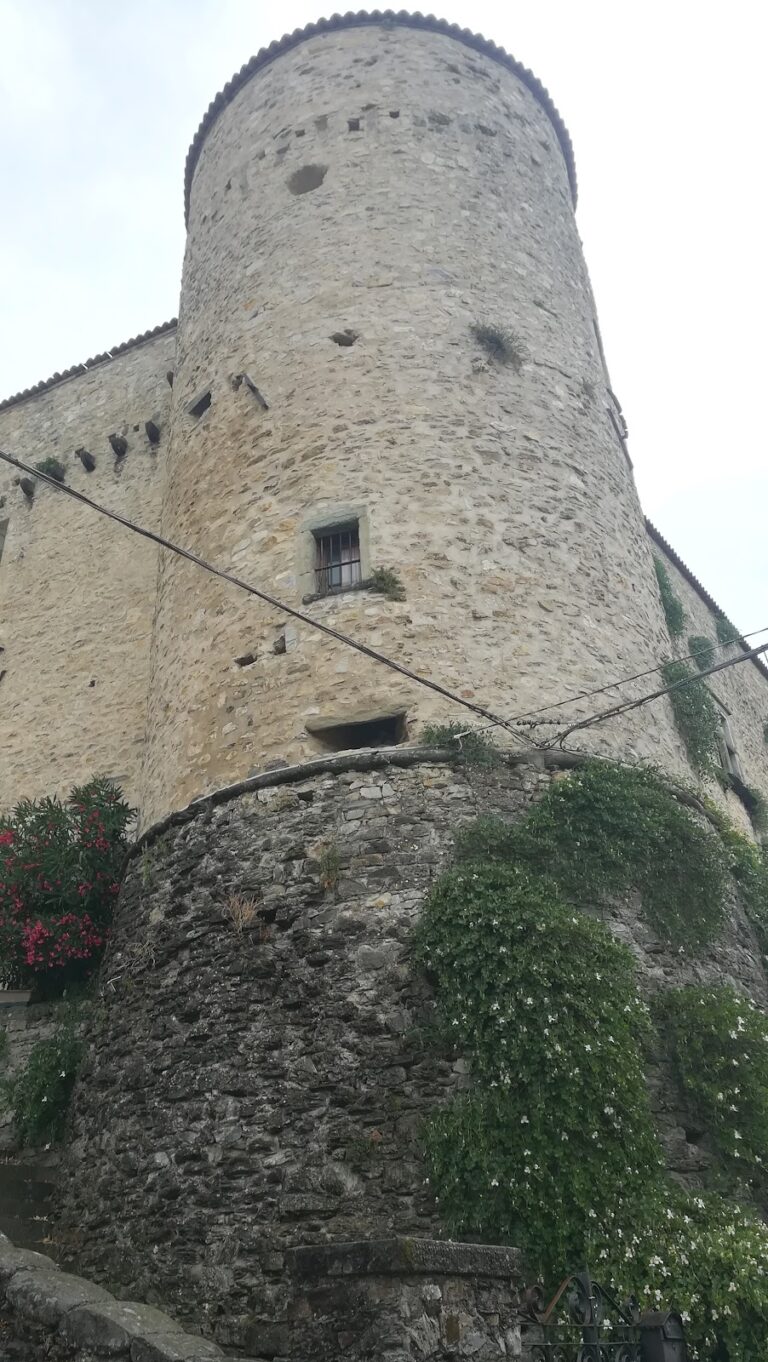
The oldest masonry is visible on the northern elevation, where a tower has been incorporated into the surrounding walling. The fortified village is enclosed by substantial triangular walls, with a gate on the southern side serving as the principal entrance. The surviving complex reflects the rebuilding and enlargement carried out in the late sixteenth century, followed by its adaptation to resist artillery in the early seventeenth century.
Courtyard and interior buildings
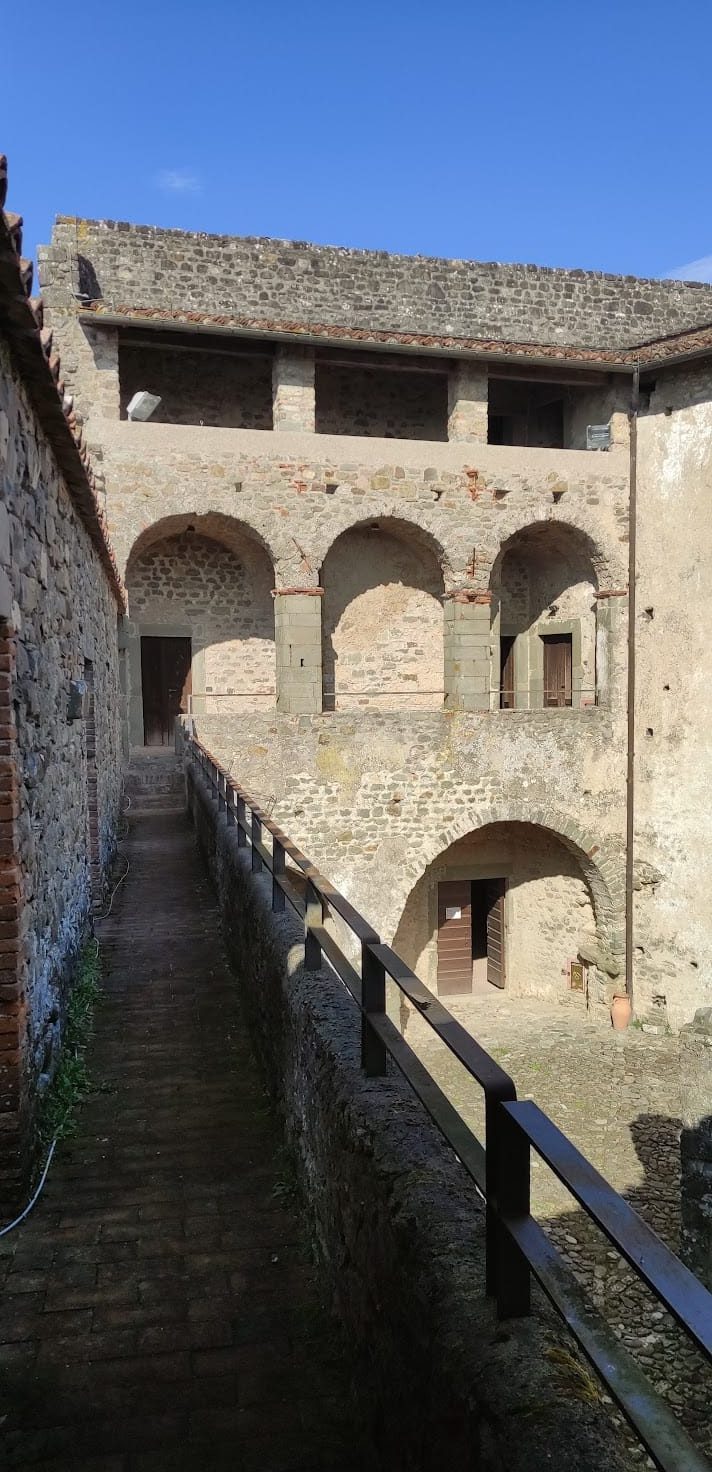
Inside the enclosure is a large trapezoidal courtyard with a central well. Its northern and southern sides preserve different architectural groups associated with the castle’s residential and military use.
North-side building
The northern side contains a structure with spacious interiors, large fireplaces, and broad vaulted ceilings. It may have served as the marquis’s residence, although that identification remains hypothetical. The building forms part of the restored complex.
Southern barracks
The southern side of the courtyard appears to have been used as barracks. This portion has partially collapsed, leaving the military character of the space visible within the larger courtyard arrangement.
Nearby sites