Barcaldine Castle: A Scottish Tower House in Argyll


Site at a Glance
- Rating
- 4.9
- Popularity
- Low
- Country
- United Kingdom
- Primary era
- Early Modern
- External website
- Open
- Eras represented
- Early Modern
- Civilizations
- Kingdom of Scotland
- Site type
- Domestic
- Remains
- Castle
On this page8 sections
History
Barcaldine Castle is an early seventeenth-century tower house in Argyll, Scotland, United Kingdom, built as a residence for Sir Duncan Campbell, seventh Laird of Glenorchy. Its main construction period is generally placed between 1601 and 1609, while Historic Scotland proposed a possible beginning in 1595 and completion in 1610. A laird was a Scottish landholder, usually the proprietor of an estate.
The Campbell estate
The Campbell family acquired the Barcaldine estates in 1597. After Sir Duncan Campbell died, his son Patrick inherited the property. The castle had a garrison in 1645 and again in 1687, reflecting its continuing military value as well as its role as a residence.
During the 1680s, the Campbells of Barcaldine invaded Caithness in an effort to recover unpaid debts. They failed to conquer the county, but received compensation in the form of the earldom of Breadalbane. In 1692, the castle was attacked during the wider tensions surrounding the massacre of Glencoe, when government soldiers killed members of the MacDonald clan.
Decline and later ownership
By 1698, Barcaldine Castle was in poor condition. Repairs took place in the early eighteenth century, but the family had abandoned it as its principal residence by 1724, choosing the newly built Barcaldine House near Inveraray instead. During the nineteenth century, after Barcaldine House had assumed that role, the castle deteriorated further and was described as ruinous, with its roof collapsed.
In 1752, members of the Barcaldine Campbells became involved in the killing of Sir Colin Campbell of Glenure, known as the Red Fox. John Campbell of Barcaldine, the Red Fox’s half-brother, accused James Stewart of the murder and had him hanged, although twelve of the fifteen jurors were Campbells. The episode later appeared in Robert Louis Stevenson’s novel Kidnapped.
The Campbells of Barcaldine became baronets in 1841. A baronet is a hereditary British title ranking below a baron. The castle was sold in 1842, bought back by the family in 1896, and restored between 1897 and 1911 under the direction of Alexander Buttar. It later passed through several ownership changes, and David Whitehead purchased it in November 2009. In 1971, it received Scotland’s Category A listed-building classification, the highest category for buildings of special architectural or historic interest.
Remains
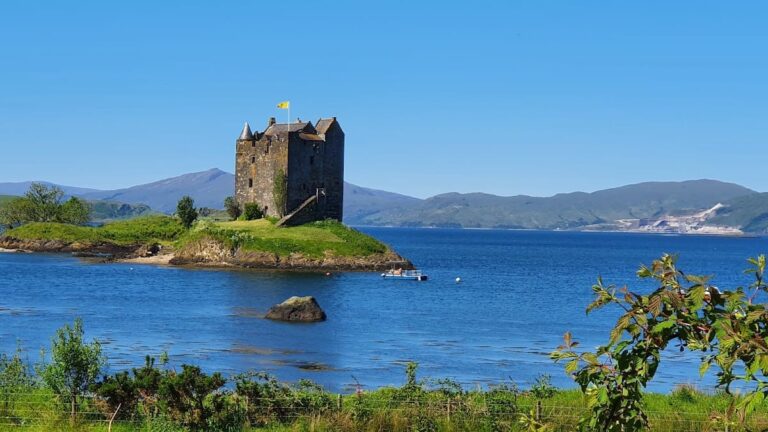
Barcaldine Castle is a three-storey rubble-stone tower house with an attic and an L-shaped plan. It stands a few hundred metres from the southern shore of Loch Creran, with views towards the loch and the Glen Coe mountains. The building combines a tall residential structure with defensive elements characteristic of a fortified Scottish residence.
The tower house
Plan and entrance
A circular stair tower fills the inner angle of the L-shaped building. The entrance is positioned at the base of this tower and is protected by an iron gate and an oak door. The vaulted basement contains the kitchen and storage cellars, while a bottle dungeon and two concealed passageways form part of the castle’s lower-level arrangements.
Turrets and roof
Three corner turrets project from the building’s corners. Each has a half-conical slate roof, while the stair tower is covered by a conical roof. Dormer windows are set into the attic, and the building is completed by a slate-covered gable roof. The facades were later finished with harling, a traditional Scottish technique that applies a roughcast coating to masonry.
Barcaldine Stones
The Barcaldine Stones are two prehistoric standing stones positioned west of the A828 road, north of Barcaldine. A prehistoric standing stone, also called a menhir, is an upright stone set up by people in the distant past.