Castello della Cecchignola: A Multi-Period Estate Complex in Rome


Site at a Glance
- Rating
- 4.3
- Popularity
- Low
- Country
- Italy
- Primary era
- Medieval
- External website
- Open
- Eras represented
- Classical, Medieval, Early Modern, Modern
- Civilizations
- Papal States, Roman
- Site type
- Military
- Remains
- Castle
On this page7 sections
History
Castello della Cecchignola is a multi-period estate complex in Rome, Italy, in the Giuliano-Dalmata district. Its fabric incorporates remains from ancient Rome, while the complex developed through medieval and modern phases of ownership, alteration, and restoration.
Medieval References and Renaissance Ownership
The earliest indirect written reference to the estate dates to 1217. A papal bull, a formal document issued by the pope, concerning the estates of the monks of Sant’Alessio mentioned land called “Cicomola,” identified with Cecchignola.
In 1458, the Capizucchi family sold the property to Cardinal Basilio Bessarion, a fifteenth-century Greek-born cardinal and humanist. After several leases, the estate passed by inheritance in 1467 to the Chapel of Sant’Eugenia in the Basilica of the Twelve Apostles in Rome. The chapel sold it to Pietro Margani in 1477.
Bessarion’s will described the estate as Cecchignola nova extra portam, meaning the “new Cecchignola outside the gate.” Later, Nicola Maria Nicolai used this designation to distinguish it from an older estate belonging to the Cenci family. The newer property was associated with the Grand Priory of Rome of the Sovereign Military Order of Malta, a Catholic religious order with a long-standing institutional and charitable presence.
Cardinal Estates and Papal Interventions
After periods of Barberini ownership and other changes of possession, Cecchignola became part of the holdings of Cardinal Scipione Caffarelli-Borghese, a major seventeenth-century papal patron. Pope Paul V had the area reclaimed and created a park in the Cecchignola ditch, using work crews in 1618 and 1619.
By the final years of the seventeenth century, the estate belonged to the Pamphili family. In 1695, Cardinal Pamphilj was said to have hosted a meal there for Rome’s cardinals. During the eighteenth century, ownership passed to the Lepri family.
In 1770, the estate came into the possession of the Grand Priory of Rome of the Order of Malta. Pope Leo XII subsequently had it acquired by the Vatican. Additions and restorations made under Leo XII were removed by his successor, Pope Pius VIII, who transferred them to Castel Gandolfo, the town south of Rome containing the papal palace traditionally used as a papal summer residence.
The Torlonia Era and Later Conservation
In 1832, the estate passed to Alessandro Torlonia and his family. The Torlonia ownership left a visible mark on the property, including the initials “AT” on the main gate and a coat of arms repeated on the estate’s masonry.
Restoration campaigns during the twentieth and early twenty-first centuries returned the complex to a condition described as reflecting its former splendor while preserving evidence of its successive historical periods. The estate now houses the University of Roman Marble Workers, which specializes in stone art, sculpture, and ancient marbles. It also contains a specialized library concerned with art and stone materials, together with several cultural foundations.
Remains
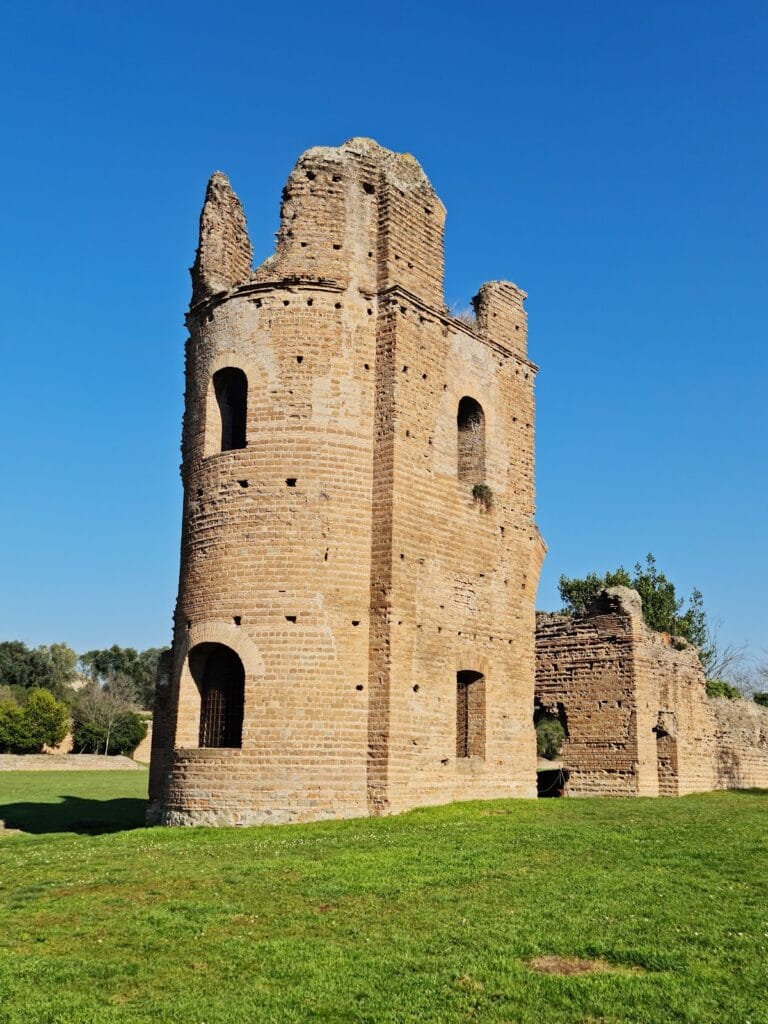
The complex combines structures from several periods, with the principal tower forming its central architectural feature. The tower survives to approximately two-thirds of its original height and has a Roman base. Its fabric retains recognizable evidence from the thirteenth, eighteenth, and nineteenth centuries, linking the surviving structure to the estate’s long sequence of alteration.
Roman Fabric and Archaeological Evidence
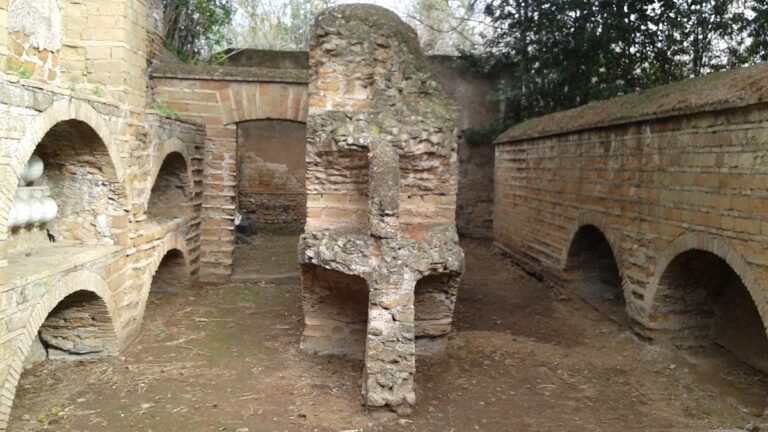
Roman remains are visible in the base of the principal tower and within the estate walls. These walls incorporate parts of several Roman buildings and structures, including basoli, large paving blocks used in Roman roads. The blocks were probably taken from the nearby ancient Via Ardeatina and reused in the later masonry.
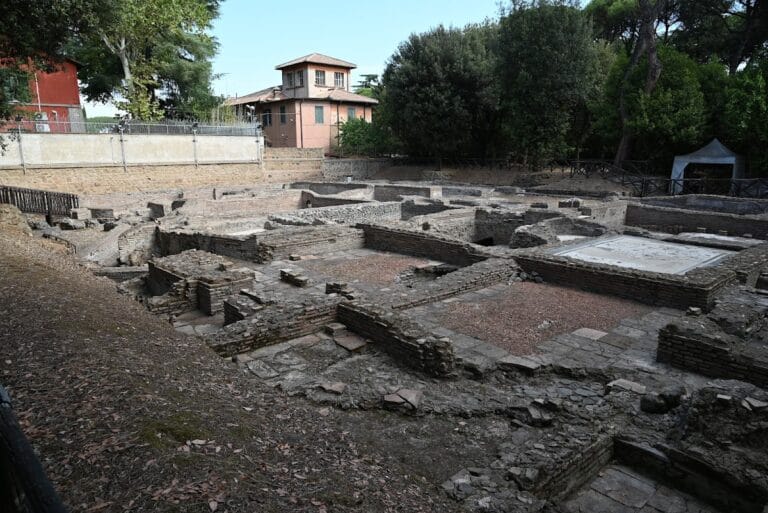
A Roman Republican domus, a private urban or rural household dwelling, was discovered beside the castle in 1939. It dates from the second to the first centuries BC, within the Roman Republican period. The discovery also brought to light a mosaic emblem, which is now preserved in the National Roman Museum at Palazzo Massimo, one of that state archaeological museum’s principal branches in Rome.
Torlonia Features
The main gate became the estate’s monumental entrance after the Torlonia family acquired the property in 1832. It bears Alessandro Torlonia’s initials, “AT.” A Torlonia coat of arms is also repeated several times across the estate’s masonry, providing a recurring architectural sign of the family’s ownership.