Hohenecken Castle: A Hohenstaufen Hill Castle in Germany


Site at a Glance
- Rating
- 4.5
- Popularity
- Low
- Country
- Germany
- Primary era
- Medieval
- External website
- Open
- Eras represented
- Medieval
- Civilizations
- Holy Roman Empire
- Site type
- Military
- Remains
- Castle
On this page7 sections
History
Hohenecken Castle is a medieval hill castle in Germany above the Hohenecken district of Kaiserslautern, built during the Hohenstaufen period, the era of the Staufen ruling dynasty that was especially prominent in the twelfth and thirteenth centuries. Its exact foundation date is unknown, although recent evidence places its beginnings around 1200, roughly five decades after the construction of the Barbarossa Castle in Kaiserslautern. The ruin is regarded by experts as one of the most noteworthy castles of the Hohenstaufen period.
Origins and the Hohenecken lordship
During the first half of the thirteenth century, the castle was granted as a fief to a Kaiserslautern family of ministeriales. These were unfree or semi-free service nobles who commonly served rulers and other lords in military and administrative roles. The family descended from the knight Reinhard of Lautern. In 1214, Reinhard received the right of patronage of Ramstein from the Staufen king Frederick II, who later became Holy Roman Emperor. The family subsequently adopted the name von Hohenecken.
A lordship developed around the castle and included the valley settlement of Hohenecken below the castle hill, together with Erfenbach, Espensteig, Siegelbach, and Stockweiler, now called Stockborn. Hohenecken Castle and this lordship remained imperial fiefs for centuries, meaning that they were held directly from the Holy Roman Emperor or the Empire.
Sieges and destruction
The castle’s decline began at the start of the early modern period. In 1525, during the German Peasants’ War, rebellious peasants captured it. On 20 August 1668, Prince-Elector Charles Louis of the Palatinate took Hohenecken after a week-long siege and bombardment. The fighting caused partial destruction.
Final destruction came during the War of the Palatine Succession, a late-seventeenth-century conflict in which France fought the Holy Roman Empire and its allies. French troops blew up the castle in 1689, leaving the site in its present ruined state.
Remains
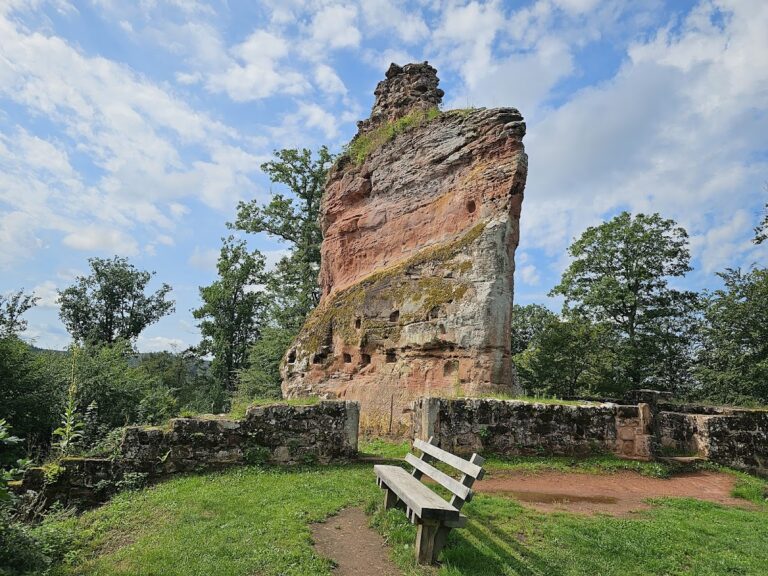
Hohenecken Castle occupies the southwestern spur of the Schlossberg above Hohenecken. The ruin stands at roughly 365 metres above sea level, while the mountain rises to 386.5 metres. The complex extends approximately 50 by 90 metres and includes an outer ward, moat, upper ward, and lower ward. Its surviving defenses are organized around a massive shield wall and the remains of a pentagonal main tower.
Defensive complex
Shield wall and pentagonal tower
The shield wall is approximately 25 metres wide and 11 metres high. This unusually massive defensive barrier protected the side of the castle most vulnerable to attack. The remains of the pentagonal bergfried, the principal defensive tower of a medieval German castle, survive within the shield wall.
Wards, moat, and outer defenses
The castle complex also contains a zwinger, an outer defensive area reached through an entrance leading into it. Beyond this area are the upper and lower wards, with a moat forming part of the defensive arrangement. Together, these elements define the surviving layout of the ruined hill castle, which also provides broad views over the surrounding area.
Nearby sites